Work Sample Tests: Design a Short, Job-Relevant Task
On this page
Work sample tests give candidates a bounded piece of work to complete, so you can discuss what they did and why. Start with one task the role actually performs, then write the instructions and evidence criteria before inviting anyone. The worksheet below helps you design that exercise without turning it into an unpaid project.
TL;DR: Choose one job task, create fictional inputs and tell candidates the time budget, permitted tools and expected output. Pilot the exercise against observable criteria, offer accessible ways to demonstrate the same skill and use the result alongside other hiring evidence.
Choose the job task for your work sample tests
Begin with a decision the person will make at work. For a support specialist, that might be deciding which customer request to address first and what needs escalation. Avoid combining queue triage, a product presentation and a writing assignment into one assessment: you will struggle to tell which skill produced the result.
LinkedIn's Hiring Assistant 2 announcement, September 2026, reports concerns about trusting candidate signals in research commissioned from Censuswide among US recruiters and talent acquisition professionals at companies with at least 200 employees. That publisher-specific survey describes perceptions; it does not establish that this exercise predicts job performance. Treat the design below as editorial guidance to pilot, rather than a validated assessment.
- Actual task: A support specialist prioritizes incoming requests using customer impact and the available evidence.
- Skill to observe: The candidate explains a defensible order, separates known facts from assumptions and recognizes escalation needs.
- Output to review: A short ordered queue, one customer response and an escalation note.
- Outside scope: Product knowledge the employer has not supplied, visual polish and typing speed.
Tip: Ask someone who does the job to name a recent decision and the information needed to make it. Replace confidential details with fictional inputs before using it in hiring.
Use your hiring intake meeting to agree why the task belongs in the role. Keep this decision separate from an interview loop design review: here you are designing the exercise itself, rather than deciding how many rounds to run.
A fictional brief for short work sample tests
The following example is fictional editorial copy for a support specialist at Lumen Labs. Its timings, customers and rules are illustrative choices, not a built-in Intervy assessment or a universal hiring standard. Give candidates the whole brief in advance of the exercise, including the criteria in the next section.
Candidate task brief
You are reviewing three requests for a fictional team collaboration service. Prepare an ordered response plan, draft a reply to the request you would handle first and write a short internal escalation note. You are being assessed on prioritization, communication and handling uncertainty; you do not need knowledge of a particular product.
- Request A — interrupted access: A customer reports that their whole team cannot sign in after a settings change. You have no independent confirmation of the cause. They have a customer workshop starting soon.
- Request B — billing question: A customer asks why their invoice increased after adding colleagues. Their account remains usable. No invoice breakdown is included.
- Request C — how-to question: A customer wants to change a project label before an internal presentation. They can still use the service; the brief provides no instructions for changing labels.
- Available policy: Escalate a suspected team-wide access interruption to the incident lead. Do not promise a recovery time without confirmation. Account-specific billing explanations require checking the invoice details.
- Deliverable: List your order and reasons, draft the first customer reply and state what you would ask the incident lead to investigate. Mark assumptions and any missing information.
Time, tools and delivery
For this example, propose a 30-minute total session: five minutes to read and clarify, 20 minutes to work and five minutes to explain the result. These are design choices to test during the pilot, not research-backed cutoffs. Tell candidates to stop when the working period ends and submit unfinished reasoning as well as completed text.
- Permitted tools: Use a text editor, spelling support and the supplied brief. No external research is needed. In this version, generative AI drafting is not permitted because the team wants to observe unaided response construction; state that rule before candidates agree to participate.
- Equal conditions: Supply the same inputs and policy to everyone. Share clarifications that affect the task with later candidates, and record which version each person received.
- Accessible alternative: Invite requests before the session through a named hiring contact. Agree adjustments such as an accessible document, extra reading time or a spoken explanation with written notes, while preserving the prioritization evidence sought.
- Submission: Accept a plain document or an agreed spoken walkthrough. Do not require a personal paid account, a public portfolio upload or access to a real customer system.
Key takeaway: Give the candidate enough context to make a decision. Missing facts should create a chance to identify uncertainty, rather than a hidden test of your company's unwritten rules.
Write the evidence rubric before reviewing anyone
A rubric describes what reviewers should look for. A scorecard is the shared record of criteria, evidence and ratings. For this fictional exercise, record a concrete observation under each criterion before choosing an illustrative rating of “needs evidence,” “demonstrated” or “strongly demonstrated.” Keep “not observed” separate when the session did not give the candidate a chance to show the skill.
- Prioritization: Needs evidence — gives an order without explaining impact. Demonstrated — puts the team-wide access issue first and explains the operational impact. Strongly demonstrated — also explains what new information could change the order and how to acknowledge waiting customers.
- Customer communication: Needs evidence — assumes the cause or promises a recovery time. Demonstrated — acknowledges the access problem, explains the next step and avoids an unsupported promise. Strongly demonstrated — also asks a focused clarification and proposes a useful update without inventing a resolution.
- Escalation judgment: Needs evidence — passes on the request without relevant context. Demonstrated — summarizes the affected group, observed symptom and uncertainty for the incident lead. Strongly demonstrated — distinguishes customer-reported facts from assumptions and identifies a useful investigation question.
For example, a fictional candidate might put A first, ask when access last worked and tell the incident lead the cause remains unconfirmed. Record those observations. If their reply promises a fix within an hour, capture that separately rather than letting a good priority order erase the unsupported promise.
Tip: Accept a different order when the candidate makes an explicit, job-relevant assumption and explains its consequences. Discuss the reasoning against the same criteria; do not reward resemblance to your preferred prose.
Decide before use which evidence is essential and what warrants a follow-up. Avoid converting these illustrative labels into a supposedly precise pass percentage. For more on separating observations from ratings, see the candidate scoring rubric.
Pilot the exercise and settle the tool policy
Ask someone familiar with the work to attempt the exercise from the brief alone, then have reviewers rate the same output independently. Compare the observations behind disagreements. If one reviewer rewards elegant writing while another rewards escalation judgment, revise the criteria before using the task with candidates.
- Check the budget: Record reading, working and discussion time separately. Remove work that is unnecessary to the decision instead of quietly expecting candidates to continue afterward.
- Check the inputs: Note every clarification the pilot required. Supply information needed for the task and remove accidental clues that give insiders an advantage.
- Check the tool policy: If AI assistance is normal in the actual job and you choose to assess it, create a separately piloted version with the same supplied tool access for everyone. Assess checking and explaining the output against published criteria.
- Check the boundary: Use fictional material you will not put into production. If the work is substantial or commercially useful, redesign it or agree compensation before asking candidates to do it.
Key takeaway: A pilot can reveal unclear instructions and inconsistent interpretation. It does not, by itself, validate the exercise as a predictor of performance or prove that it treats every candidate fairly.
Keep a versioned master of the brief, inputs, clarification answers and rubric. When you change a task midway through a hiring round, record the difference and decide whether the evidence remains comparable. Do not silently score earlier candidates against criteria they never received.
Keep the follow-up questions ready
After the work, use the same core prompts to explore reasoning: “Which fact most affected your order?”, “What would change your decision?” and “Which part of your reply needs verification?” Probe an unclear observation without coaching the candidate toward an answer. An interview preparation app or structured interview tool should support the questions you have chosen; it cannot make an unclear task job-relevant for you.
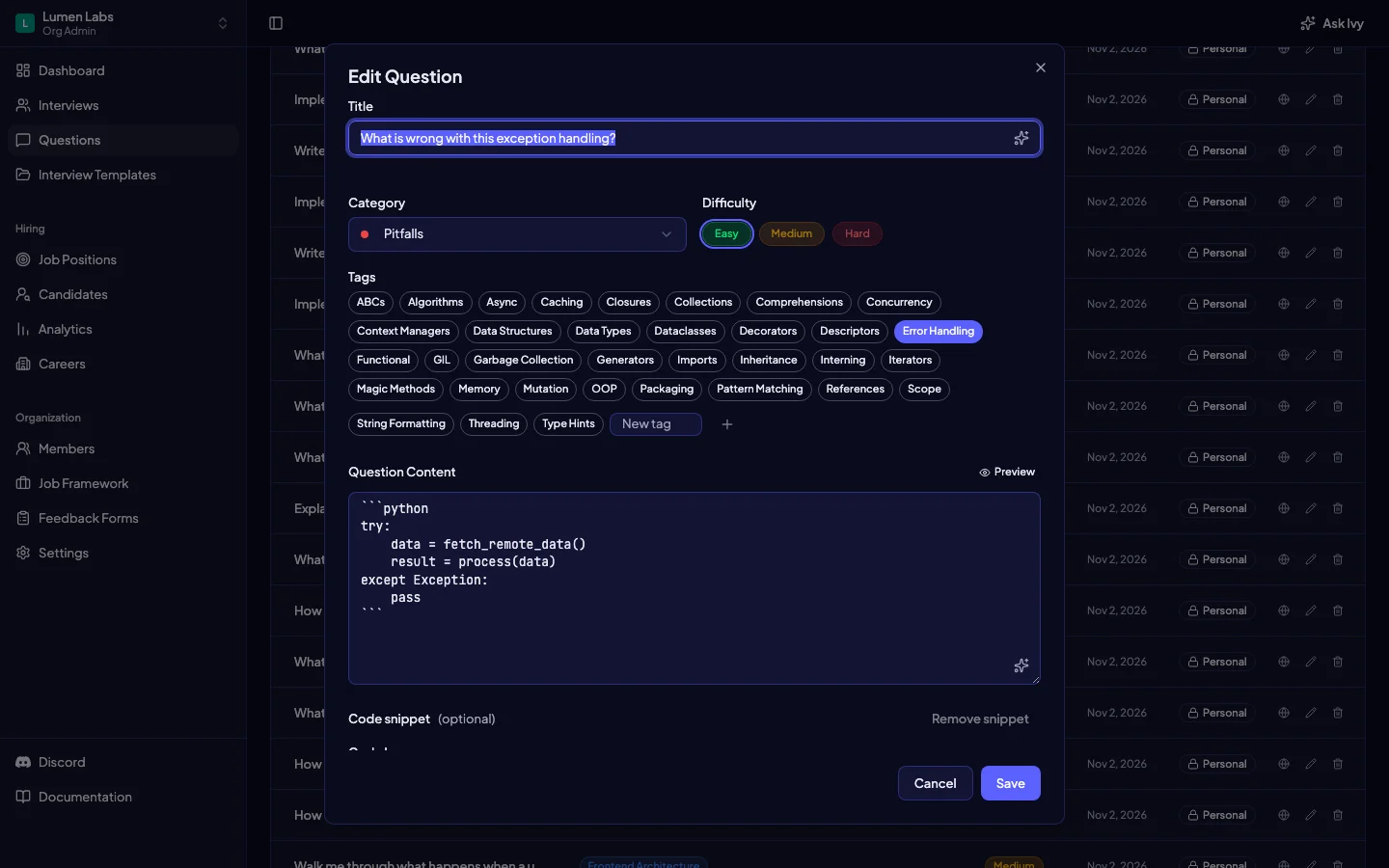
Intervy's question editor lets you edit question text and reference answers. Editing requires the appropriate question permissions in your organization. The screenshot shows an existing technical question, separately from the fictional support worksheet above; it illustrates the editor, not an automated work sample workflow.
- Prepare the discussion: Put the core follow-up prompts and the evidence you want to explore in your interview preparation notes.
- Keep the worksheet separate: Maintain the candidate brief, agreed adjustments and submission instructions in your hiring team's controlled materials.
- Review the decision: Combine the exercise observations with the other agreed role evidence. Identify any remaining gap before deciding the next step.
Tip: Start with one task and one pilot. You can explore Intervy for interview preparation while keeping ownership of the exercise design, candidate instructions and hiring decision with your team.