Interview Loop Design: Shorten Rounds, Keep the Signal
On this page
A candidate finishes a hiring-manager conversation, then tells the same project story to a peer and again to a director. Your team has more notes, but what new evidence supports the decision? Better interview loop design starts with that question: identify what each round must establish before deciding which meeting to remove.
TL;DR: Audit the decisions, questions, candidate effort, and owners behind every round. Give each round one primary evidence goal, remove duplicate requests, and pilot a shorter loop while checking whether the team still has enough evidence to decide.
Ashby's Recruiter Productivity report, published April 28, 2026, observes an additional interview event for technical hires compared with business hires and describes roughly a week added to the process. That is a planning warning, rather than a guarantee that removing your final round saves a week. Audit your own evidence and waiting time before changing the calendar.
Start interview loop design with a round inventory
Choose one role and examine completed candidate journeys alongside the intended process. Include screens, assessments, take-home work, informal introductions, and additional conversations requested at the debrief. A meeting still costs candidate time when your team calls it optional.
Copy this worksheet and complete a row for every candidate-facing stage. Use the actual questions and feedback, rather than a stage name such as “technical” or “culture.” Keep the role's essential criteria beside it so you can spot a requirement that no round covers.
| Audit field | What to record |
|---|---|
| Round and sequence | Name, position in the loop, and whether it depends on another round |
| Decision supported | The specific advance, reject, or final-hire decision it informs |
| Primary evidence goal | The job-relevant capability or requirement it must establish |
| Evidence request | Exact questions, exercise, follow-ups, and expected observations |
| Candidate effort | Meeting time, preparation, assignment time, and repeat requests |
| Evidence owner | Who evaluates this goal and submits the written assessment |
| Scheduling and decision owners | Who books the next step and who resolves the decision |
| Overlap and action | Keep, narrow, combine, remove, or investigate; explain why |
A useful completed row might read: “Work sample; decide whether to advance; assess debugging reasoning; observe diagnosis and trade-offs; reviewer submits evidence before the debrief.” A row that says only “get another opinion” needs a clearer purpose.
- Separate facts from estimates. Mark take-home effort as estimated until candidates can report it.
- Record exceptions. Include rounds added after someone said “we need one more conversation.”
- Keep the whole funnel visible. Review candidates who withdrew or were rejected, alongside those hired.
Tip: Use the hiring pipeline stages guide to name your stages consistently. This audit asks whether each stage earns its place through distinct evidence.
Give each round one primary evidence goal
Write a sentence for every round: “After this interview, we should be able to decide whether the candidate can [specific capability], using evidence from [question, exercise or work sample].” Make each placeholder concrete enough that an interviewer could distinguish a strong response from an incomplete one.
One primary goal can contain related criteria. A work sample might assess problem framing and trade-offs together; it should not become a catch-all for leadership, motivation, domain knowledge, and every concern the panel has. Map the complete set of required criteria across the remaining rounds before deleting anything.
Here is an illustrative redesign, not a recommended interview count for every role:
| Existing round | What the audit finds | Proposed action |
|---|---|---|
| Recruiter screen | Role expectations and practical constraints | Keep; avoid repeating the full career history later |
| Hiring-manager interview | Past delivery decisions and level of responsibility | Keep; specify the evidence needed for the role |
| Work sample | Direct observation of job-relevant reasoning | Keep; define the assessment criteria beforehand |
| Peer conversation | Retells the delivery story without a distinct criterion | Narrow to a collaboration scenario, or remove if that evidence is already covered |
| Director interview | Repeats the manager's questions and recommendation | Remove the assessment round if no evidence gap remains; offer a separate candidate conversation when useful |
Before removing the director interview, check for a genuinely distinct responsibility it tests. If the role requires organization-wide judgment and no remaining stage evaluates that, keep a focused assessment or move that goal into an appropriate existing round.
- Name the observation. Replace “leadership presence” with a relevant decision, action, and outcome you can discuss.
- Protect candidate questions. Keep time for candidates to evaluate the role; do not turn a shorter loop into uninterrupted assessment.
- Check feasibility. Combining rounds is useful only if the resulting session still allows sufficient evidence and accessible participation.
Key takeaway: A round is ready to go when its necessary evidence is retained elsewhere, or the team agrees that its evidence request is irrelevant to the role.
Find repeated questions before cutting interviews
Place every round's prompts side by side. Mark both literal repeats and questions that ask for the same story in different words. “Describe a difficult stakeholder” and “tell me about a disagreement” may both elicit the same example without adding a different observation.
For each overlap, ask whether the second interviewer is testing another criterion, seeking useful independent evidence, or simply repeating an earlier conversation. A deliberate independent check can be justified for a critical requirement. Write down what independent observation it adds and how conflicting evidence will be resolved.
- Exact duplicate. Keep one owner unless a documented independent check is necessary.
- Same story, different criterion. Give each interviewer a distinct follow-up and assessment focus.
- Unresolved concern. Use a targeted question only when the existing evidence cannot settle it.
- Candidate clarification. Explain the gap and request the smallest additional effort that could resolve it.
An interview template builder can make this comparison easier by keeping prompts in a reviewable list. In Intervy, members with the appropriate template permissions can select and reorder questions in reusable interview templates. Review the lists manually: this is not automatic duplicate detection.
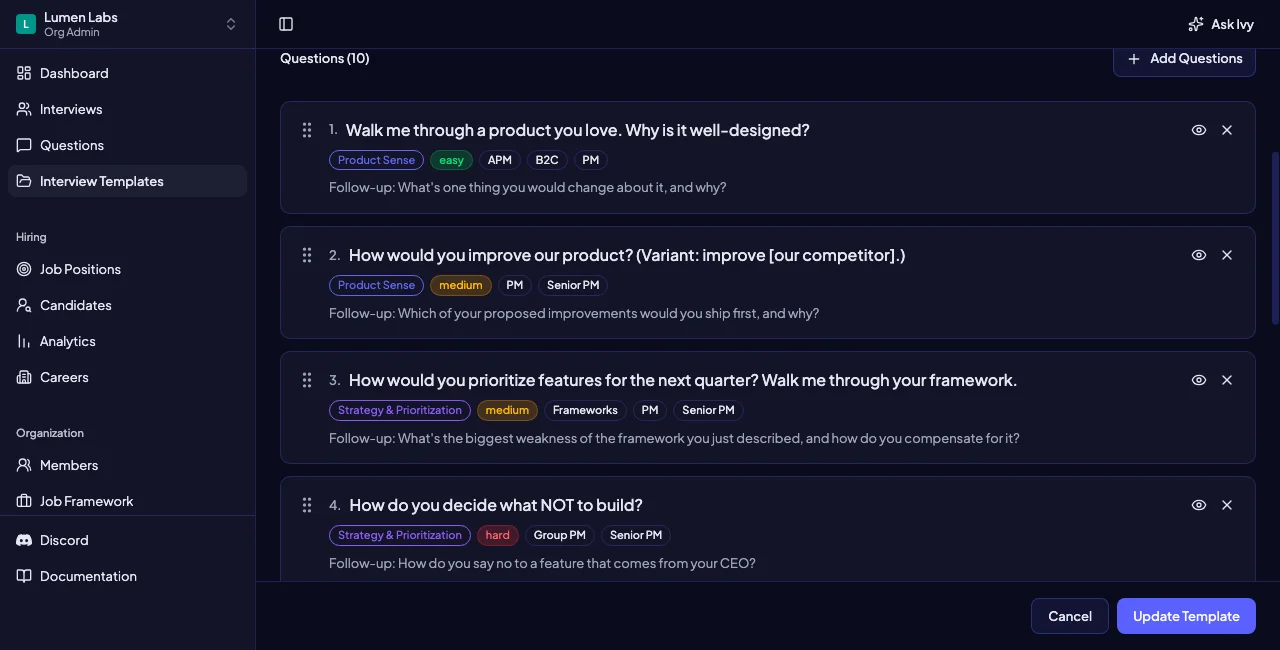
Tip: Compare the criterion and intended observation as well as the wording. Two different questions can duplicate evidence; the same opening question can support distinct, carefully planned follow-ups.
Set decision and scheduling ownership
A shorter assessment plan still needs a clear handoff. Ashby's Recruiting Operations Benchmarks report, published May 7, 2026, describes delays accumulating across review, scheduling, feedback, decisions, and offers. It also separates the time to send a schedule from the wait until the interview happens.
Assign an evidence owner to each round, a scheduling owner to each handoff, and a decision owner to resolve the assessment. These can be different people. The interview panel roles guide helps define responsibilities; add a deadline and escalation route to make those responsibilities actionable.
- Evidence deadline. Choose when written feedback is due, such as before the next business day's debrief, and agree what happens if it is missing.
- Decision deadline. Set when the decision owner must advance, reject, or name a specific unresolved criterion.
- Scheduling handoff. Name who contacts the candidate, maintains interviewer availability, and handles rescheduling.
- Backup owner. Identify who acts when the usual decision-maker or interviewer is unavailable.
- Extra-round rule. Require a named evidence gap, a focused request, an owner, and a decision deadline before adding another assessment.
Agree deadlines with the people who must meet them. Allow candidate scheduling constraints and accommodations; a team's internal speed target should not become pressure on the candidate to accept an unsuitable time.
Key takeaway: “Waiting for more confidence” is not a complete reason for another round. Name the missing evidence and the decision it could change.
Measure interview loop design by time and signal quality
Pilot the revised loop for a clearly defined role and level. Keep the assessment criteria stable so you can distinguish a shorter process from a lower hiring bar. Log changes to the role, sourcing mix, or interviewer team that could affect the comparison.
Track candidate effort and elapsed time separately. Removing a meeting may reduce effort while leaving a scheduling bottleneck untouched. Compressing everything into a longer session may reduce calendar days without improving the candidate experience.
| Measure | Suggested definition | What to inspect |
|---|---|---|
| Candidate assessment time | Interview minutes plus reported preparation and assignment time | Did total effort fall, including work outside meetings? |
| Loop elapsed time | First assessment to communicated decision | Did waits shrink, or move to another handoff? |
| Evidence completeness | Required criteria with a usable observation and assessment | Are essential criteria still covered at the debrief? |
| Unresolved decisions | Debriefs needing another assessment, with the reason recorded | Did cutting a round create a recurring gap? |
| Candidate experience | Short feedback request about repetition, clarity, and burden | Do candidates notice a more coherent process? |
Treat these as operational indicators. Complete feedback does not prove that the assessment predicts job performance, and interviewer agreement alone does not prove accuracy. Follow later outcomes through a consistent quality of hire measurement approach, while acknowledging that onboarding and management affect those outcomes too.
- Compare like with like. Separate materially different roles, levels, and assessment formats.
- Keep denominators. Report how many candidate journeys and completed feedback requests support a result.
- Investigate gaps. If a required criterion is repeatedly missing, repair the remaining assessment or restore a focused round.
- Avoid early certainty. A small pilot can reveal friction; it cannot establish that hiring quality is unchanged.
Tip: Agree what would trigger a revision before the pilot starts. For example, repeated debriefs lacking evidence for a critical criterion deserve action even if calendar time improves.
Run the audit on one role
Bring the worksheet, current prompts, and recent feedback to a working session with the hiring manager and talent operations lead. Decide which requests to retain, narrow, combine, or remove, then publish the revised evidence goals and handoffs to the interviewers.
Use a structured interview tool such as Intervy to prepare reusable question templates for the remaining assessments. Keep the audit decisions and measurement plan explicit; software cannot decide which evidence your hiring team needs.
- Before the pilot. Confirm that every required criterion has an evidence owner.
- During the pilot. Record candidate effort, waiting time, and reasons for exceptions.
- At the review. Check whether the shorter loop still produces the evidence needed to decide, then adjust the plan.
Key takeaway: Remove repetition first. Keep the evidence goals clear enough that the team can explain why every remaining interview is necessary.