Hiring Pipeline Stages: Build a Clearer Interview Process
On this page
- Start hiring pipeline stages with decisions
- Choose a starting shape for your hiring pipeline stages
- Match the path to the evidence you need
- Decide when interview stages should run in parallel
- Give every phase guidance and a way to evaluate it
- Plan the evaluation before the conversation
- Review your hiring pipeline stages from the candidate's side
Hiring pipeline stages should answer a simple question: what must we learn before we ask a candidate to invest more time? When each round has a distinct purpose, interviewers know what evidence to gather and candidates can understand the journey ahead.
TL;DR: Start with the fewest stages that can support a sound decision. Give each phase a specific evidence goal, decide which conversations can happen in parallel, and review the whole path from the candidate's point of view.
Start hiring pipeline stages with decisions
A pipeline is more useful when its stages represent decisions instead of meetings. A screening conversation might establish whether the role and candidate's expectations align. A skills interview should test the capabilities the job needs. A final conversation can resolve remaining questions and clarify the work ahead.
Before adding a stage, write down what it will decide. Then ask whether an earlier stage could collect the same evidence. If two rounds ask the same questions without changing the decision, combine them or give each interviewer a different assignment.
- Screening: Confirm essential requirements, availability, and mutual interest.
- Skills assessment: Look for evidence of the role's core capabilities through questions or a practical task.
- Final conversation: Explore unresolved evidence, expectations, and the team's decision criteria.
Tip: Give every stage a one-sentence exit question, such as “Do we have enough evidence of the skills this role requires?” That makes the next step easier to explain to both the panel and the candidate.
The goal is a structured interview process, not a longer process. You can use a structured interview tool to keep the questions and evaluation criteria attached to the work rather than relying on memory.
Choose a starting shape for your hiring pipeline stages
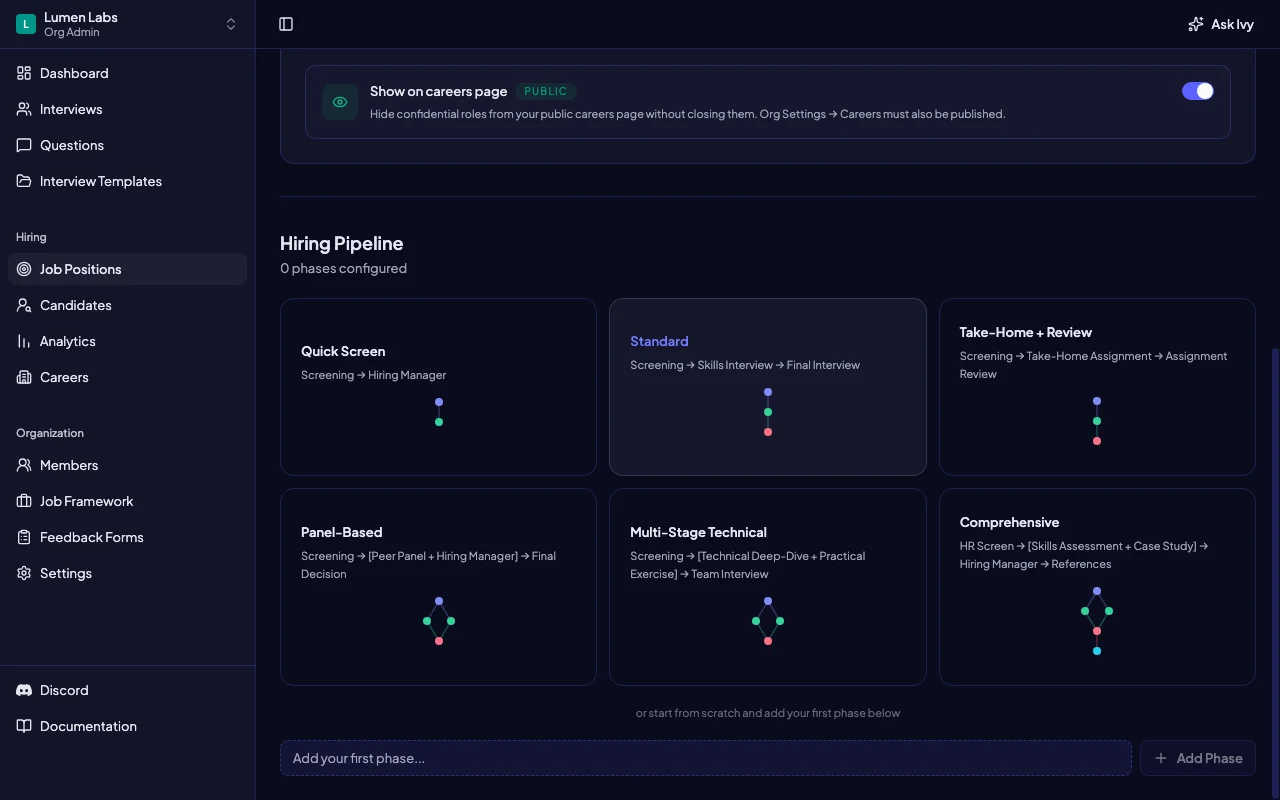
You do not need to draw a process from a blank page. Intervy's job-position editor offers layouts ranging from a short screen and hiring-manager conversation to a standard screening, skills, and final sequence. It also offers layouts for a take-home review, a panel, and a deeper technical process. Treat these as starting points that you can adapt to the role.
Match the path to the evidence you need
A short process can work when the role's requirements are clear and one focused conversation covers most of the evaluation. A role that needs specialist judgment may need a separate skills phase. If you use an assignment, plan a review conversation so the candidate can explain choices and trade-offs.
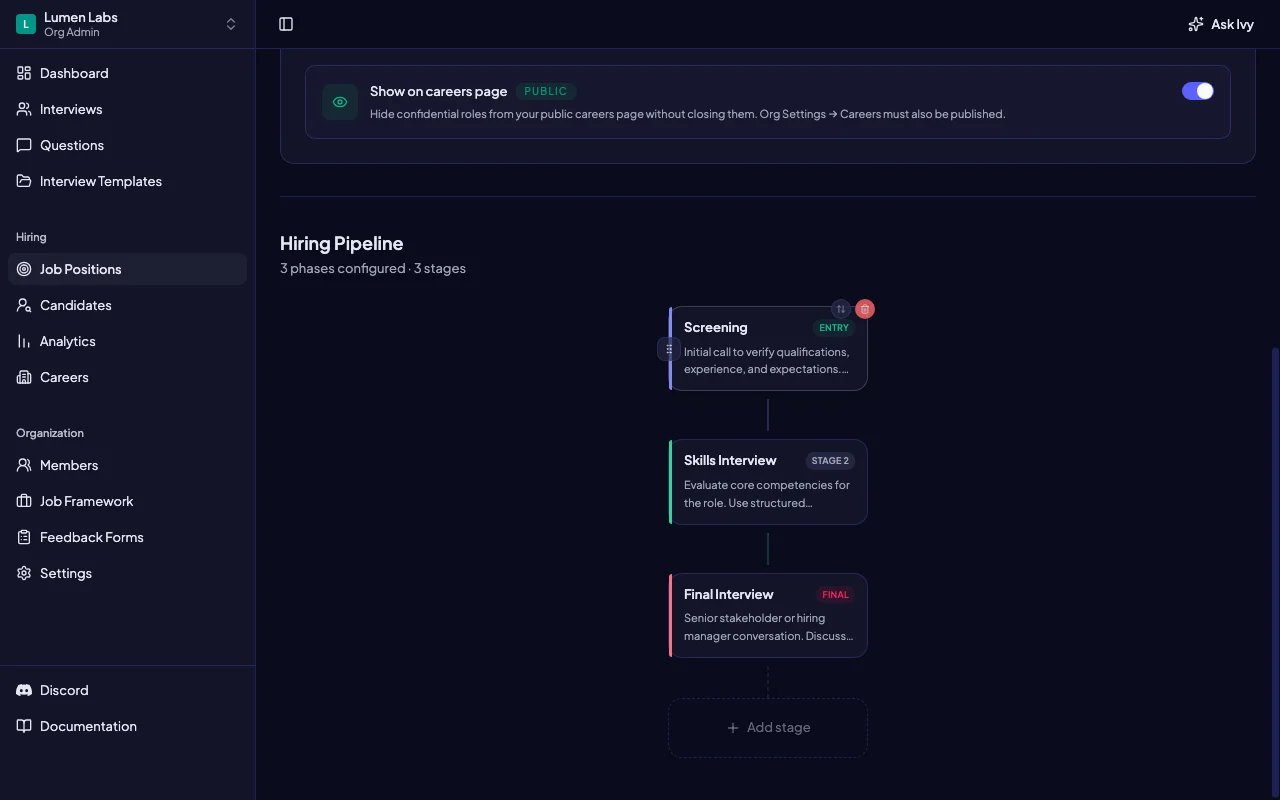
Intervy's Standard layout puts Screening, Skills Interview, and Final Interview in sequence, with guidance for the purpose of each phase. That is a useful draft, but the names alone are insufficient. Decide what a strong answer looks like before you invite a candidate into each round.
Key takeaway: Choose a preset for its decision path, then edit the phases for the actual job. A preset is the beginning of the design conversation.
Decide when interview stages should run in parallel
Sometimes two conversations answer independent questions. A peer panel may look at collaboration while a hiring manager explores role scope. In that case, placing both phases in the same stage can make the plan easier to see. Intervy's pipeline editor supports multiple phases within a stage as well as moving phases between stages.
Parallel phases still need a shared standard. Tell each interviewer what they own and where their assessment stops. If everyone asks about the same project, you have added candidate effort without gaining a different signal.
- Assign a distinct focus. For example, let one conversation examine technical decisions and another examine teamwork.
- Use the same criteria for the same role. Candidates should face a comparable assessment path.
- Agree on handoffs. Decide which evidence must be reviewed before the next stage begins.
- Keep candidate time visible. Two parallel phases may shorten elapsed time while still asking for two conversations.
The practical question is whether the extra phase changes the quality of the decision enough to justify its time. For a fuller look at assigning evidence goals, see our guide to interview panel roles.
Tip: Share the purpose and expected length of each conversation with candidates in advance. Clear expectations make an unfamiliar process easier to navigate.
Give every phase guidance and a way to evaluate it
A stage name such as “Technical Interview” gives little direction on its own. Add a short brief: which skills matter, what questions will reveal them, and which observations count as evidence? In Intervy, a pipeline phase can hold guidance and an interview template, so the plan can travel with the role.
An interview template builder is most helpful when the template reflects a decision rather than a collection of favorite questions. Choose questions that expose the capability you named in the phase brief. If the stage is about debugging, for example, ask the candidate to explain how they narrow down an unfamiliar failure and what information they would seek first.
Plan the evaluation before the conversation
Write down the signals that would change your assessment in either direction. Invite the interviewer to record observations while the details are fresh. Then compare that evidence against the criteria you set for the role, rather than treating confidence or speaking style as a proxy for ability.
- Purpose: The decision this phase contributes to.
- Evidence: The work example, answer, or exercise that could support that decision.
- Criteria: What a strong, mixed, or weak response would show.
- Owner: Who collects the evidence and who decides the next step.
Intervy shows the configured phases on each candidate application, grouped by stage. That gives the team a common map for the process as candidates move through it. For more on combining observations, read our guide to interview scorecards.
Key takeaway: A good phase brief tells an interviewer what to learn and how to recognize it. The name of the interview is only a label.
Review your hiring pipeline stages from the candidate's side
Once the stages are drafted, walk through them as if you were applying. Count every conversation, assignment, and wait for a decision. Ask what the candidate gains from each step and what information the team needs before requesting more time.
Keep the process easy to explain: what happens next, who participates, and what the conversation covers. If the panel cannot explain why a stage exists, revise it before candidates encounter it. If two phases pursue the same signal, clarify their focus or remove one.
A technical interview platform can help the team see the same sequence, but the quality of that sequence still comes from deliberate choices. Start with a simple path, prepare each interviewer, and adjust the stages when you learn that a step is not producing useful evidence.
Tip: After a hiring cycle, compare the questions you planned with the evidence you actually used. That review is a practical way to simplify the next pipeline.
Ready to map a role's process? Open Intervy, choose a pipeline layout for a new position, and give each phase a clear decision to support.