How to Assign Interview Panel Roles for Better Hiring
On this page
Interview panel roles work best when each person knows what evidence they are responsible for gathering. Without that agreement, a candidate can answer the same broad questions several times while a critical skill goes unexplored. A useful panel plan names an owner for each conversation, gives that person a narrow assessment goal, and brings the observations together after the interviews.
TL;DR: Give every panel member a distinct question theme and a clear handoff. Assign an interviewer to each interview phase, prepare the questions before the call, and compare recorded evidence in the debrief.
Define interview panel roles around evidence
Start with the hiring decision you need to make. List the skills and working behaviors the role requires, then decide which conversation is best suited to test each one. The point is to avoid asking three people to make the same general judgment of whether the candidate seems strong.
A panel plan might look like this:
- Screening owner: Checks the candidate's relevant experience, motivation, and practical expectations. This person identifies topics that need a deeper follow-up, rather than trying to settle every question.
- Peer interviewer: Explores how the candidate works with others and approaches the day-to-day problems of the role. Ask for a concrete example and probe what the candidate personally did.
- Hiring manager: Tests role-specific judgment, prioritization, and the decisions the person would own. Focus on trade-offs that matter for this team.
- Debrief owner: Brings the panel's observations into one discussion and checks where the evidence supports or challenges the initial impression.
These are responsibilities, not job titles. One small team might combine two responsibilities in a single conversation; a larger team might use separate conversations. Intervy includes a panel-based workflow example with screening, peer, hiring manager, and final-decision phases, giving you a starting structure to adapt.
Tip: Write one sentence for each interviewer: “After this conversation, we should know whether the candidate can…” If two sentences are nearly identical, adjust the question themes before scheduling.
Assign interview panel roles before scheduling
A phase has to belong to someone. In Intervy, the scheduling dialog lets a hiring lead choose an interviewer, set the date and time, and add optional preparation notes. The application then shows the assigned person and those notes alongside the scheduled interview. This keeps the handoff visible to the team running the process.
Use the preparation note for the question the interviewer should answer, not a vague instruction to “assess fit.” For example: “Explore how the candidate handled disagreement over a technical decision. Ask what evidence changed their mind.” The note should also say what another panel member is covering, so the interviewer knows where to stop.
Before the invitation goes out, check three things:
- Ownership: Does each conversation have a named interviewer who is available and prepared?
- Scope: Can every interviewer explain their evidence goal in one sentence?
- Coverage: Are any must-have skills missing, or is the panel repeating the same theme?
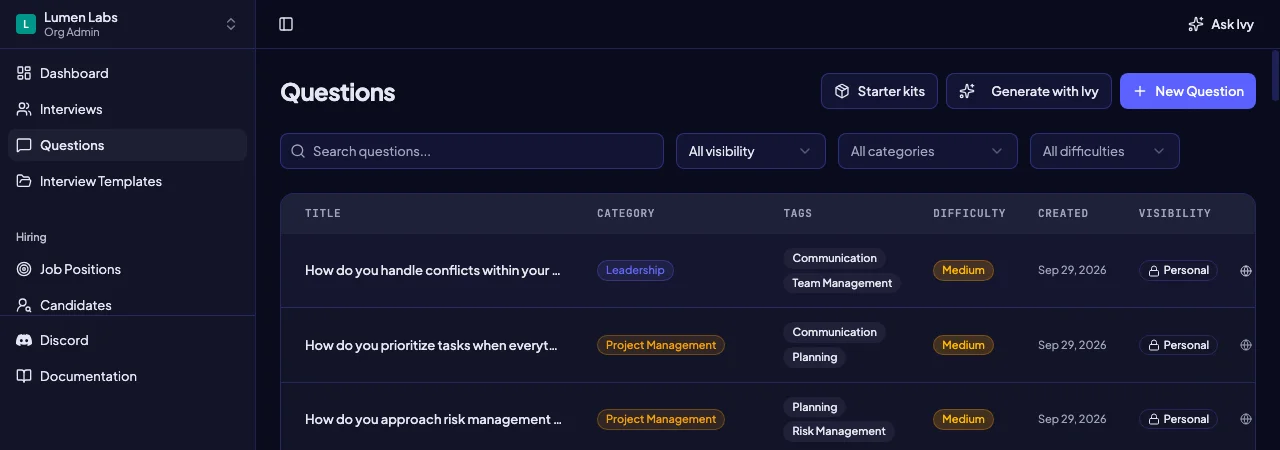
An interview template builder can help turn those goals into a repeatable set of questions. Intervy supports interview templates and can attach a selected template when an interview is scheduled. Treat the template as a guide to the evidence you want, while leaving room to ask follow-up questions about the candidate's own examples.
Key takeaway: A clear assignment is more useful than a longer panel. Give each interviewer one primary responsibility and a prepared set of prompts.
Prepare interviewers without scripting every answer
Good panel preparation is brief enough that people will actually use it. Share the role's essential criteria, the specific evidence goal for that phase, and a few questions that invite examples. A technical interview preparation tool should make those materials easy to find, but the quality of the interview still depends on what the interviewer asks next.
For a peer conversation, “Tell me about a disagreement” is only an opening. Follow up with what each person wanted, what the candidate did, what changed, and what the team learned. For a manager conversation, ask the candidate to walk through a decision with competing priorities. A specific story gives the panel something more useful to compare than a polished general answer.
Ask interviewers to leave room for the candidate to explain context. A narrow assignment does not mean interrupting every answer that crosses into another theme. It means knowing which parts of the answer this interviewer is responsible for evaluating and which parts should be passed to a colleague for a deeper question.
- Before the call: Review the evidence goal and prepare follow-ups tied to the role.
- During the call: Capture the candidate's example, the decision they made, and the outcome they described.
- After the call: Record the observation before hearing the rest of the panel's conclusions.
For a fast individual preparation routine, see our interviewer preparation checklist. For a fuller question structure, read the structured technical interviews guide.
Tip: Ask each interviewer to write down one piece of supporting evidence and one unresolved question. That makes the debrief more precise than a single overall impression.
Record evidence before the panel debrief
The strongest debrief begins with what happened in the interviews. Record the question, the candidate's answer, and the observation it supports. Separate a direct example from an interpretation: “described two alternatives and why one failed” is evidence; “seems strategic” is a conclusion that needs an explanation.
Intervy's interview view provides a notes field alongside each question. A completed interview review shows the recorded responses and ratings together, so an interviewer can return to the details before a debrief. This is where an interview scoring tool helps: it gives the panel a common record to discuss instead of relying on memory alone.
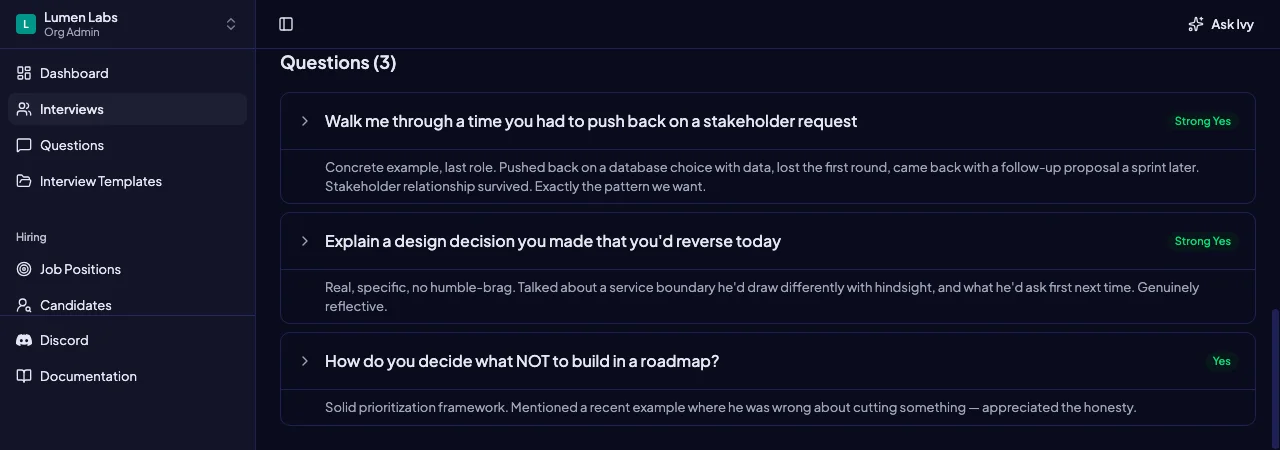
When the panel meets, ask each owner to report on their assigned evidence goal first. If a peer interviewer assessed collaboration, have them describe the example they heard before offering a recommendation. If an answer created a new concern, identify what could resolve it. The aim is a decision grounded in the candidate's work, not a vote based on who spoke most confidently.
On Growth and Scale plans, the application scorecard shows the interviewer attached to each phase and identifies the owner next to recorded concerns. That helps a hiring lead follow an observation back to the conversation where it arose. For more on comparing assessments, see interview scorecards versus gut feel.
Key takeaway: The debrief should compare observations across distinct responsibilities. If the panel disagrees, find the exact evidence behind the disagreement before debating a recommendation.
Make the next panel easier to run
After a hiring decision, look at the process as well as the candidate. Which questions produced useful examples? Where did interviewers repeat one another? Which skill still had too little evidence when the debrief began? Use those answers to revise the role assignments and templates for the next candidate.
- Keep: Questions that produced concrete examples tied to the role.
- Change: Repeated questions or phases with no clear evidence goal.
- Add: A follow-up for a skill the panel could not assess confidently.
You do not need a complex panel to get value from this approach. You need a deliberate division of work, a visible handoff, and a habit of recording observations before group discussion. A structured interview tool can hold the assignments and interview records together; the team still owns the judgment.
If you are setting up a new panel, begin with the phases your team already uses. Give each phase an evidence goal, assign its interviewer in Intervy, and prepare a small set of questions before the first call. After the interviews, review what each person actually learned and adjust the plan where the evidence was thin.
Key takeaway: Assign the work before the interviews and improve the plan after each debrief. The panel gets better when every conversation has a purpose you can name.