Hiring Intake Meeting: Agenda and Role Brief Template
On this page
- Prepare the hiring intake meeting before the clock starts
- A 30-minute hiring intake meeting agenda
- Worked role brief: outcomes, evidence and trainable skills
- Resolve scope, level and trade-offs explicitly
- Translate the brief into role and competency information
- Reusable checklist and handoff to recruiting
A hiring intake meeting should answer a practical question: do the hiring manager and recruiter mean the same thing by this role? If one expects a queue owner and the other starts searching for a department builder, a polished job description can conceal the disagreement. Leave with a brief you can recruit against, or a visible decision that still prevents you from starting.
TL;DR: Prepare a draft, use a 30-minute agenda to agree outcomes and essential evidence, and separate trainable skills from requirements. Record disagreements with a named decision owner and deadline; begin recruiting only against the parts of the brief that are settled.
Prepare the hiring intake meeting before the clock starts
Bring the hiring manager and recruiter together, adding the person authorized to decide any disputed scope or budget. Send a draft brief beforehand so the meeting can resolve choices. The agenda below is our editorial recommendation for a prepared discussion, rather than a measured optimum or an Intervy workflow.
Greenhouse's “Structured hiring: Role kick-off meeting” guidance, updated July 2022, recommends connecting business objectives to candidate requirements and dividing hiring responsibilities. The worksheet here turns those preparation questions into explicit decisions. It does not promise a particular hiring outcome.
- Hiring manager prepares: the business problem, expected results, reporting line, available support and work this person will not own.
- Recruiter prepares: questions about contradictory requirements, comparable role titles and constraints that need approval.
- Decision owner prepares: confirmed boundaries for compensation, location and headcount, or a clear statement that approval is still missing.
Tip: Ask everyone to mark each draft requirement as agreed, proposed or unresolved. Silence in a shared document is not agreement.
A 30-minute hiring intake meeting agenda
Use one shared brief during the discussion. The recruiter can facilitate while the hiring manager explains the work; name a note owner so decisions survive the call. If preparation is incomplete, use the time to identify missing decisions and schedule their resolution.
| Minutes | Decision | Record before moving on |
|---|---|---|
| 0–5 | Why does this role exist? | Business problem and results the hire should influence |
| 5–11 | What work belongs here? | Scope, reporting line, authority and explicit exclusions |
| 11–18 | What evidence is essential? | Job-related abilities, acceptable evidence and trainable skills |
| 18–24 | Which trade-offs can we accept? | Agreed alternatives; disputed scope, level or constraints |
| 24–28 | Who decides what remains? | Named owner, deadline and consequence for recruiting |
| 28–30 | Are we ready to start? | Agreed brief, or explicit unresolved decisions and a hold |
- Close with a read-back: “We are hiring this person to achieve these outcomes, with this scope and these essential abilities.” Let each participant correct it.
- Record the start decision: specify whether sourcing can begin, which requirements it uses, and which activities remain on hold.
Key takeaway: A useful close can be “not ready.” An unresolved level or budget decision should have an owner, rather than become a recruiter's private assumption.
Worked role brief: outcomes, evidence and trainable skills
The following Lumen Labs example is fictional editorial advice. Maya is the hiring manager, Rowan the recruiter and Ellis the department lead. Their proposed role is a customer support specialist who owns a queue; the examples and targets illustrate a brief, not measured results or a preloaded product template.
- Business need: customers receive inconsistent updates when a request passes between support and engineering.
- Proposed outcome: by the end of the first three months, the hire independently manages the agreed queue and gives each escalated request a clear owner and next update time.
- Success evidence after joining: Maya reviews a sample of handoffs for a stated problem, relevant context, receiving owner and customer update. The team must agree its review standard before treating it as a performance target.
- Scope and authority: prioritize the assigned queue, explain next steps and escalate within an agreed policy. Engineering owns technical fixes; Maya owns staffing and policy changes.
Separate what you hope the hire achieves from the evidence you can reasonably collect before hiring. A candidate can explain sound escalation judgment without having used your exact helpdesk product. A familiar product name alone does not show that judgment.
| Category | Requirement or example | How the team will use it |
|---|---|---|
| Essential evidence | Explains why an outage takes priority over a how-to request, while checking impact and urgency | Rowan looks for relevant examples; Maya probes the reasoning |
| Essential evidence | Gives engineering a clear problem description and identifies what remains unknown | Maya asks for a fictional escalation explanation |
| Essential evidence | Writes a clear customer update without inventing a resolution time | Maya reviews a short fictional response |
| Trainable skill | Lumen Labs' helpdesk product and internal product catalog | Maya provides onboarding and confirms support is available |
| Unresolved requirement | Whether this person must own weekend coverage | Ellis decides before Rowan uses availability as a screening requirement |
- Acceptable alternatives: evidence from an internal service desk or another customer-facing role can count when it demonstrates the same essential ability.
- Excluded proxy: do not treat a particular previous job title as the only route to the required evidence.
Tip: For every “must have,” finish the sentence: “Without this ability, this outcome becomes difficult because…” If the connection is unclear, investigate before adding a rejection rule.
Resolve scope, level and trade-offs explicitly
Use the worksheet below when the draft contains incompatible expectations. The named owner is responsible for obtaining the decision, even when another person must authorize it. Replace the fictional deadlines with actual dates and times in your own brief.
| Disagreement | Options and consequence | Decision owner | Deadline | Recruiting rule until resolved |
|---|---|---|---|---|
| Scope: queue ownership or department design? | Queue specialist fits the stated need; department design adds authority and different evidence | Maya | Tuesday, 12:00 | Draft for queue ownership only; hold outreach until confirmed |
| Level: independent specialist or team lead? | Independent work does not imply people management; team leadership changes scope and compensation review | Ellis | Tuesday, 16:00 | Do not advertise a level or reject profiles against one |
| Trade-off: exact helpdesk experience or transferable judgment? | Accept transferable evidence if Maya can provide onboarding | Maya | Wednesday, 10:00 | Rowan records comparable experience without rejecting on product name |
| Constraint: weekend coverage within the approved package? | Confirm coverage need and compensation, or assign coverage elsewhere | Ellis | Wednesday, 12:00 | Hold the role launch; do not imply coverage terms in outreach |
For each decision, add the answer, who approved it and when the brief was updated. If a deadline passes, the owner either supplies the answer or records a new decision date and continued hold. Avoid letting “we will see who applies” quietly settle essential scope.
- Challenge the conflict: ask which business outcome requires the disputed scope or level.
- Name the cost: accepting a trainable skill requires an onboarding owner and capacity; adding leadership requires a fresh scope check.
- Preserve uncertainty: record what remains unknown instead of copying a proposed choice into the agreed requirements.
Key takeaway: A trade-off is complete when the team accepts its consequence and assigns the work it creates.
Translate the brief into role and competency information
Once scope and level are agreed, carry the same terms into recruiting materials. A competency is a job-related ability you want evidence for, such as prioritization or customer communication. Keep the handoff small: identify the ability, the expected level and the observable evidence; you do not need to redesign every interview round in this meeting.
- Role and level: use the agreed work and authority to select them. If the team still means different things by the level, return to the unresolved decision.
- Competency evidence: replace “strong communicator” with “explains next steps and uncertainty clearly without promising an unconfirmed fix.”
- Evidence owner: assign who will check that requirement and where existing screening or interview material already covers it.
Intervy's position details let you select a role and level and write a description. Its role competency matrix shows expectations by level. Viewing and changing these records depend on the relevant workspace permissions; ask an authorized teammate to make changes when you lack access.
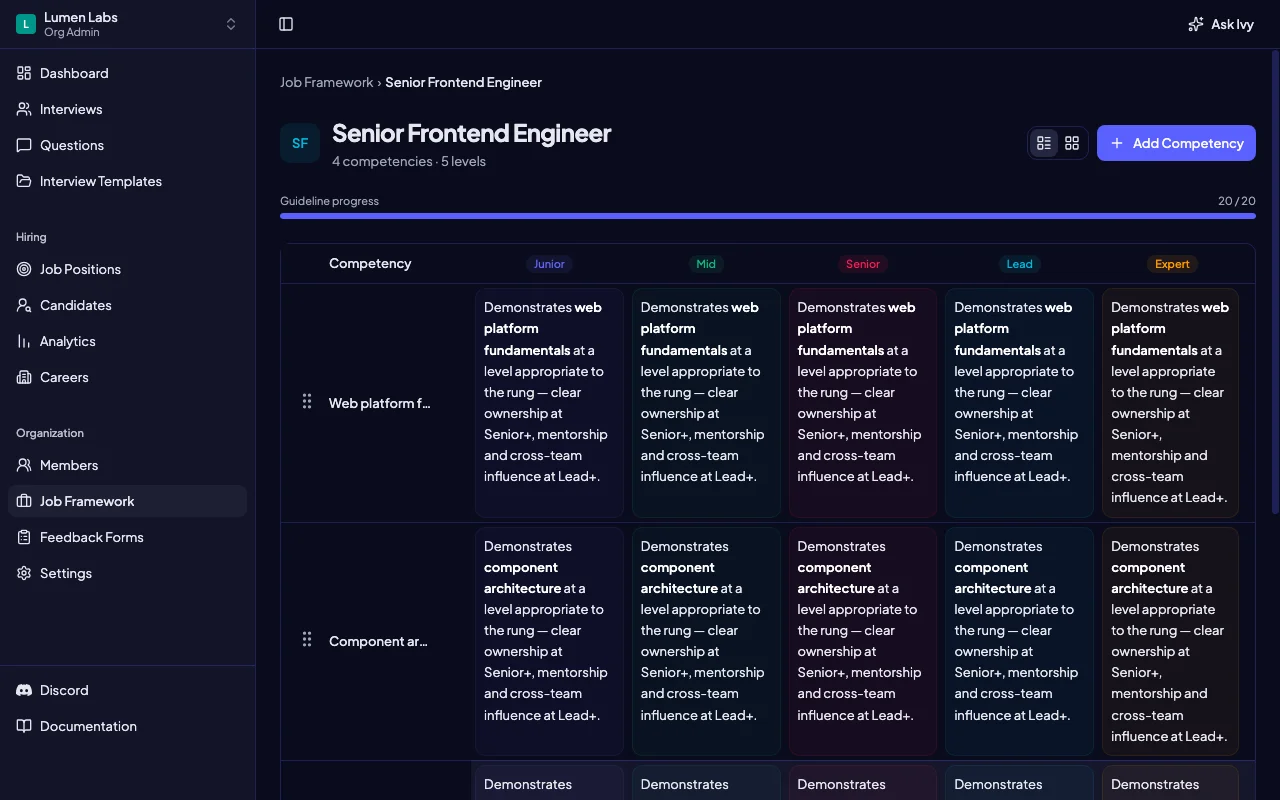
The screenshot shows a separate engineering role to illustrate the matrix, not the fictional support brief entered automatically. The agenda, disagreement log and approval decision in this guide are worksheets for your team to maintain. Do not assume a structured interview tool resolves those decisions for you.
For the next step, use the competency-based hiring framework guide to refine evidence descriptions, or the hiring-bar calibration guide when the agreed level needs clearer expectations.
Tip: Before choosing an interview preparation app for hiring managers, agree what each essential requirement means. Then use that wording consistently in your preparation materials.
Reusable checklist and handoff to recruiting
Copy these checks into your own role brief. They are editorial recommendations, separate from Intervy capabilities. For the fictional example, Rowan receives the final brief only after Ellis resolves coverage and level and Maya confirms the onboarding commitment.
- Purpose agreed: business need, expected outcomes and excluded responsibilities are written down.
- Scope agreed: reporting line, authority, level and constraints have explicit decisions.
- Requirements justified: each essential ability connects to an outcome and has acceptable evidence.
- Learning supported: trainable skills have an onboarding owner and a realistic support commitment.
- Disagreements owned: every open decision has a person, deadline and clear effect on recruiting.
- Handoff accepted: recruiter and hiring manager confirm the same dated brief, evidence owners and permission to start.
Send the recruiter the agreed brief, unresolved-decision log and next review date together. Name who can authorize changes after launch; when a requirement changes, update the brief and tell everyone using it. Keep that change visible so candidates are assessed against a shared understanding.
Key takeaway: End intake with a usable recruiting decision. When you are ready to carry the agreed role and expectations into your workspace, open Intervy with the brief beside you.