Interview Debrief Agenda: Resolve Mixed Panel Feedback
On this page
One interviewer sees an exceptional hire. Another recommends rejection. A useful interview debrief agenda gives both judgments the same test: what did the candidate demonstrate, which job criterion does it address, and what remains unknown? Bring the panel together to answer those questions before anyone tries to win the room.
TL;DR: Collect independent feedback before the meeting, review evidence by competency, and probe both strong yes and weak no ratings. Separate missing evidence from disagreements about the criteria, assign any remaining gap, and close with a written decision and rationale.
Prepare the interview debrief agenda before discussion
Set the decision question in the invitation: whether this candidate meets the agreed requirements for this role and level. Name the decision owner, facilitator, and person recording the outcome. One person can hold more than one responsibility, but everyone should know who makes the final call if the panel stays divided.
Ask interviewers to submit their feedback independently before reading other recommendations or joining a group discussion. Use the same short structure for every contribution:
- Criterion assessed: The competency and the expectation for this role.
- Observed evidence: What the candidate said, produced, or did, with the question or exercise attached.
- Assessment: How that evidence compares with the agreed anchor.
- Recommendation and confidence: The proposed outcome and how much evidence supports it.
- Unanswered question: What the interviewer did not establish.
Treat this as a panel practice even when your structured interview tool makes the feedback easy to collect. Do not assume the software hides other interviewers' views. If feedback is missing, ask for the original observation before presenting the panel's overall verdict; record that late submission as a limitation.
Tip: Send the criteria with the invitation. A debrief should apply the hiring bar you agreed before interviewing, rather than inventing a new requirement for one candidate.
For help with the earlier setup, use the interview panel roles guide. This agenda begins where those assignments end: with a set of observations that now needs a decision.
Run a focused interview debrief agenda
Use the following thirty-minute schedule as a starting template, not a research-backed optimum. Adjust the time for the role and complexity, while preserving the order. If the evidence cannot support a decision, document the gap instead of letting the meeting drift into another round of opinions.
| Time | Discussion | Required output |
|---|---|---|
| 0–3 minutes | Confirm role criteria, decision owner, and feedback completeness | Shared decision question and known limitations |
| 3–15 minutes | Review evidence competency by competency | Meets, below, or unresolved assessment for each criterion |
| 15–23 minutes | Examine the largest rating differences | Evidence gap, interpretation difference, or preference disagreement |
| 23–27 minutes | Decide which gaps could change the outcome | Specific question, owner, deadline, and proportionate action |
| 27–30 minutes | Record the decision and next communication | Rationale, dissent, accepted risks, and next step |
Keep the opening factual. The facilitator can say: “We have feedback from every assigned interviewer. Let's start with the evidence for prioritization.” Avoid starting with a show of hands that frames everything afterward as a defense of a vote.
- Keep the unit of discussion small. Finish one competency before moving to another.
- Invite the observation before the verdict. Ask each relevant interviewer what happened in the assessment.
- Park repeated arguments. Write the unresolved question and return to it in the gap review.
Key takeaway: The meeting should produce a traceable assessment of the job criteria. Agreement is useful, but a unanimous vote is not a substitute for that record.
Review evidence by competency, not overall impression
For each competency, read the requirement, then the observations supporting and challenging it. Distinguish an observed shortfall from an untested skill. “Did not explain a recovery plan when prompted” and “we never asked about recovery” lead to different next steps.
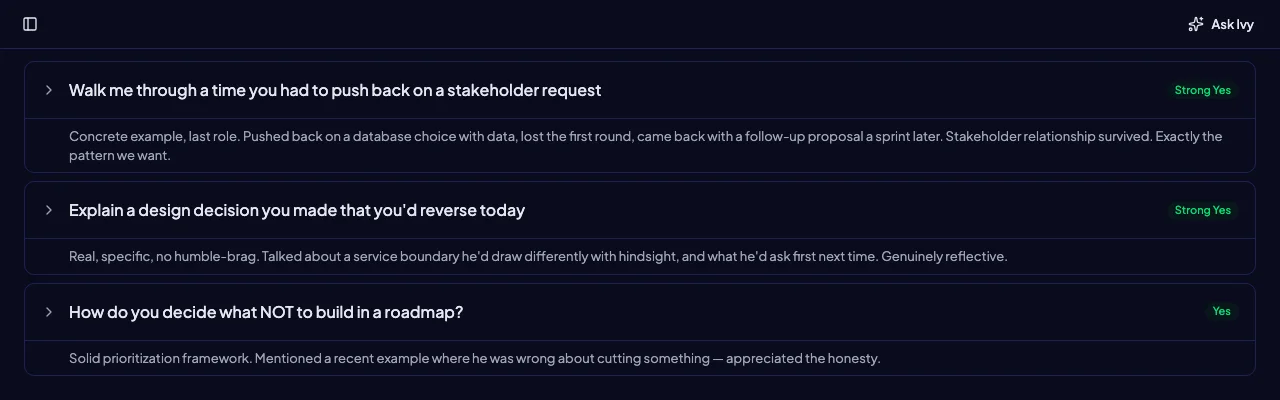
In Intervy, the interview review page displays question ratings and recorded comments. An interview scoring tool can help you return to the answer behind a recommendation; the panel still has to interpret that answer against the role's criteria.
Build a compact evidence row as you talk:
- Expectation: What acceptable performance looks like for the role.
- Supporting observation: A specific answer, work sample, or behavior.
- Contrary observation: Evidence that challenges the assessment.
- Conclusion: Meets the criterion, falls below it, or remains unresolved.
For example, a fictional product panel may hear a persuasive roadmap explanation in one interview and a weak prioritization answer in another. Compare the prompts and constraints: did one ask for a familiar example while the other introduced a new trade-off? Decide whether the answers establish the same capability before calling the ratings inconsistent.
Tip: Keep the original observation separate from the panel's interpretation. If the assessment changes during discussion, record what new evidence or clarified anchor caused the change.
The interview scorecards guide explains the input record. Here, the work is deciding what that record supports, including where a positive overall impression leaves an essential criterion unproven.
Interrogate strong yes and weak no ratings
Ask the strongest advocate to explain the evidence before asking others to endorse the conclusion. Then give the skeptical interviewer the same opportunity. Neither enthusiasm nor hesitation should receive an automatic veto or an automatic pass.
Ashby's Quality of Hire Talent Trends Report, September 9, 2026, found that hires with both a 2 and a 4 interview rating averaged 4.0 on its later quality-of-hire measure, compared with 3.7 for hires whose interview ratings were all 3s. Interview feedback used a 1–4 scale; quality of hire used 1–5. These are results among hires, not proof that hiring a mixed-feedback candidate causes better performance; the report also notes that early departures can be underrepresented.
Use that finding as a reason to inspect the disagreement, not as a hiring rule:
- For the strong yes: Which essential criterion did the candidate demonstrate particularly well? What evidence would weaken your recommendation? Are you extending one impressive answer to skills you did not assess?
- For the weak no: Which requirement was missed? Was it tested directly? Is the concern a demonstrated shortfall, an unanswered question, or a preference for a different working style?
- For both: Did you use the same role-level anchor? Would the same answer from another candidate receive the same assessment?
Suppose the advocate cites a clear, relevant trade-off, while the skeptic says the candidate “wasn't polished.” Ask the skeptic to connect that concern to a defined communication requirement and an observed behavior. If the role requires explaining risks to customers, examine that evidence; if polish was never a criterion, avoid adding it after the interview.
Key takeaway: A strong yes deserves scrutiny, and a weak no deserves a specific explanation. Neither rating tells you enough without its evidence and job relevance.
Separate evidence gaps from preference disagreements
Label the disagreement before choosing an action. More interviewing can answer a missing question; it cannot resolve a panel that has different definitions of acceptable performance. Keep any follow-up bounded and proportionate to the decision it could change.
- Evidence gap: The required capability was not assessed clearly. Assign someone to review existing material first, then propose a targeted follow-up only if needed.
- Interpretation difference: Interviewers read the same observation differently. Return to the anchor and explain which part of the answer meets or misses it.
- Preference disagreement: Interviewers favor different styles or backgrounds without a corresponding job requirement. Ask for the criterion; if none applies, exclude that preference from the decision rationale.
- Criterion disagreement: The panel disputes what the role actually requires. Have the role owner resolve the requirement and consider whether the assessment needs to be corrected consistently across candidates.
An unresolved gap needs more than “recruiter to follow up.” Write the question, why it could change the outcome, the person responsible, and a due date. Include what would count as sufficient evidence and who will make the decision once it arrives.
Tip: If no plausible answer to a proposed follow-up would change the decision, do not ask the candidate to spend time on it. Record the existing rationale and close the loop.
Close with a documented decision record
Copy this template into the place your team keeps hiring decisions. It is a manual panel record, not a claim that Intervy automatically manages this agenda or its follow-up owners.
| Field | What to record |
|---|---|
| Role and level | The position and expectations applied |
| Decision owner and date | Who made the call, and when |
| Feedback completeness | Submitted assessments and missing inputs |
| Criterion findings | Each essential criterion, evidence reference, and conclusion |
| Disagreement | What differed, how it was examined, and any remaining dissent |
| Open gap | The precise unanswered question and its decision relevance |
| Gap owner and deadline | Who obtains the evidence, by when, and the decision checkpoint |
| Decision | Advance, reject, or defer pending named evidence |
| Rationale and accepted risks | Why the findings support the decision and what uncertainty remains |
| Candidate communication | Who communicates the outcome or next step, and when |
Read the record back to the panel. Ask whether it represents the observations accurately, including dissent. A decision owner can make a call without unanimity, but should explain why the evidence supports that call and which uncertainties the team accepts.
- If advancing: State which requirements are supported and which risks are acceptable.
- If rejecting: Identify the job-related shortfall that supports the decision.
- If deferring: Name the missing evidence, owner, deadline, and next decision point.
Key takeaway: Close with a decision or a bounded route to one. “Let's think about it” leaves the candidate waiting and gives the next meeting no better evidence.
Start with one upcoming debrief: collect independent notes, run the competency review, and complete this record before ending the meeting. Explore Intervy to keep question ratings and comments available for that discussion, while keeping the hiring decision with your team.