Interviewer Training Before the First Live Interview
On this page
Interviewer training needs a decision at the end: can this person run your agreed interview without a coach supplying the next question? Before giving a new interviewer their first live candidate, let them observe a fictional exchange, rehearse it with feedback and show what they can do independently. Keep a short record of the behaviors behind your decision.
TL;DR: Use your existing role rubric and interview questions. Observe a fictional interview, practice neutral follow-ups, compare evidence notes and repeat without coaching. A lead decides ready or retry from observed behavior; this worksheet is editorial guidance, not a validated certification.
Set the Interviewer Training Decision First
Start with one role and one interview the team already knows how to conduct. The hiring manager owns the readiness decision; an experienced interviewer coaches the practice, and recruiting operations can coordinate the materials and retry. One person can hold several of these responsibilities.
Bring the agreed role rubric: the written criteria and descriptions used to assess candidate answers. If those are still disputed, resolve the hiring bar first. This exercise trains someone to use an existing interview, rather than redesigning its questions or deciding what seniority means.
- Prepare one interview pack. Include the role and level, core questions, permitted follow-ups, time boundaries and candidate-facing opening and closing.
- Name the behaviors to observe. Following the pack, asking without supplying the answer, taking usable notes and identifying missing evidence are different from sounding confident.
- Separate the two judgments. Candidate evidence is assessed against the role rubric. Interviewer readiness is assessed against how the trainee conducts the interview and handles that evidence.
Tip: Write the decision before practice: “Ready to conduct this role’s skills interview independently, or retry these named behaviors.” Avoid a blanket approval to interview for any role.
Observe a Fictional Interview Before Taking the Lead
Use a colleague playing a fictional candidate. No applicant needs to become a training exercise. The following Lumen Labs support-role scenario is invented; substitute an equivalent question from your existing pack while keeping the agreed criteria.
Assume the team already assesses prioritization by how a candidate weighs urgency and customer impact. The coach asks, “Tell me about a time you had several support requests competing for attention. How did you decide what to handle first?” The colleague, playing a fictional candidate named Alex, answers, “There was an outage and an invoice question. I took the outage first because several customers could not work, then replied to the invoice request.”
- Observe the follow-up. The coach asks, “What did you do next?” The fictional candidate replies, “I told the affected customers that I was investigating and checked the service status.”
- Write candidate evidence. “Put the outage before the invoice request; explained that several customers were blocked; described an update and status check.”
- Mark the gap. “Escalation decision not described.” Do not convert silence into evidence that the candidate cannot escalate.
- Write interviewer observations separately. “Asked for the next action without suggesting escalation.” That describes the coach, not the candidate.
Compare the trainee’s notes with the coach’s after the exchange. “Seems calm and capable” is an impression; it does not tell a later reader what happened. Ask the trainee to replace it with an action from the answer or mark it as an unsupported impression to exclude from the assessment.
Key takeaway: Observation is active work. The trainee should identify the question, the follow-up, the evidence it elicited and what remains unknown before seeing the coach’s interpretation.
Run Coached Interviewer Training, Then Remove the Prompts
Now the trainee asks the core question while the coach observes. Give the fictional candidate a fresh answer: “I had a login problem and a billing request. I sorted them out with the team.” The trainee needs more detail, but the follow-up must stay within the team’s agreed rules.
The research context is narrower than a training guarantee. Levashina and colleagues’ The Structured Employment Interview, Personnel Psychology, 2014, reviews interview structure, rating scales and probing or follow-up questions using narrative synthesis and, where possible, quantitative review. It does not validate the exercises or readiness checks in this article.
- Ask for the person’s contribution. “What did you personally do?” leaves the action open. “You escalated the login problem, right?” supplies an action the answer has not established.
- Ask for the reason. “What information shaped that order?” invites evidence. “Was customer impact your top priority?” introduces the criterion you hope to hear.
- Ask for the result. “What happened after your response?” leaves room for an unsuccessful outcome. Do not reward a rehearsed success story without examining the action behind it.
Pause when coaching is useful. Record the trainee’s exact question, explain which words supplied an answer, and let them rephrase it. Count that as coached practice, not independent readiness evidence.
For the retry, change the fictional answer while preserving the criterion and difficulty. For example, the candidate can describe a widespread login failure alongside a routine account request. The trainee runs the opening, core question, permitted follow-ups, notes and closing without prompts; the coach observes silently unless intervention is necessary.
Tip: If the coach has to rescue a leading question or supply a missing step, record it. Schedule another independent attempt rather than treating the corrected attempt as proof that help is no longer needed.
Copy This Manual Practice Worksheet
Keep one copy per practice attempt in a team document. This is a manual worksheet, not an Intervy form. Record both what happened and the next action so a different coach can continue the work.
| Worksheet field | What to record |
|---|---|
| Scope and people | Role, level, interview round, trainee, coach and deciding lead |
| Agreed materials | Rubric and interview-pack version or review date |
| Attempt | Observation, coached rehearsal or independent retry; date |
| Question and follow-up | Core question and the trainee’s exact follow-up words |
| Candidate evidence | Fictional candidate’s stated actions, reasons and results |
| Missing evidence | What was not established; distinguish unasked from asked but unanswered |
| Impressions to exclude | Labels such as “confident”; replace with relevant observations or omit |
| Trainee behavior | What the trainee did, including any coach intervention |
| Criterion connection | Which agreed role criterion the candidate evidence informs; remaining uncertainty |
| Decision and next action | Ready for this interview, retry, or repair the pack; reason, owner and next review date |
For the sparse practice answer, a useful entry might read: “Asked ‘What did you personally do?’ without prompting. Recorded that Alex contacted the service team. Reason for prioritizing the login problem still missing.” The trainee has collected an action without inventing its rationale; the remaining gap tells them what to explore next.
- Keep notes independently. Have the trainee finish their evidence notes before reading the coach’s, then compare the observations and criterion connections.
- Investigate disagreement. Ask which words or actions support each interpretation. Matching the coach’s rating by itself does not demonstrate sound interviewing.
Key takeaway: A reusable worksheet preserves uncertainty. Blank evidence should become an explicit gap, not a flattering adjective or an automatic low rating.
Decide Ready, Retry or Repair the Interview Pack
Use the independent attempt to review observable behaviors. These checks are suggested coaching criteria, not a validated pass mark or a prediction of hiring success. Do not add them into a percentage that hides a material problem.
- Follows the agreed interview. Uses the planned core questions and opening, manages the time boundary and leaves space for candidate questions without a reminder.
- Probes without teaching the answer. Uses permitted follow-ups, lets the candidate finish and avoids supplying the desired action or reason.
- Produces usable evidence notes. Records relevant actions and reasons, separates impressions and identifies missing evidence.
- Explains the assessment. Connects observations to the existing rubric and can explain uncertainty without copying the coach’s conclusion.
- Handles the close. Uses the agreed closing language and next-step explanation without inventing a promise.
A ready decision names its scope and evidence: “Ready for the support skills interview; independent retry followed the pack, used open probes and recorded the unresolved escalation evidence.” This records the lead’s judgment, not a permanent credential.
For a retry, choose the specific failure mechanism. If the trainee supplies answers, rehearse rephrasing leading probes and repeat with a new fictional response. If notes contain only impressions, practice rewriting them from the exchange before running another independent attempt. Record the owner and next review date; hold the live assignment until the lead reviews the new evidence.
Tip: When experienced interviewers cannot explain a question or reconcile the rubric, repair the pack first. Record that dependency separately from the trainee’s performance, then retry against the clarified materials.
Use Intervy for the Interview Materials
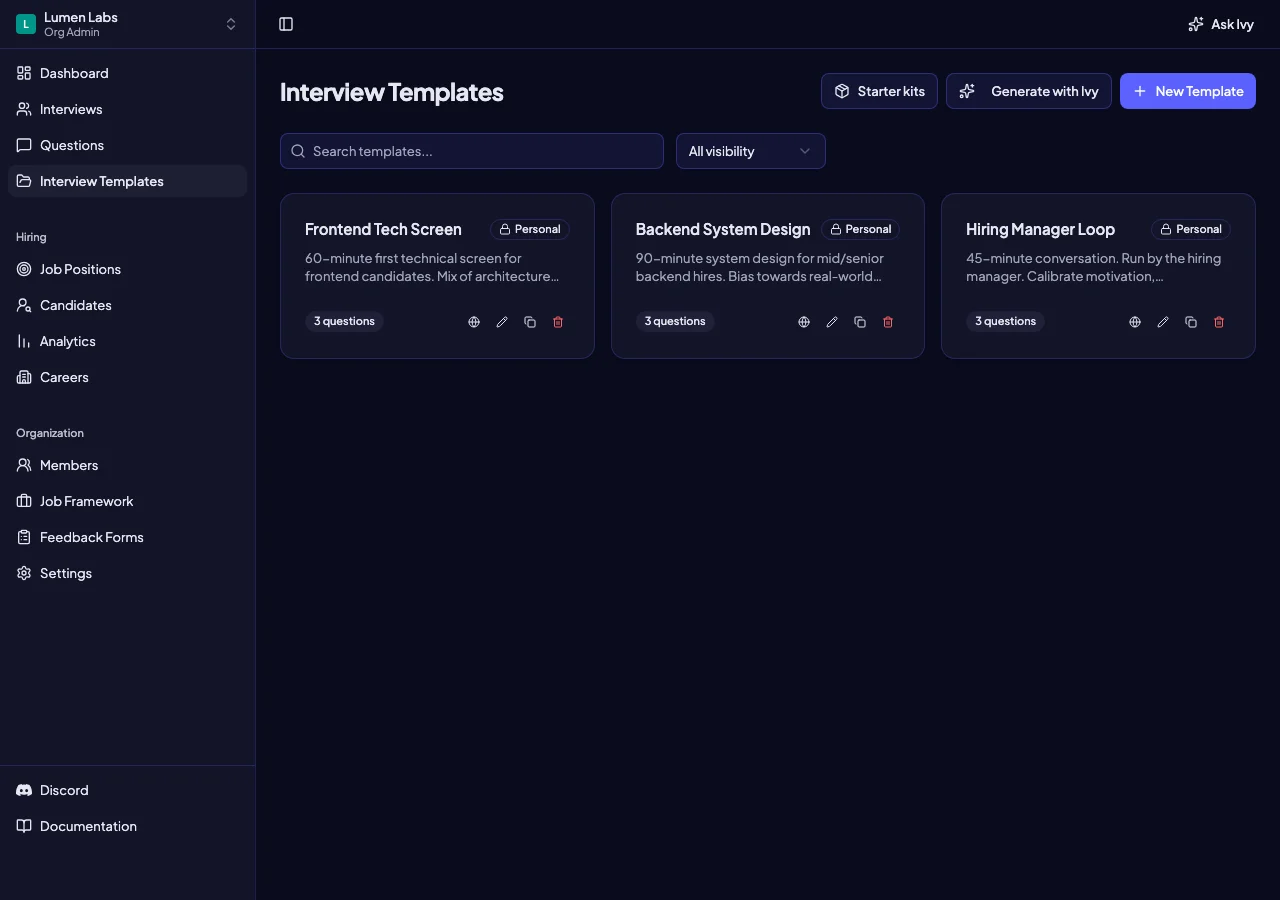
Intervy’s interview template builder groups questions into an ordered interview plan. With the necessary template permissions, a lead can review or edit those materials before the trainee practices. The fictional templates and interview below illustrate the product; they are separate from the support-role exercise above.
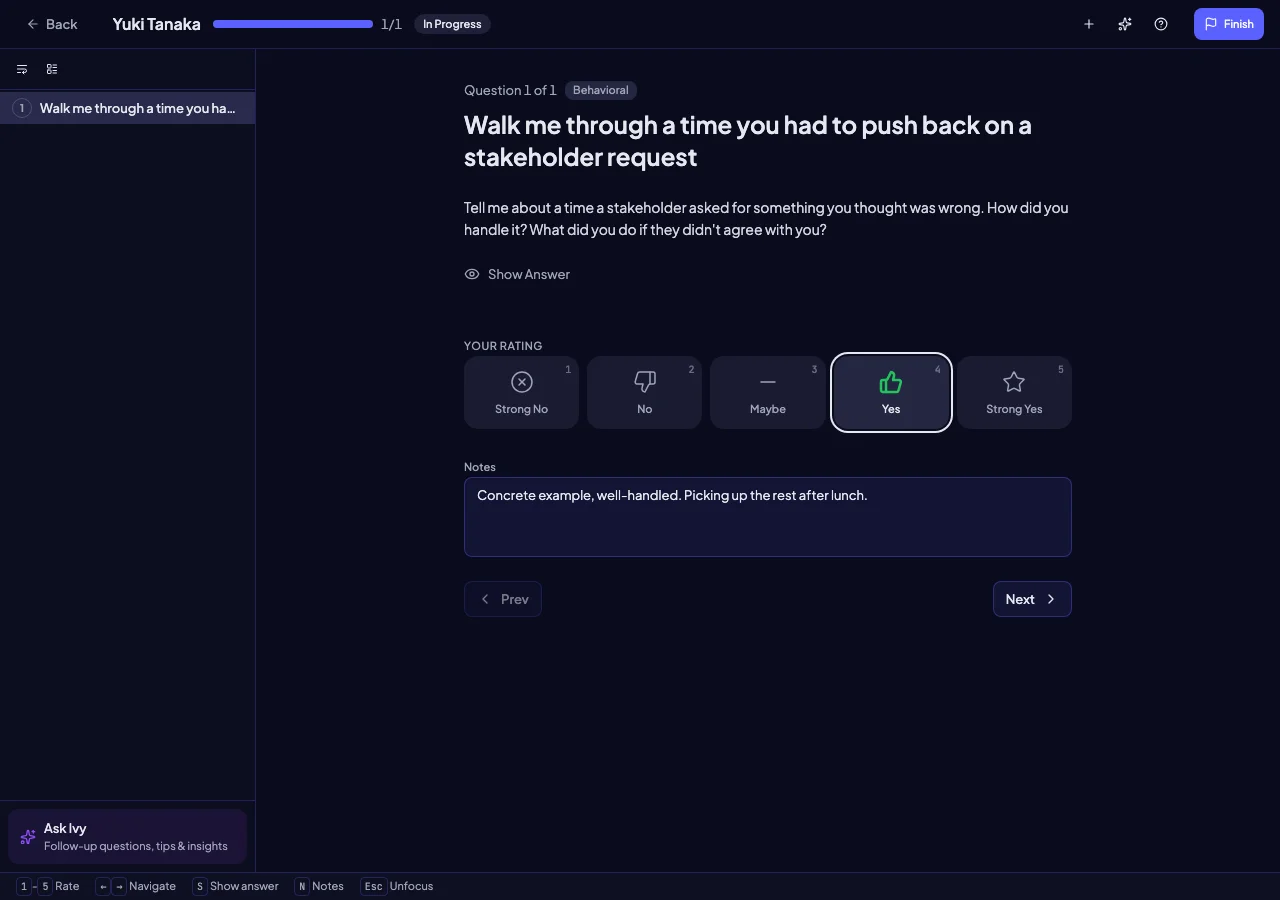
In the conduct view, each question has separate rating and notes controls. Editing requires organization membership and access to that interview; the interview must be started and still open. Use those controls for candidate assessment, while keeping the trainee’s practice observations and the readiness decision in the manual worksheet.
- Keep the training record separate. This plan recommends human observation and coaching in a team document. It does not describe built-in training, shadowing, certification or training analytics.
- Prepare the first assignment. After the lead’s readiness decision, use the pre-call preparation routine. For evidence-led evaluation, see our interview scorecards guide.
Key takeaway: Choose one interview pack and book a fictional rehearsal before assigning a live candidate. Explore Intervy as a structured interview tool for the questions, notes and ratings; keep the readiness judgment explicit and owned by the lead.