Candidate Screening Rubric for AI-Polished Applications
On this page
A candidate screening rubric becomes more useful when every reviewer can point to evidence for the job, rather than the smoothness of an application. A polished CV can describe impressive outcomes without showing what the applicant did. A rough CV can hide relevant work behind short bullets. The first pass needs a consistent way to separate those cases.
TL;DR: Write the job's essential evidence anchors before opening applications. Advance clear matches, hold plausible but incomplete cases for a focused follow-up, and reject only against a documented requirement. Review your decision patterns to see whether the rubric is screening for ability or for writing polish.
Why a candidate screening rubric matters now
SHRM's 2026 Trends and Predictions warns that AI-generated applications may make top talent harder to identify, while automated resume screening may make some qualified people harder to notice. That is a forecast, not evidence that any particular applicant used AI. It gives hiring teams a practical reason to make their first-pass decisions explainable.
Application review can also slow a busy process. Ashby's 2026 Recruiting Operations Benchmarks report identifies review as an early delay point, especially when technical roles draw many applicants. A written rule for what to look for makes a high-volume queue easier to divide among reviewers without asking each person to invent a standard.
- Treat prose as presentation. Grammar, confident adjectives, and tidy formatting show how an application was written. They do not, by themselves, show the work required for the role.
- Treat evidence as a lead. A project, deliverable, decision, or result gives a reviewer something specific to verify later.
- Keep uncertainty visible. A missing detail can mean the candidate lacks the experience, or that the CV simply did not describe it.
Key takeaway: The rubric should help you decide what to learn next. It cannot prove whether an application was AI-written, and it should not pretend to.
Write candidate screening rubric anchors before reviewing
Start with the role's actual work. For each essential requirement, write one observable example that would count as evidence and one gap that would require follow-up. Keep the list short enough for reviewers to use consistently. If a criterion does not affect the next-stage decision, remove it from the first pass.
Consider a customer support team hiring someone to own complex account escalations. Its first screen could use the anchors below. They are examples to adapt to the job, not universal qualifications.
| Criterion | Evidence to look for | Ambiguity to resolve |
|---|---|---|
| Investigating an escalation | Describes a customer problem, the steps taken to diagnose it, and the person's contribution | Says “handled escalations” without a case or scope |
| Coordinating a resolution | Names the teams involved and explains how a decision or handoff was managed | Lists “cross-functional collaboration” without a concrete interaction |
| Communicating outcomes | Shows a customer update, prevention step, or measurable service outcome | Claims “excellent communication” without an example |
Do not turn the table into a demand for a particular writing style. A candidate might present relevant evidence in a portfolio, application answer, or brief CV bullet. Reviewers should record the location of that evidence and use the same anchors for everyone applying to the role.
Tip: Give reviewers one real or fictional example of a clear match, a plausible but incomplete match, and a clear miss before they start. Discuss the edge cases together so “hold” means the same thing across the team.
For an interview-stage framework that goes beyond the first pass, see our guide to a competency-based hiring framework. Its role-level definitions can inform the later assessment, while this screen asks only whether the application contains enough relevant evidence to proceed.
Make advance, hold and reject decisions from evidence
An effective decision table has an action and a reason. Do not use a single vague “fit” score to combine essential requirements, writing quality, and personal impressions. Review the stated must-haves first, then decide what the next stage would need to confirm.
| Application signal | Decision | Reviewer note and next step |
|---|---|---|
| Describes a relevant escalation, names the candidate's actions, and meets every genuine prerequisite | Advance | Record the example and ask a later interviewer to test the decision process behind it |
| Lists relevant work but leaves ownership or outcomes unclear | Hold | Name the missing fact; use the same focused follow-up for comparable applicants |
| Has a sparse CV but a relevant portfolio example | Hold or advance | Read the supplied evidence against the same anchor; do not penalize brevity alone |
| Clearly states that a genuine, documented prerequisite cannot be met | Reject | Record the specific requirement and the evidence that makes it a clear miss |
| Uses polished claims with no job-relevant example | Hold, if a short clarification could resolve the gap | Ask for one concrete case rather than inferring capability from tone |
The middle category matters. It keeps “not shown” separate from “shown not to meet the requirement.” A hold is a defined next action with an owner and deadline, not an indefinite pile of applications. If the team cannot afford a clarification step for every hold, tighten the anchors and the follow-up question before reviewing the next batch.
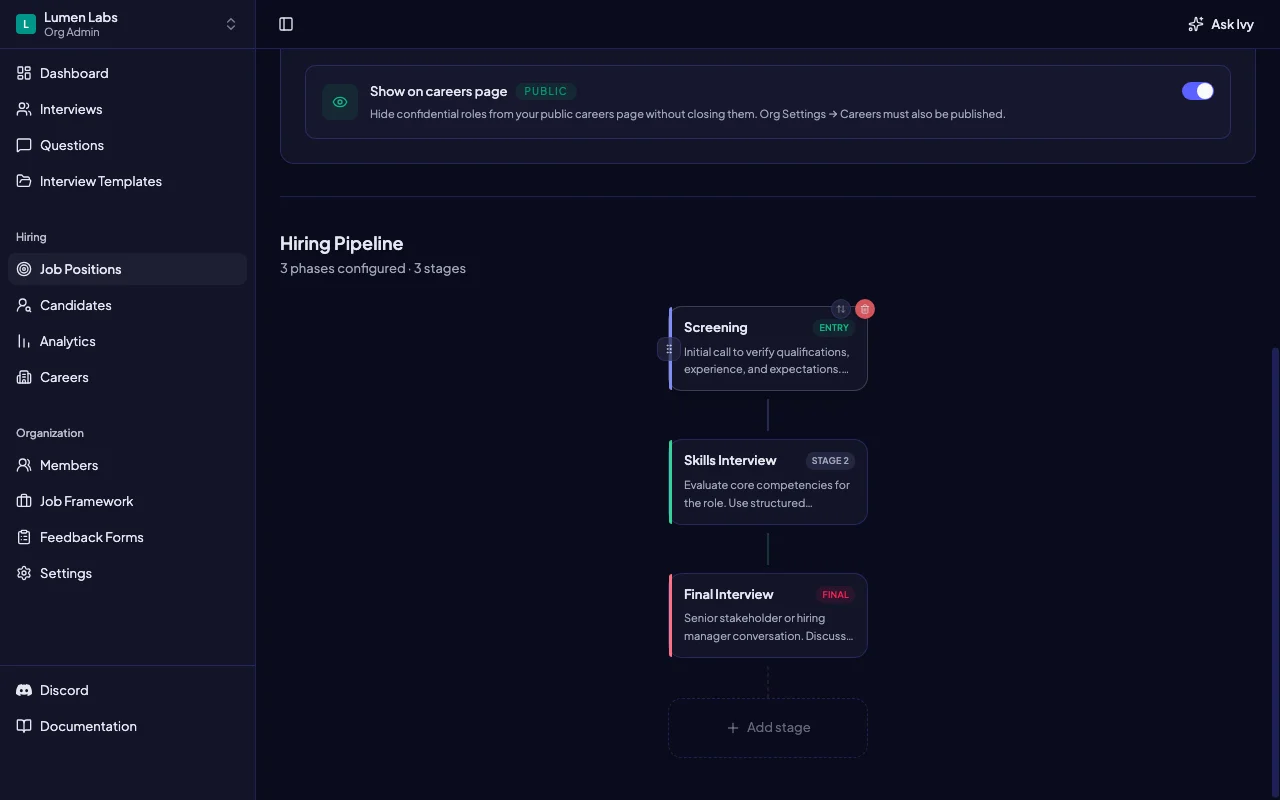
Intervy's job-position editor includes a Screening phase in its Standard pipeline layout. You can add guidance for that phase and connect an interview template. Use that space to carry the uncertainty from the first pass into a focused conversation, instead of making the screen a second unstructured CV review.
Key takeaway: Reject on a clear, job-related miss. Hold an unresolved signal only when you can state exactly how to resolve it. Advance when the application supplies enough evidence to justify the next assessment.
Turn incomplete CV evidence into a structured screen
When a CV is ambiguous, ask a question that maps to one anchor. For the escalation example, the screen might ask: “Tell me about a customer escalation you personally helped resolve. What did you diagnose, who did you involve, and what happened next?” This tests the candidate's account of the work without asking them to defend their CV's prose.
Before the call, agree on what a useful answer would contain: the situation, the person's contribution, a reasoned choice, and an outcome or learning. Ask the same core question for applicants held on the same gap. Follow-ups can clarify details, but the decision standard should stay anchored to the job.
- Missing scope: Ask which part of the work the candidate owned.
- Missing method: Ask what information they gathered and why they chose a course of action.
- Missing outcome: Ask how they knew the issue was resolved and what they would change.
Record the answer as evidence, including uncertainty that remains. A structured interview tool can help keep the question and guidance visible to the interviewer. For ways to turn a CV detail into a targeted follow-up, read our guide to questions from a CV.
Tip: Avoid a “Did you write this yourself?” test. It measures an assertion about authorship, while a role-based question measures the experience you need to evaluate.
Audit the candidate screening rubric after a batch
Once several reviewers have used the rubric, compare decisions against the written anchors. Look for clusters of rejects attributed to missing evidence, differences between reviewers, and hold cases that never received the promised follow-up. Revisit examples where a later structured screen changed the initial view.
Ask whether the same evidence would have received the same decision in a shorter or less polished application. If not, the team may be rewarding presentation despite its stated rule. Also check whether a supposedly essential criterion has any clear connection to the work; if it does not, revise it before the next batch rather than applying it more strictly.
- Sample decisions. Read a mix of advances, holds, and rejects with the job criteria beside them.
- Compare reasons. Group the recorded reasons by criterion, not by general labels such as “weak profile.”
- Close the loop. Record what the structured screen clarified and which anchors produced useful signals.
- Revise together. Agree on changed anchors before applying them to new applicants, then document the new version.
The goal is a repeatable first decision that respects both reviewer time and candidate opportunity. Whether you use a candidate screening tool or a shared review sheet, write the evidence bar, give ambiguous cases a real path to clarification, and let the audit tell you where the screen needs work.