Quality of Hire Metrics: Connect Interviews to Outcomes
On this page
Quality of hire metrics answer a question that time-to-fill cannot: after someone joins, did the hiring decision work for the role? A useful answer starts before the offer. You need a clear picture of success, the evidence behind the decision, and a later check against actual work.
TL;DR: Choose a review window and owner, define role-specific success criteria, preserve interview evidence, then compare it with job outcomes. Look for patterns across similar roles and sources, but treat small samples and manager ratings with care.
Define quality of hire metrics before the first interview
There is no universal quality-of-hire score that fits every job. A new customer success manager might be expected to run a sound onboarding handoff; an engineering manager might be expected to improve team planning. Write down a small number of observable outcomes for the specific role before the interviews begin.
An outcome can be a completed piece of work, a demonstrated skill on the job, or a manager's evidence-backed assessment against agreed expectations. Avoid using only retention or a broad "great hire" label: either can conceal why the result happened. If the role changes after the person joins, record that change before comparing the outcome with interview notes.
- Pick the window. Decide whether the first useful check comes at 90 days, six months, or another point that gives the hire a fair chance to show the chosen outcomes.
- Name an owner. The hiring manager records job evidence; a talent partner schedules the review and keeps the definitions consistent.
- Set the denominator. Include every hire who reached the review window, and separately record missing reviews and early exits so they do not disappear from the picture.
Tip: Use one short review form per role family. Ask for the outcome, the evidence seen, and what support or changing circumstances affected the result.
In Ashby's September 2026 quality-of-hire report, hiring managers receive short surveys after a new hire starts, commonly at 30, 60 and 90 days. That cadence is an example, not a rule for every job. A longer cycle may be needed before an outcome is observable.
Connect quality of hire metrics to interview evidence
Before the decision, list the capabilities that matter and what acceptable evidence looks like for each. A structured interview tool can help the panel use the same criteria, while an interview scoring tool can preserve ratings and the reasons behind them. The useful record is the example and its context, not an overall number alone.
Intervy lets teams define competencies and expectations by role and level. On Growth and Scale plans, its application scorecard brings together ratings, recommendations, concerns and feedback by interview phase. That gives a reviewer a way to revisit what the panel actually observed when a later outcome is available. Each interview's review keeps question ratings next to the written examples behind them.
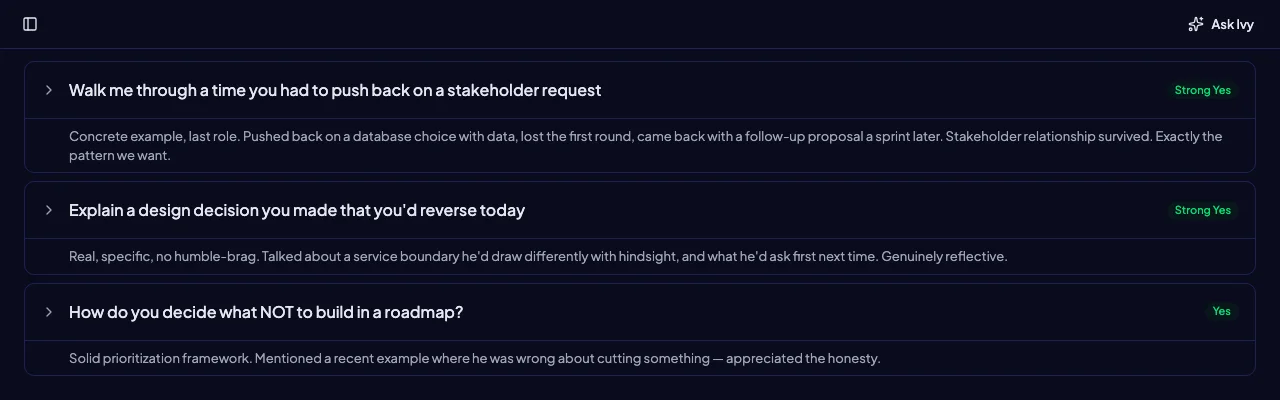
- Keep the criterion. Record the role requirement and the interview task or question that tested it.
- Keep the observation. Save the candidate's example, the interviewer's rating and any uncertainty or disagreement.
- Keep the decision. Note which evidence changed the panel's view and which gaps the team expected to coach after hire.
Key takeaway: Treat the interview record as a hypothesis about job performance. The later review tests that hypothesis; it does not turn a score into a prediction by itself.
If your panel is still deciding how to make ratings comparable, start with our guide to scoring candidates fairly. Its rubric approach gives the outcome review a clearer starting point than a collection of unanchored impressions.
Use a lightweight worksheet at the outcome review
One row per hire and criterion is enough to start. Store employee outcome notes in the system your people team uses for performance reviews, with access appropriate to that information. Bring only the comparison needed for a hiring-process review into the discussion. Intervy supplies the interview-side evidence; this worksheet is a team practice, not an automatic Intervy quality-of-hire report.
| Worksheet field | Question to answer |
|---|---|
| Role and review window | Which job and time period are we evaluating? |
| Success criterion | What did good performance mean before hiring? |
| Interview evidence | What example and rating supported the decision? |
| Observed outcome | What work or behavior can the manager point to now? |
| Context | Did onboarding, scope or resources change the opportunity to succeed? |
| Next action | Keep the criterion, revise a question, or improve support? |
Consider a fictional customer success hire. The panel rated their onboarding plan highly because they identified handoff risks and proposed a clear first meeting. At the agreed review, the manager records whether the hire actually ran clear handoffs, along with the accounts and support they were given. A mismatch may indicate that the interview exercise missed a crucial part of the job; it may also point to a changed workload or weak onboarding.
Tip: Ask the manager for a concrete example before assigning an outcome rating. Write down "not yet observable" when a criterion has had no fair test.
For an initial review, the point is to learn where the interview process gathered useful evidence. Avoid blending the fields into a single precise-looking index before the team agrees what each outcome means and how missing data is handled.
Segment the results and keep the limits visible
Review similar roles together. The same result can mean different things for a first sales hire and an established engineering team. Then look at candidate source within each role group, when the sample is large enough to say anything useful. Intervy records candidate source and lets teams filter candidates by it, which can help assemble the interview-side context; the outcome comparison remains a separate review.
Ashby's September 2026 report found that scores were broadly similar across inbound, sourced and referred hires in its dataset. That finding is a reason to check your own context, not a reason to favor a channel automatically. A source pattern might reflect the jobs filled, interview process, manager expectations or support after joining.
- Show the counts. Put the number of hires and completed reviews next to every comparison.
- Keep distributions. Averages can hide a mix of strong and weak outcomes; inspect the underlying cases.
- Separate missing outcomes. Early exits and overdue reviews can distort the result when excluded.
- Look for alternative explanations. Onboarding quality, manager changes and role redesign may explain a mismatch.
Key takeaway: A small group of hires can suggest questions for a team discussion. It rarely justifies declaring one interviewer, source or score pattern predictive.
The Ashby analysis also compares interview scorecards with later manager ratings. It reports an association in its customer data, while noting that some people may leave before a later survey is completed. That limitation matters whenever you try to infer hiring quality from the hires who remain available to rate.
Close the feedback loop without chasing a perfect score
Review the worksheet with talent and hiring managers on a regular schedule. Pick one process change at a time: sharpen a criterion, replace a weak question, improve interviewer guidance, or make onboarding support more explicit. At the next review, ask whether the change produced clearer evidence and whether the outcome measure still fits the role.
Keep speed alongside quality, not inside the same score. Our time-to-hire benchmarks guide helps teams see where a process slows down. A faster pipeline is useful, but the later outcome review answers a different question about the decision and the support that followed it.
- Before interviews: agree on role outcomes and evidence anchors.
- At decision: save examples, ratings, concerns and the reason for the choice.
- After joining: review observable outcomes at the chosen window.
- At calibration: compare similar cases and change one part of the process.
Tip: Begin with one role family and one review window. A modest, repeatable worksheet will teach more than a broad metric that nobody can explain.
You can use Intervy to organize the role criteria and interview record that start this loop. The quality-of-hire conversation happens when your team returns to that evidence after seeing the work itself.