Recruiter Interview Questions for Talent Advisory Skills
On this page
- Choose recruiter interview questions around the actual job
- Recruiter interview questions for intake disagreement
- 1. A hiring manager insists on an exact industry background. How would you challenge the requirement?
- 2. Two interviewers describe different priorities for the same vacancy. What do you do before sourcing?
- Test sourcing evidence and trade-offs
- 3. Your shortlist is small. How would you decide whether to broaden the search or change the outreach?
- 4. A referral channel fills roles quickly but reaches a narrow network. How would you advise the team?
- Assess stakeholder communication under pressure
- 5. A manager asks for a recruiting update. What would you include beyond activity counts?
- 6. A senior stakeholder wants to reject someone for vague culture fit. How would you respond?
- Protect candidate trust when answers are uncertain
- 7. A candidate asks whether the role is remote, but the team has not decided. What do you say?
- 8. A candidate says the interview process changed without warning. How do you repair trust?
- Probe AI judgment and accountability
- 9. An AI sourcing summary claims a candidate lacks a required skill. What do you check before acting?
- 10. A manager wants an AI-written rejection explanation sent immediately. What would you review?
- Compare the evidence and prepare your next interview
Recruiter interview questions should help you decide whether someone can advise a hiring team when the brief is uncertain, evidence is incomplete, or a candidate needs an honest answer. This bank is for talent acquisition leaders hiring recruiters. Use it to examine the decisions behind a polished recruiting story.
TL;DR: Ask recruiters to challenge a requirement, interpret sourcing evidence, advise a stakeholder and protect candidate trust. These ten fictional scenarios include reference-answer signals and probes; compare the reasoning against agreed job criteria rather than expecting a memorized script.
Choose recruiter interview questions around the actual job
Start by naming the advisory work your recruiter will own. A high-volume recruiter and a specialist search recruiter may need different sourcing depth, but both should be able to explain a recommendation and its limits.
In its September 2026 Hiring Assistant 2 announcement, LinkedIn describes growth in strategic talent acquisition roles on its platform. That vendor observation provides context for this bank; it does not establish a growth rate for every employer or prove that using AI improves hiring.
- Agree the evidence. Select scenarios that resemble the work and define what a useful answer must demonstrate before interviewing.
- Keep the comparison consistent. Ask the same core questions and allow comparable clarification time. Use probes to investigate missing reasoning.
- Accept different paths. The reference answers below are signals to listen for, not the only correct wording. Ask experienced recruiters for an anonymized example; accept a hypothetical response when the scenario is unfamiliar.
Tip: Use the hiring intake meeting guide to clarify the outcomes behind the vacancy before choosing questions for the recruiter who will support it.
Recruiter interview questions for intake disagreement
These questions test whether the recruiter can turn a disputed preference into an evidence-seeking conversation. Listen for respectful challenge and a way to reach a decision, rather than automatic agreement or confrontation.
1. A hiring manager insists on an exact industry background. How would you challenge the requirement?
- Reference answer signals: Ask which first-quarter outcome depends on that background and what failure the manager fears. Separate essential knowledge from learnable context, propose equivalent evidence from adjacent sectors, and agree a small review of representative profiles before changing the search. Record who decides and when to revisit.
- Probe: What evidence would make you keep the restriction?
- Watch for: Treating the manager’s preference as either untouchable or automatically wrong. Neither response establishes what the role requires.
2. Two interviewers describe different priorities for the same vacancy. What do you do before sourcing?
- Reference answer signals: Ask each for concrete work outcomes, then bring the conflicting priorities into one intake discussion. Agree essential criteria, evidence to assess them and unresolved decisions with an owner. Confirm the brief back to both stakeholders; do not silently choose the more senior opinion.
- Probe: How would you proceed if they cannot agree today?
Tip: Ask what would change the recruiter’s mind. Challenge without a condition for reconsideration can become another inflexible preference.
Test sourcing evidence and trade-offs
An activity total is only a starting point. Ask the recruiter to explain what they would inspect, which uncertainty matters and what evidence would change their recommendation.
3. Your shortlist is small. How would you decide whether to broaden the search or change the outreach?
- Reference answer signals: Inspect the funnel by source and stage: eligible profiles, contacts, responses and qualified conversations. Check a sample against the agreed criteria. Distinguish scarce fit from poor reach or weak messaging, then test one change with a review date and explain the quality-versus-speed trade-off.
- Probe: What result would cause you to stop the experiment?
- Watch for: Changing several variables at once, then declaring success from a few positive replies without checking qualification.
4. A referral channel fills roles quickly but reaches a narrow network. How would you advise the team?
- Reference answer signals: Keep role-relevant evidence consistent while comparing source coverage, stage conversion and missing populations where data can appropriately be used. Explain that fast hiring alone does not establish a sound channel mix. Propose complementary outreach, review burden and a bounded evaluation rather than an unsupported quota or abandoning a useful source.
- Probe: What would you report when the sample is too small to compare?
Tip: A strong sourcing recommendation names the trade-off and a review point. It does not need to pretend that a small sample supports a precise forecast.
Assess stakeholder communication under pressure
A useful adviser can translate incomplete recruiting evidence into a decision a manager can act on. Ask for the words the recruiter would actually use, then examine what happens if the stakeholder disagrees.
5. A manager asks for a recruiting update. What would you include beyond activity counts?
- Reference answer signals: Summarize progress against the agreed requirements, the strongest available evidence, bottlenecks and uncertainty. Recommend a next action with its trade-off, owner and decision date. Keep candidate details limited to what the stakeholder needs; distinguish a forecast from a commitment.
- Probe: Give the update in three sentences.
6. A senior stakeholder wants to reject someone for vague culture fit. How would you respond?
- Reference answer signals: Ask for the observed behavior and its connection to an agreed job requirement. Separate missing evidence from a demonstrated concern, compare the same criteria across candidates and propose a focused follow-up if justified. Document the reason and use the appropriate escalation path if the objection remains unsupported.
- Probe: What would you say directly to the stakeholder?
- Watch for: Replacing one vague label with another, or presenting a private disagreement as a settled hiring decision.
Tip: Require a concrete recommendation, an owner and a next decision. A polished status update can still leave the stakeholder unsure what to do.
Protect candidate trust when answers are uncertain
Use these scenarios to examine whether the recruiter distinguishes a confirmed commitment from an unresolved decision. Treat the candidate as someone making a consequential choice, rather than a person to keep in the funnel at any cost.
7. A candidate asks whether the role is remote, but the team has not decided. What do you say?
- Reference answer signals: State what is confirmed and what is unresolved without implying a promise. Ask what the candidate needs to make an informed choice, get a named owner to resolve the policy and agree when to update them. If that date passes, communicate the delay instead of going silent.
- Probe: Draft the next update when you still have no decision.
8. A candidate says the interview process changed without warning. How do you repair trust?
- Reference answer signals: Acknowledge the specific change and its impact, explain the confirmed reason without blame, and clarify the remaining steps and time commitment. Offer feasible options without implying the candidate must accept. Agree the next communication and take the inconsistency back to the team.
- Probe: What if the candidate chooses to withdraw?
- Watch for: Promising a shorter process without authority to change it, or blaming the hiring manager to deflect responsibility.
Tip: Give credit for a clear statement of uncertainty and a credible next update. Do not reward reassurance that depends on an unconfirmed promise.
Probe AI judgment and accountability
These scenarios concern a recruiter’s judgment when using tools permitted by their organization. They are editorial interview exercises, not descriptions of automatic checks or messaging in Intervy.
9. An AI sourcing summary claims a candidate lacks a required skill. What do you check before acting?
- Reference answer signals: Check the original evidence and whether the requirement is job-related. Treat absent information as unknown rather than proof of inability, and use a consistent clarification opportunity. Check tool-use policy and permitted data before further processing; the recruiter remains accountable for the recommendation and records corrections.
- Probe: How would you handle conflicting evidence in the CV?
- Watch for: Treating a missing keyword as proof of missing capability, or accepting a confident summary without examining its basis.
10. A manager wants an AI-written rejection explanation sent immediately. What would you review?
- Reference answer signals: Verify that the stated reasons match the actual decision and approved evidence, remove invented feedback and unnecessary personal data, and check tone and policy before sending. Explain uncertainty or escalate if the decision rationale is unsupported. AI can draft wording; it cannot supply a reason the team never established.
- Probe: Which sentence would make you stop the send?
Tip: Separate writing assistance from decision authority. Ask who checks the evidence and who remains accountable if the draft is wrong.
Compare the evidence and prepare your next interview
After the interview, record the observed reasoning before discussing an overall recommendation. Use a simple worksheet: the job criterion, the candidate’s answer, the trade-off they identified and any evidence still missing. This worksheet is advice for your team; it is not a built-in task or handoff workflow.
- Insufficient evidence: The answer repeats a principle, such as “communicate clearly,” without explaining an action or decision.
- Usable evidence: The recruiter identifies a relevant action, explains the reason and names a next step.
- Stronger evidence: The recruiter also tests assumptions, weighs alternatives and explains when new evidence would change the recommendation.
These are illustrative discussion anchors, not a validated selection scale. Keep missing evidence separate from negative evidence, and avoid treating confidence, familiar terminology or agreement with you as proof of skill. The interviewer training practice plan can help your team rehearse this distinction before interviewing.
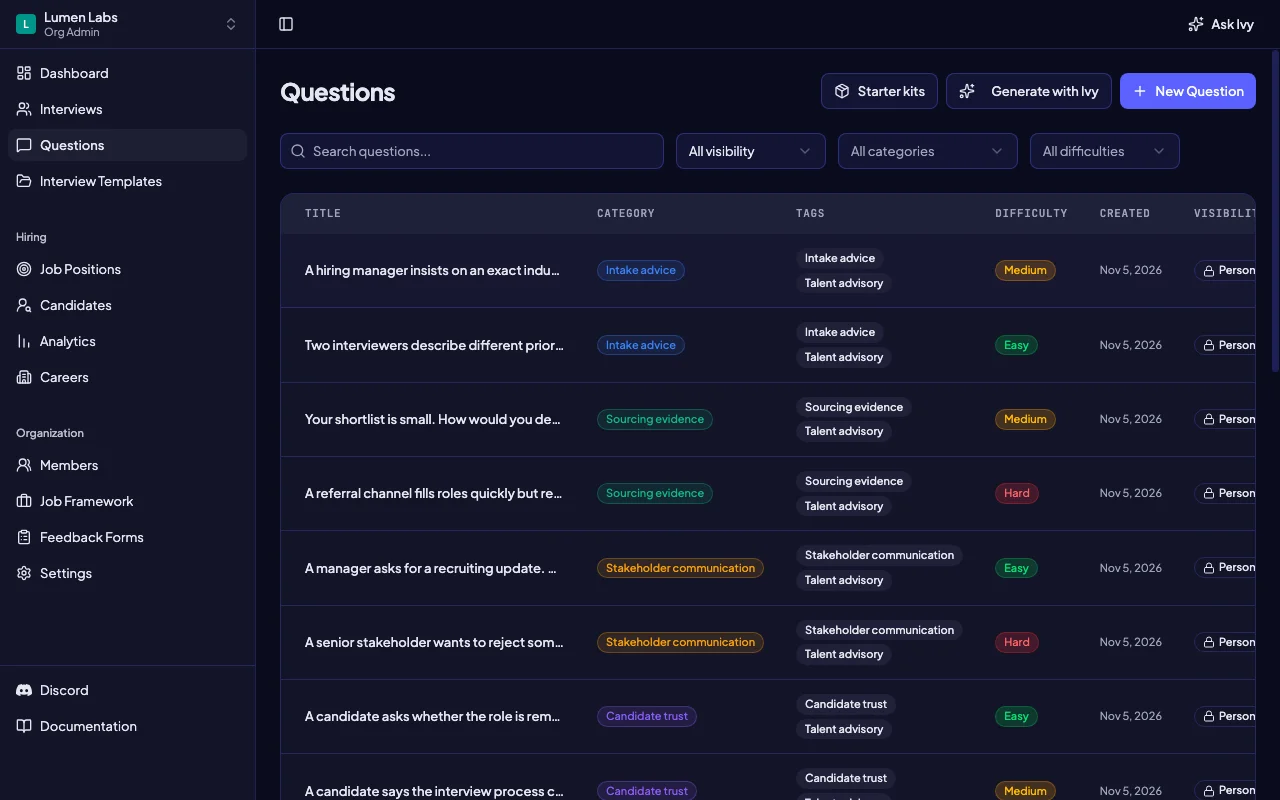
You can use a structured interview tool to keep the selected prompts and reference signals together. If your team uses an interview scoring tool, agree the job criteria and evidence expectations before assigning ratings; a number alone does not explain a hiring recommendation.
To use this bank in Intervy, open the Import section and select “Recruiter Talent Advisory” in Sample Interview Data to load all 10 questions. Importing requires organization membership and permission to both update and publish questions; ask an organization admin if your role lacks either. The same update permission lets you adapt the questions manually. The sample provides prompts, probes and reference answers, rather than automatic policy checks or automated candidate communication.
Key takeaway: Hire for the quality of the recruiter’s advice: what they verify, how they explain trade-offs, and how they communicate what they do and do not know.