Hiring Funnel Stages: From Application to a Clear Hire
On this page
- Give each hiring funnel stage a decision
- Make Applied and In Review evidence-led
- Applied: assign the first review
- In Review: close specific evidence gaps
- Separate an offer decision from a hire
- Offer: agree what is being decided
- Hired: finish the handoff
- Calculate hiring funnel conversion with clear denominators
- Use benchmarks as scoped context
- Investigate drop-offs before changing the process
- Run a short weekly funnel review
Your hiring funnel should help you answer a practical question: what needs to happen before this application can move forward? For a hiring manager or founder, a useful funnel connects each stage to an owner, a decision and evidence. The percentages come after those definitions, so everyone knows what they are counting.
TL;DR: Use Applied → In Review → Offer → Hired as broad application stages, with explicit evidence and communication owners. Calculate conversions within the same group of applications, and separate candidates still progressing from confirmed rejections or withdrawals.
Give each hiring funnel stage a decision
An applicant tracking system, or ATS, records applications as your team considers them. Broad ATS stages describe the application's position in that process; interview phases describe the conversations and assessments inside it. Agree on both, but avoid making a new application status for every meeting.
Intervy uses Applied, In Review, Offer and Hired as its broad application stages, with Rejected and Withdrawn as separate outcomes. Treat those labels as a shared vocabulary. They do not replace your team's responsibility to assess evidence or tell a candidate what happens next.
- Applied: An application has arrived and needs an initial review against the role requirements.
- In Review: The team is gathering and assessing evidence, which may involve several interview phases.
- Offer: The process has reached an offer decision or discussion; distinguish that from a confirmed acceptance.
- Hired: Record the completed hiring outcome according to your agreed process, with the handoff owner identified.
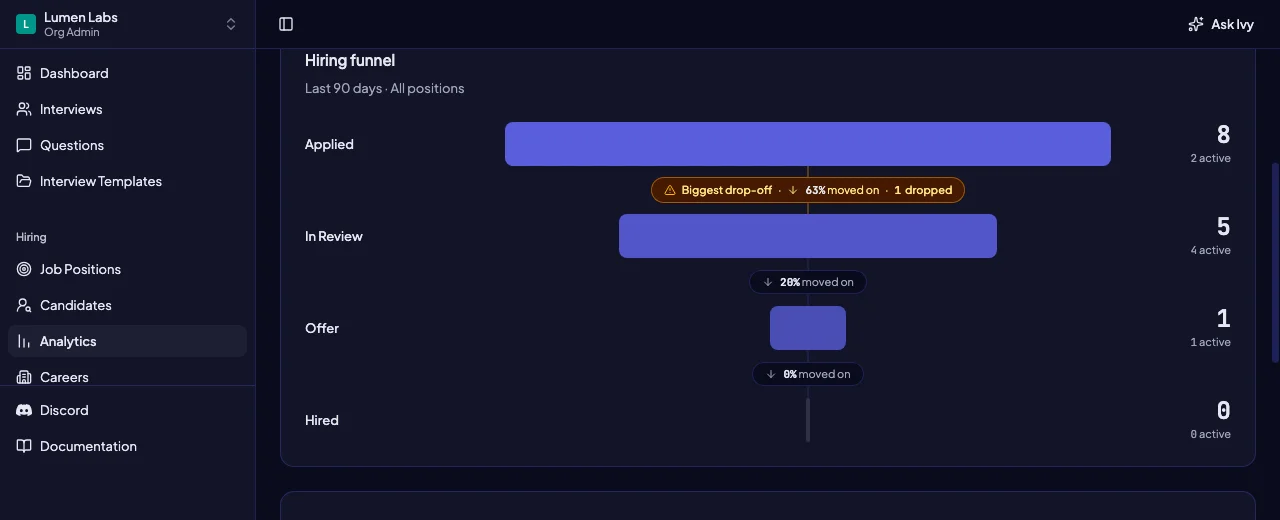
The screenshot below shows a fictional organization-wide cohort in Intervy's Analytics view. Reached counts describe how far applications have progressed within the selected application-date period; they are different from counting only the people currently sitting at each stage. Zero hires does not mean every active applicant has been lost.
Tip: Keep interview design separate from funnel reporting. Use our hiring pipeline stages guide to plan the evidence each interview phase should collect, then return here to review application-to-hire movement.
Make Applied and In Review evidence-led
Applied: assign the first review
Name one person who owns the incoming applications for a role. In a small company, that may be the founder or hiring manager; with a recruiting team, it may be a recruiter. Give that person an agreed set of essential requirements and a way to raise uncertainty rather than guessing.
For a fictional support-specialist role at Lumen Labs, an application might describe handling urgent customer requests. The reviewer should look for a concrete example of prioritization, then record what remains unclear. A polished description alone should not substitute for the job-related evidence your team agreed to collect.
- Owner: The initial reviewer checks the application and records the next decision.
- Evidence: Relevant experience or examples support a review conversation; missing evidence becomes a focused question.
- Candidate update: A named contact communicates the next step or the decision to close the application.
In Review: close specific evidence gaps
Before each interview, identify the question that meeting must resolve. For the support role, ask how the candidate would prioritize an outage, a billing question and a how-to request. Record the reasoning you actually hear, including what the answer does not establish.
- Use a scorecard. A scorecard is a shared record of criteria, evidence and ratings. Use an interview scoring tool to preserve those observations, then compare them with the role requirements. A rating without an explanation leaves the next reviewer unable to understand the judgment.
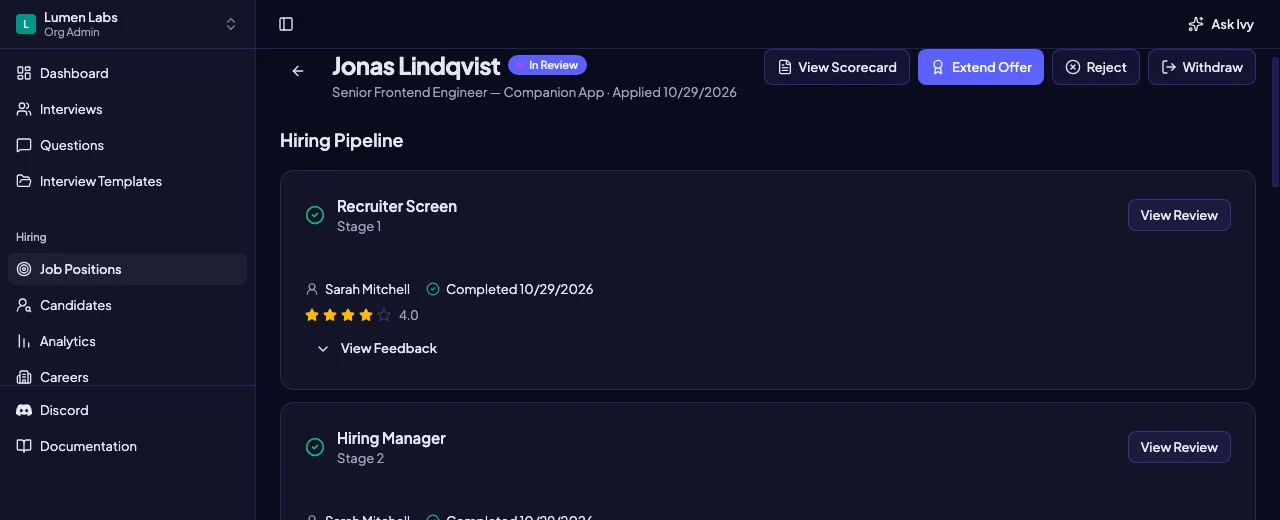
In Intervy, the application detail brings the candidate's interview phases together. The separate fictional engineering application below illustrates that record; its people and counts are independent of the support-role arithmetic later in this guide.
Key takeaway: Advance because the required evidence supports the next decision. When evidence is missing, name the gap and its owner instead of adding an unfocused extra meeting.
Separate an offer decision from a hire
Offer: agree what is being decided
Before an offer conversation, the hiring manager should review the recorded evidence and resolve material disagreements. Identify who approves the proposed terms and who speaks with the candidate. For a founder, this is also the point to confirm that the role and budget still match the business need.
Keep the team's decision to make an offer separate from the candidate's response. An application at Offer may still be awaiting a conversation, an answer or another agreed step. Write down which of those meanings your report uses before comparing offer conversion rates.
- Decision owner: The hiring manager or founder confirms the hiring recommendation and required approvals.
- Evidence: The debrief addresses the essential criteria, unresolved concerns and any relevant trade-offs.
- Communication owner: One contact explains the offer, answers questions and agrees when to follow up.
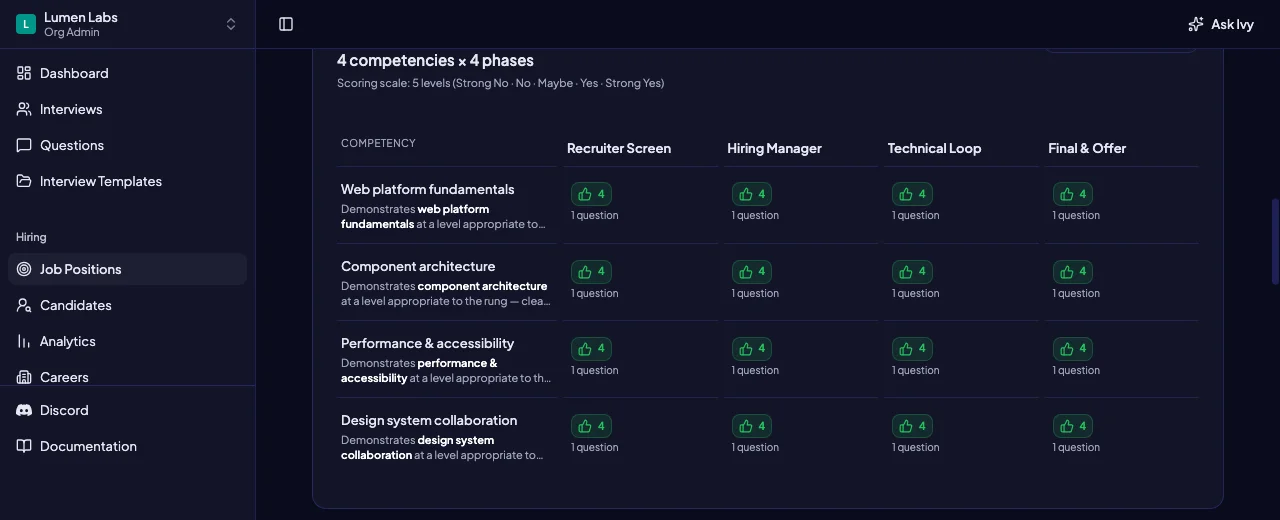
Where your plan and permissions provide scorecard access, Intervy brings recorded evaluation results together for review. The fictional matrix below illustrates completed ratings across interview phases. It records judgments; it does not establish that a candidate will perform well or make the hiring decision for you.
Hired: finish the handoff
Once the hiring outcome is confirmed, assign the handoff to the person responsible for the next steps. Confirm the agreed start arrangements through your own process and update the application record. Do not silently use “Hired” to mean “we intend to make an offer.”
Tip: Include pending offers in your review conversation. A candidate who has not responded is an unresolved outcome, even when your team would prefer a faster answer.
Calculate hiring funnel conversion with clear denominators
A cohort is a defined group of applications, such as everyone who applied for one role during a particular month. Keep that group fixed when calculating its progression. Dividing this month's hires by this month's new applications can mix people from different hiring cycles.
Here is a fictional arithmetic example, not measured Lumen Labs results, an Intervy report or a conversion benchmark. Imagine 100 applications for a support-specialist role. At the review date, 40 have reached In Review, 10 have reached Offer and 6 have been hired.
| Movement | Calculation | Conversion so far |
|---|---|---|
| Applied → In Review | 40 ÷ 100 | 40% |
| In Review → Offer | 10 ÷ 40 | 25% |
| Offer → Hired | 6 ÷ 10 | 60% |
| Applied → Hired | 6 ÷ 100 | 6% |
Those reached counts include applications that subsequently moved further. The six hires are included among the ten that reached Offer, and those ten are included among the forty that reached In Review. Do not add the reached counts together to calculate the cohort's size.
- At Applied: 50 were rejected, 5 withdrew and 5 remain active without reaching review.
- At In Review: 20 were rejected, 5 withdrew and 5 remain active without reaching offer.
- At Offer: 6 were hired, 2 declined and 2 are pending.
These outcomes reconcile to the original 100 applications. There are twelve unresolved applications: five at Applied, five at In Review and two at Offer. The difference between a stage's reached count and the next stage's reached count therefore includes active work as well as confirmed exits.
The offer numbers answer two different questions. Hires divided by all offer-stage entrants is 6 ÷ 10, or 60% so far. Among the eight resolved offer outcomes in this example, acceptance is 6 ÷ 8, or 75%; the two pending offers are excluded and must be disclosed.
Key takeaway: Put the numerator, denominator, cohort definition and review date beside each rate. If the denominator is zero, report that the rate cannot yet be calculated rather than displaying a meaningful-looking percentage.
Use benchmarks as scoped context
External benchmarks can help you ask better questions, provided their definitions match yours. Check whether the source counts applications, individual people, formal offers or offer-stage entrants. Then check whether pending outcomes are included and whether the roles and observation period resemble your own.
In Ashby's “Offer Acceptance Rates,” published June 6, 2024, the vendor analyzed 230,000 applications that reached offer stage from January 2021 through March 2024 and reported an average acceptance rate of 78%. Its method evaluates final outcomes of offer-stage entrants, accounting for organization-based rejection reasons and differences in when teams create formal offers. That historical vendor dataset is context, not a universal target or a direct comparison with a rate that includes pending offers.
- Match the population: Compare like roles and candidate sources where your data allows it.
- Match the definition: Recalculate your own rate using the source's denominator before calling a gap meaningful.
- Keep uncertainty visible: Show the underlying counts, particularly when only a few offers have been resolved.
For timing questions, use our time-to-hire benchmarks guide alongside the conversion review. Read each cited source's scope before adopting a target; neither a fast process nor a high conversion percentage alone demonstrates a sound hiring decision.
Tip: Start with a comparable earlier cohort from your own team. Record process changes and unresolved applications before interpreting a difference as improvement.
Investigate drop-offs before changing the process
A falling conversion rate identifies a question, not its cause. Separate employer rejections, candidate withdrawals and applications still waiting for a decision. Then inspect the affected records and ask the people responsible for the stage what happened.
For the fictional support role, a large Applied-to-Review difference could reflect unsuitable applications, an unclear role description or an unreviewed queue. Those explanations suggest different actions. Counting all three together as “candidate drop-off” would hide the decision you need to make.
- Review backlog: Identify applications awaiting a first review and give the owner a concrete next action.
- Missing evidence: Check whether interview questions collect what the hiring decision requires.
- Withdrawals: Review recorded reasons and candidate feedback; do not invent a motive from elapsed time.
- Pending offers: Confirm the candidate's questions and agreed follow-up before classifying the outcome.
Lever's “Recruitment Funnel Optimization Tips for TA Teams,” February 8, 2022, recommends looking at stage waiting time alongside candidate-experience and recruiting-performance measures. Treat that as operational advice, rather than proof that a particular delay caused your withdrawals.
Key takeaway: Choose a repair that fits the evidence. An application waiting on your team needs an owner and a decision; a candidate declining an offer needs a separate investigation.
Run a short weekly funnel review
Bring the hiring manager and the people who own candidate updates together around the same cohort and review date. Start with unresolved decisions, then examine confirmed exits. Use the conversation to assign work, rather than rewarding whichever percentage looks highest.
- Confirm definitions: Agree which applications and dates the report includes.
- Inspect active work: Name the next action and owner for applications awaiting progress.
- Explain exits: Separate documented reasons from assumptions and missing information.
- Choose one adjustment: State what will change, who owns it and what evidence you will review next time.
Use a structured interview tool to keep questions and observations connected to the role criteria, while retaining a human owner for each decision. Start with Intervy's hiring pipeline, then agree the evidence and candidate update needed at each stage of your own process.
Key takeaway: A useful hiring funnel ends the review with clear decisions and follow-ups. Keep its active candidates visible until their outcomes are known.