QA Interview Questions That Test Release-Risk Judgment
On this page
- Choose QA interview questions around the job
- QA interview questions for risk-based test selection
- 1. You have forty minutes before release. Which tests do you run first?
- 2. A tiny wording change shares a deployment with a checkout change. How do you scope testing?
- Investigate flaky tests without dismissing defects
- 3. A test fails once and passes on retry. What do you investigate?
- 4. A developer proposes quarantining an intermittent payment test. What conditions do you set?
- Probe API and data-integrity outcomes
- 5. How would you test that one customer cannot read or change another customer's records?
- 6. An order request times out. How do you test whether retrying duplicates the order?
- 7. A bulk update fails halfway through. What data checks do you make?
- Explore deliberately and report useful bugs
- 8. You have twenty minutes to explore a new file-upload flow. What is your charter?
- 9. Write a useful report for a save action that sometimes loses edits.
- Work through a release recommendation
- 10. A critical path is untested and the rest of the suite is green. What do you recommend?
- 11. A staged rollout shows an increase in failed saves. What do you check before expanding?
- 12. A fix passes its original reproduction. What else establishes readiness?
- Score answers against the role's seniority
- Reuse the QA Engineer sample question set
Good QA interview questions put a candidate in a decision they might actually face: a deadline is approaching, a failure is unexplained, and someone needs a release recommendation. Ask what they would test, what evidence would change their mind, and how they would explain the remaining risk.
TL;DR: Use the twelve scenarios below to assess prioritization, failure investigation, API and data integrity, exploration, and release communication. Choose a small, consistent subset for each role, probe the reasoning, and score against level-specific anchors. The accompanying QA Engineer sample set includes all twelve questions and follow-up prompts.
Choose QA interview questions around the job
Start by identifying the work this hire will own. A junior tester working within a defined plan and a senior engineer advising on release readiness need different expectations, even when they discuss the same scenario.
- Suggested interview shape: Use one prioritization scenario, one investigation scenario, one API or data scenario, and the worked release decision. Leave time for clarification and follow-up.
- Keep comparisons fair: Give candidates the same initial facts and planned probes. Record useful questions they ask rather than rewarding familiarity with your particular toolchain.
- Separate evidence from vocabulary: Ask for the observable result that would confirm a hypothesis. Naming a testing technique earns little without explaining where it applies.
Use the backend developer interview questions when you also need implementation depth.
Tip: Tell candidates that the examples are fictional and clarification is welcome. You want to observe their reasoning, not whether they guess an unstated requirement.
QA interview questions for risk-based test selection
1. You have forty minutes before release. Which tests do you run first?
Answer signals: The candidate asks what changed, which users are exposed, and what harm a failure could cause. They prioritize affected critical journeys, access boundaries, and saved data, then state which coverage they will omit. A strong answer connects each check to a risk rather than proposing an arbitrary smoke suite.
- Follow-up: What would you leave untested, and tell the release owner?
- Concern: “Run as many tests as possible” without an ordering, stopping point, or account of the missing evidence.
2. A tiny wording change shares a deployment with a checkout change. How do you scope testing?
Answer signals: Check the wording in context, but also inspect the actual deployment scope and shared dependencies. The candidate should explain why the visible size of one change does not establish the impact of the whole release.
- Follow-up: What evidence would justify reducing the scope?
- Concern: Assuming the release is low risk because the initial request sounded cosmetic.
Key takeaway: Prioritization includes a reason to stop. Look for a bounded plan with explicit omissions and a clear account of their consequences.
Investigate flaky tests without dismissing defects
3. A test fails once and passes on retry. What do you investigate?
Answer signals: Preserve the first failure's trace, logs, inputs, and timing before rerunning. Compare isolated and parallel execution, shared data, and dependency behavior; check the user-visible outcome as well as the assertion. Ask the candidate to propose a controlled experiment that distinguishes a test problem from a product race.
- Follow-up: What evidence would distinguish a test problem from a product race?
- Concern: Treating a green retry as proof that the original failure can be ignored.
Playwright's official retry documentation classifies a retry pass as flaky. That classification describes execution results; it does not establish the cause.
4. A developer proposes quarantining an intermittent payment test. What conditions do you set?
Answer signals: Identify the behavior the test protects, preserve the failure evidence, and assess the consequence of losing that signal. A credible temporary plan has alternate coverage, a named owner, and a review deadline. Quarantine changes the suite; it does not resolve the underlying payment risk.
- Follow-up: What if the release deadline arrives before the cause is known?
- Concern: Removing the test to make the report green without telling the release owner what remains uncertain.
Tip: Push once on the candidate's favorite explanation: “What observation would show that you are wrong?” This reveals whether they are investigating or defending a guess.
Probe API and data-integrity outcomes
5. How would you test that one customer cannot read or change another customer's records?
Answer signals: Use two authorized customer contexts with distinct records, then attempt direct cross-customer reads and writes. Verify the response contains no protected information and that the attempted write leaves data unchanged. Check permitted access too: a broken endpoint that rejects everyone is not adequate evidence of correct access control.
- Follow-up: Would hiding the record in the interface establish this?
- Concern: Testing only navigation or only an unauthenticated request.
6. An order request times out. How do you test whether retrying duplicates the order?
Answer signals: Determine whether the original request committed despite the lost response. Repeat the same logical operation, including concurrent retries, and reconcile the intended effect across the order, inventory, and payment.
- Follow-up: What changes when two retries arrive together?
- Concern: Checking only the final response while ignoring duplicate business effects.
7. A bulk update fails halfway through. What data checks do you make?
Answer signals: First establish whether the contract promises all-or-nothing behavior or intentional partial completion. Force a controlled failure, reconcile every input with stored results and reported errors, then test recovery. A strong candidate distinguishes local rollback from effects in another system.
- Follow-up: What if partial completion is an intentional contract?
- Concern: Declaring success because the error message appears, without examining the resulting state.
Key takeaway: For these questions, ask candidates to name both the action and its observable consequence. “Test the API” is a starting point, not an answer.
Explore deliberately and report useful bugs
8. You have twenty minutes to explore a new file-upload flow. What is your charter?
Answer signals: Choose a focused aim, such as preserving a valid document through interruption and retry. Explore boundaries, cancellation, recovery, and understandable errors using safe synthetic files. Record observations and coverage gaps so the next tester knows what remains.
- Follow-up: How do you report what the timebox did not cover?
- Concern: Random clicking with no question to answer or notes to preserve.
9. Write a useful report for a save action that sometimes loses edits.
Answer signals: Ask for expected and observed behavior, relevant setup, build, minimal steps, frequency, and user impact. Unreliable reproduction calls for better evidence collection, not invented certainty.
- Follow-up: How do you make progress when you cannot reproduce it reliably?
- Concern: A report that says only “save is broken,” or asserts a cause the evidence does not establish.
Tip: Have the candidate write a short report during the interview. Evaluate whether another engineer could investigate it, including what they would still need to ask.
Work through a release recommendation
10. A critical path is untested and the rest of the suite is green. What do you recommend?
Use this fictional worked example: a release changes checkout retry behavior. The ordinary purchase journey passes, but the team has not checked whether a lost response followed by retry can charge twice. Ask for a recommendation before providing more facts.
A defensible answer is to hold the affected change, or reduce release scope if the team can safely exclude it, while obtaining evidence about duplicate charges. The candidate should identify who owns the final release decision.
- Evidence: Ordinary purchase passed; retry-after-lost-response behavior remains untested.
- Uncertainty: Duplicate charging is plausible but unconfirmed; customer exposure is not yet established.
- Next check: Exercise the lost-response and concurrent-retry cases, then reconcile charges and orders.
- Decision checkpoint: Return to the release owner with results, remaining limitations, and a recommendation before expanding exposure.
Follow-up: Which new evidence would change your recommendation? Look for a specific answer, such as verified exclusion of the affected change or decisive results for the missing behavior. “Everything is green now” still needs an explanation of what was tested.
11. A staged rollout shows an increase in failed saves. What do you check before expanding?
Answer signals: Compare versions across comparable users and time, segment affected journeys, inspect failures, and verify saved data. Pause expansion while investigating a credible regression and agree recovery ownership.
- Follow-up: What if aggregate success looks unchanged?
- Concern: Expanding solely because the headline metric remains within a broad target.
12. A fix passes its original reproduction. What else establishes readiness?
Answer signals: Verify the original failure on the fixed build, then inspect neighboring behavior the fix could change. Depending on the mechanism, check stored outcomes, permissions, and recovery. Stop when identified risks have decisive evidence and remaining uncertainty is explicitly accepted.
- Follow-up: When would you stop adding tests?
- Concern: Either calling one passing reproduction complete or demanding unlimited regression without a risk rationale.
Key takeaway: A useful release recommendation states what is known, what is uncertain, what action is proposed, and who decides. Confidence without those details is difficult to evaluate.
Score answers against the role's seniority
Use the following anchors as a proposed rubric, adapting them before the first candidate. Score prioritization, investigation, outcome verification, and communication separately.
| Anchor | Junior expectation | Mid-level expectation | Senior expectation |
|---|---|---|---|
| Below expectation | Cannot describe a relevant check even with clarification | Lists checks but cannot connect them to risk or distinguish hypotheses | Makes a release claim without accounting for critical uncertainty or ownership |
| Meets expectation | Executes relevant checks, records results, and escalates uncertainty | Independently prioritizes, investigates competing causes, and verifies resulting state | Integrates technical evidence, exposure, recovery options, and decision ownership |
| Strong evidence | Explains expected outcomes and improves the report after a probe | Designs a discriminating experiment and revises the plan when evidence changes | Challenges assumptions, bounds residual risk, and defines evidence that would change the recommendation |
- Write the observation: “Preserved the failing trace and proposed an isolated comparison” is more useful than “good debugger.”
- Calibrate the bar: Do not require a junior candidate to own a company-wide release decision. Do require them to recognize when they need help.
- Review independently: Record your assessment before discussing the candidate with other interviewers.
Use the guide to scoring candidates fairly to prepare your broader rubric. These anchors supply the QA-specific evidence to discuss within it.
Tip: Keep a candidate's revised answer after a follow-up alongside the original. Improvement with a prompt and independent recognition are different observations.
Reuse the QA Engineer sample question set
For your next interview, pick the scenarios that match the role and agree on the anchors first. Use your technical interview preparation tool to organize that choice.
In Intervy, an authorized question publisher can open the Import section and select QA Engineer in the Sample Interview Data card to load all 12 questions, reference answers, follow-ups, and the accompanying interview template. To keep a downloadable copy, use Export Questions after loading the set. Check the resulting question library before your interview.
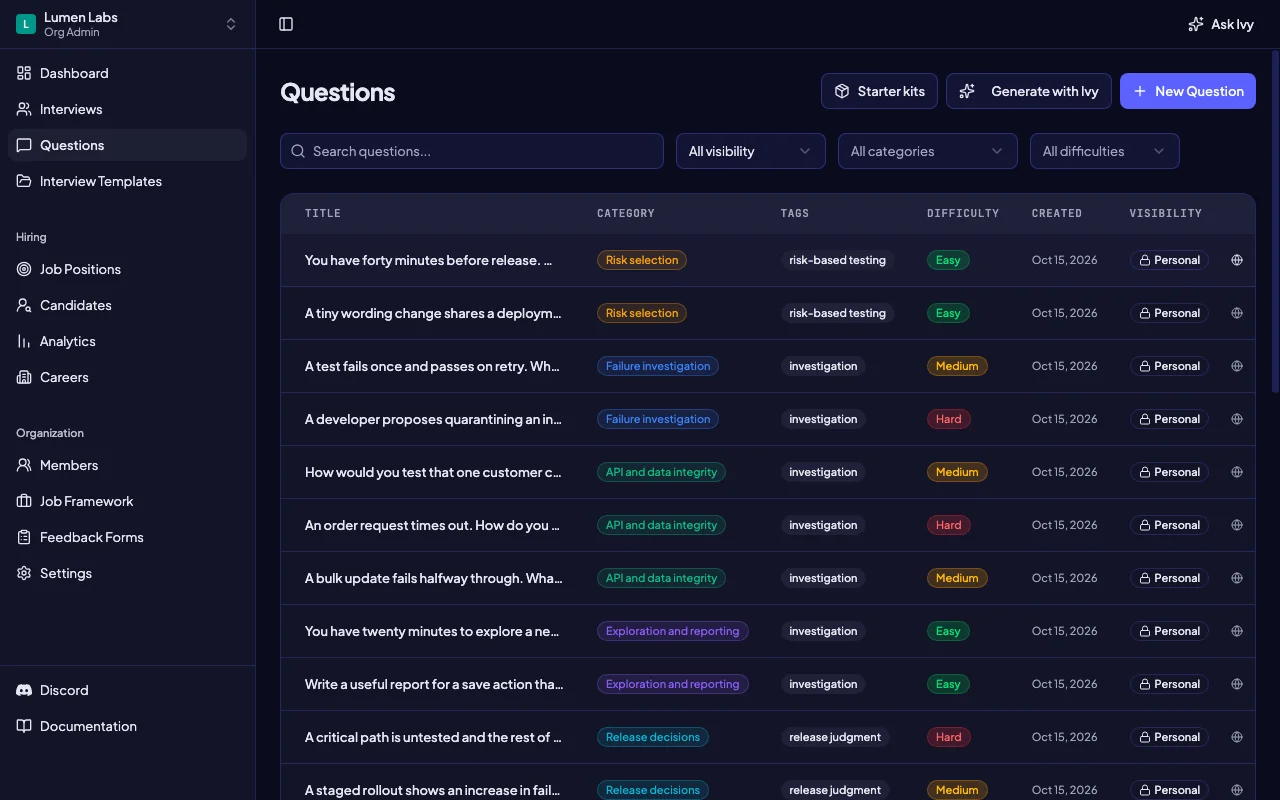
- Choose your subset: Use the template as a starting bank rather than trying to ask all twelve scenarios in one sitting.
- Agree on evidence: Share the planned probes and role-level anchors with interviewers.
- Record limitations: Keep missing evidence visible when the panel makes its recommendation.
Key takeaway: Use your structured interview tool to keep the questions consistent. Keep the hiring judgment tied to observed reasoning, relevant outcomes, and acknowledged uncertainty.