Data Analyst Interview Questions for Business Judgment
On this page
- Choose data analyst interview questions around the decision
- Data analyst interview questions with answer signals
- 1. A manager asks whether onboarding improved. What metric would you define?
- 2. Revenue rose while conversion fell. Is the business healthier?
- 3. Some orders have no acquisition channel. Would you exclude them?
- 4. Your customer table has repeated email addresses. How would you count customers?
- 5. Conversion improves in each device segment but falls overall. Can both be true?
- 6. A randomized test reports conversion of 10% versus 11%. What does that tell you?
- 7. A test wins among users who clicked the new feature. Should you ship?
- 8. The overall test is inconclusive, but one of twenty segments looks positive. What next?
- 9. Finance reports fewer paid customers than your dashboard. How do you resolve it?
- 10. A leader wants to cut a channel because its dashboard return is lowest. What do you recommend?
- Anchor the score to observable reasoning
- Import the question bank and prepare your interview
Good data analyst interview questions reveal how a candidate turns an unclear request into a defensible recommendation. Ask them to define the decision, inspect the evidence and explain what remains uncertain before they reach for SQL.
TL;DR: Use the ten scenarios below to assess metric definition, messy-data investigation, experiment interpretation and stakeholder communication. Score the reasoning against shared anchors, then import the companion question set for your next interview.
Choose data analyst interview questions around the decision
Treat these questions as a bank, not a ten-question speed round. For a suggested 45-minute interview, reserve five minutes for context, thirty for four scenarios and ten for questions and explanation. Choose one scenario from each competency and keep the core prompts consistent across candidates for the same role.
- Set the context. State the business model, available data and decision deadline. Let candidates ask clarifying questions without making them guess your preferred metric.
- Accept different tools. A sketch, spreadsheet or SQL query can all expose reasoning. Evaluate the business definition before syntax; use our SQL interview questions for a separate database-skills assessment.
- Record observations. Write what the candidate checked, assumed and recommended. Use a structured interview tool to organize your prompts and an interview scoring tool to retain evidence against your agreed criteria.
Tip: All numbers and situations below are fictional interview exercises. The suggested answers are signals to investigate, not scripts a candidate must recite.
Data analyst interview questions with answer signals
For each question, ask the opening prompt before the follow-up. An alternative answer can earn a strong score when its assumptions are explicit and its checks support the recommendation.
1. A manager asks whether onboarding improved. What metric would you define?
Clarify the decision: keep or revise onboarding. Define seven-day activation as eligible new accounts completing a specified meaningful action within seven days, divided by eligible new accounts with seven full days of observation. State account versus user grain, signup cohort, exclusions and time zone. Compare mature cohorts; pair activation with a guardrail such as support burden.
- Follow-up probe: What changes if new accounts have not had a full week to activate?
- Answer signal: Defines eligible cohorts, action and observation window. Connects the metric to the decision and tests whether the action reflects customer value.
- Weak signal: Names a denominator but ignores immature cohorts.
2. Revenue rose while conversion fell. Is the business healthier?
Define conversion per eligible visitor or account and revenue net of refunds over a consistent window. Inspect traffic mix, order value, repeat purchases and margin before judging health. State which business decision the analysis informs; rising revenue alone cannot establish improved acquisition quality.
- Follow-up probe: Which additional breakdown would change your recommendation?
- Answer signal: Checks definitions and separates volume from value. Identifies a mix explanation and a decision-relevant guardrail.
- Weak signal: Chooses revenue as the winner without defining either measure.
3. Some orders have no acquisition channel. Would you exclude them?
Measure missingness by date, device and purchase value. Compare the unknown group with known channels; determine whether tracking or attribution rules changed. Keep an explicit unknown group, show coverage and a sensitivity analysis, and avoid reallocating missing orders without evidence.
- Follow-up probe: How would you report results if the missing group is concentrated on mobile?
- Answer signal: Retains unknowns and checks where missingness concentrates. Bounds how missing attribution could change the budget decision.
- Weak signal: Drops missing records and reports precise channel performance.
4. Your customer table has repeated email addresses. How would you count customers?
Clarify whether the decision needs people, accounts or paying organizations. Inspect stable identifiers and duplicate patterns before removing records. Separate repeated events, merged accounts and legitimate shared emails; compare counts before and after a documented rule and inspect examples.
- Follow-up probe: What if a household shares an email address?
- Answer signal: Chooses a business entity and checks stable identifiers. Quantifies sensitivity to ambiguous matches and proposes review for uncertain cases.
- Weak signal: Deletes repeated emails automatically.
5. Conversion improves in each device segment but falls overall. Can both be true?
Yes: a larger share of traffic can move to a lower-converting device segment. Build a two-period table of visitors and conversions by device, reconcile totals and compare rates using fixed device weights. Report both actual aggregate performance and the standardized comparison; do not infer a redesign effect from this observation.
- Follow-up probe: Which comparison would you show before recommending a redesign?
- Answer signal: Explains the changing segment weights and reconciles totals. Separates mix from within-segment change and avoids a causal claim.
- Weak signal: Calls the dashboard wrong because the directions differ.
Microsoft Research’s 2017 paper A Dirty Dozen: Twelve Common Metric Interpretation Pitfalls in Online Controlled Experiments explains why experiment setup and metric interpretation need separate scrutiny. Apply that distinction in the next scenarios.
6. A randomized test reports conversion of 10% versus 11%. What does that tell you?
The observed difference is one percentage point, or a 10% relative increase. Ask for sample sizes, assignment unit, uncertainty interval, planned stopping rule and guardrails. Check exposure and assignment quality; the point estimate alone does not establish a reliable benefit.
- Follow-up probe: What information do you need before recommending rollout?
- Answer signal: Distinguishes absolute from relative change and asks for uncertainty. Checks experimental validity and practical value before choosing an action.
- Weak signal: Treats the point estimate as proof of a winner.
7. A test wins among users who clicked the new feature. Should you ship?
Clicking happens after assignment and can select different types of users between variants. Start with the pre-specified analysis of all assigned eligible units, checking exposure and missing outcomes. Treat the clicked-user comparison as exploratory; define a future experiment if that subgroup is the actual target.
- Follow-up probe: Would comparing all randomly assigned users change your answer?
- Answer signal: Identifies selection after assignment. Explains a valid primary comparison and a separate hypothesis for follow-up.
- Weak signal: Ships from the clicked-user result alone.
8. The overall test is inconclusive, but one of twenty segments looks positive. What next?
Ask whether the segment and analysis were pre-specified, how many comparisons were explored and whether there is evidence of differing effects. Report uncertainty and guardrails, avoid promoting an exploratory result to a confirmed win, and plan a powered confirmation if the business value warrants it.
- Follow-up probe: What if that segment was specified before the test?
- Answer signal: Flags multiple comparisons and distinguishes exploration from confirmation. Tests the interaction question and proposes a proportionate confirmation decision.
- Weak signal: Declares the positive segment a proven winner.
9. Finance reports fewer paid customers than your dashboard. How do you resolve it?
Reconcile definitions, customer grain, reporting cutoff, time zone, refunds, cancellations and refresh time. Trace a small matched sample of differing records, then quantify each cause. Tell leadership which decision is affected, which definition each figure answers, and when reconciliation will finish; defer an irreversible decision if uncertainty is material.
- Follow-up probe: The leadership meeting starts in an hour. What do you say now?
- Answer signal: Reconciles definitions and checks actual differing records. Communicates a bounded interim recommendation with an owner and update time.
- Weak signal: Chooses the larger number or blames another team.
10. A leader wants to cut a channel because its dashboard return is lowest. What do you recommend?
Check costs, attribution windows, missing conversions, customer maturity and contribution margin. Observed attributed return does not establish the sales that would disappear without the channel. Recommend a reversible budget change or a suitable controlled holdout when feasible, with guardrails and a review date.
- Follow-up probe: How would you explain the difference between attribution and incremental impact?
- Answer signal: Checks comparability and distinguishes attribution from causation. Proposes an actionable, reversible next step with a decision threshold.
- Weak signal: Cuts the channel directly from the ranking.
Key takeaway: A strong analyst can explain what would change their recommendation. Naming a statistical method or writing a working query is only useful when it resolves the decision.
Anchor the score to observable reasoning
Use the same three anchors for each scenario, with the question-specific examples above as calibration. Agree on the expected level before interviewing; a junior analyst may need a prompt to identify a caveat, while a senior analyst should identify consequential uncertainty independently.
- 1 — Unsupported conclusion. Jumps to a recommendation, leaves the population undefined or ignores a threat that can reverse the result.
- 2 — Defensible analysis. Defines the relevant measure, performs the decisive checks and states an appropriate limitation.
- 3 — Decision-ready judgment. Meets anchor 2, quantifies or bounds uncertainty where possible, and proposes a proportionate next action with a guardrail or review point.
Score each competency separately before discussing the candidate. A polished presentation should not erase a missing denominator, and a slower explanation should not erase correct reasoning. Record which follow-up prompts you gave so the panel can distinguish independent judgment from coached answers; use our rubric guide to prepare the wider panel.
Tip: Keep the rating separate from the hiring decision. If a competency was not observed, record that gap rather than assigning a low score by default. The companion answers include these question-specific anchors for interviewer preparation.
Import the question bank and prepare your interview
The companion Data Analyst sample question set contains all 10 questions, follow-up probes, reference answers and scoring anchors. It is a new set for this article, available through the existing customer import workflow.
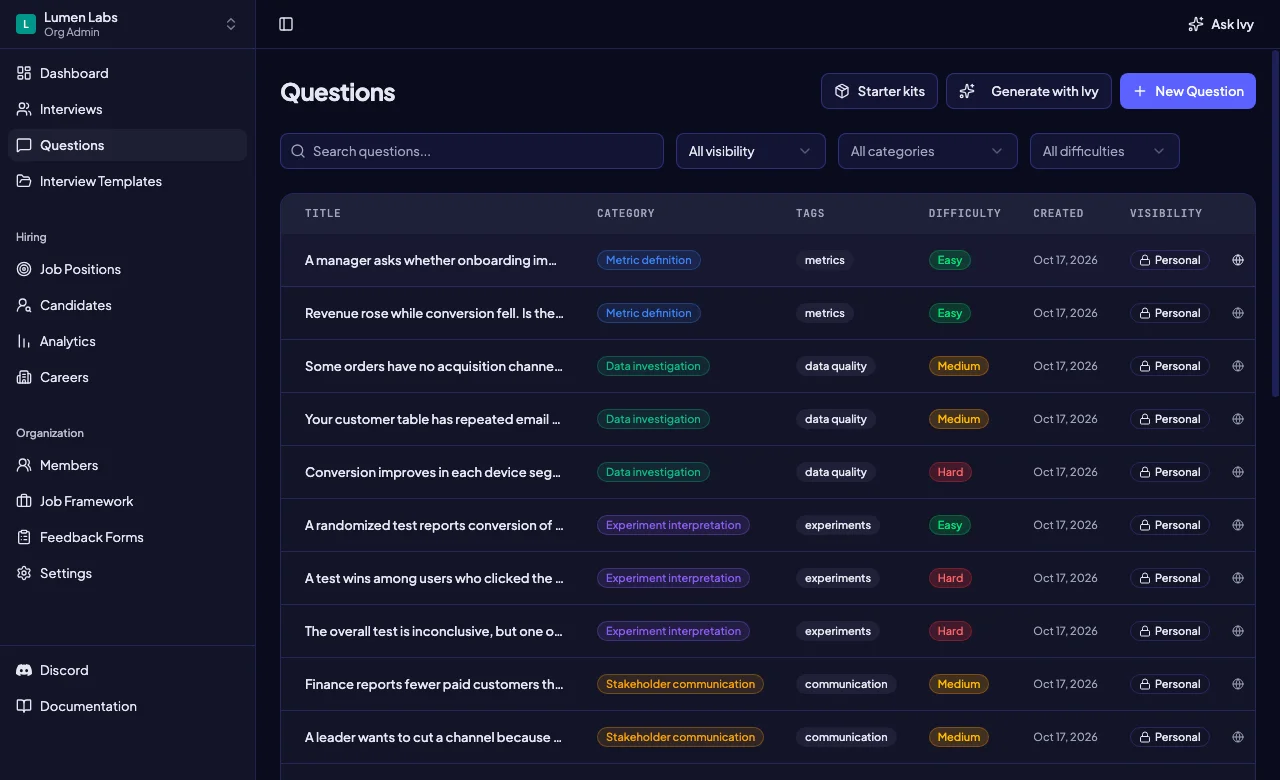
- Load the sample. Open the Import section, find Sample Interview Data, choose Data Analyst (10 questions) in Interview set, and click Load.
- Review the result. Use the success message's View questions and View templates links to inspect the imported material before an interview.
- Import your own file. In the Import card, select duplicate handling, click Import Questions, then choose a compatible previously exported JSON question file. Review the success or error message before continuing. Choose Overwrite duplicates only when you intend to replace matching question content; otherwise use Skip duplicates.
- Check permission. Importing questions requires membership in the destination organization and permission to publish questions. If your role lacks that permission, ask your organization administrator to arrange the import.
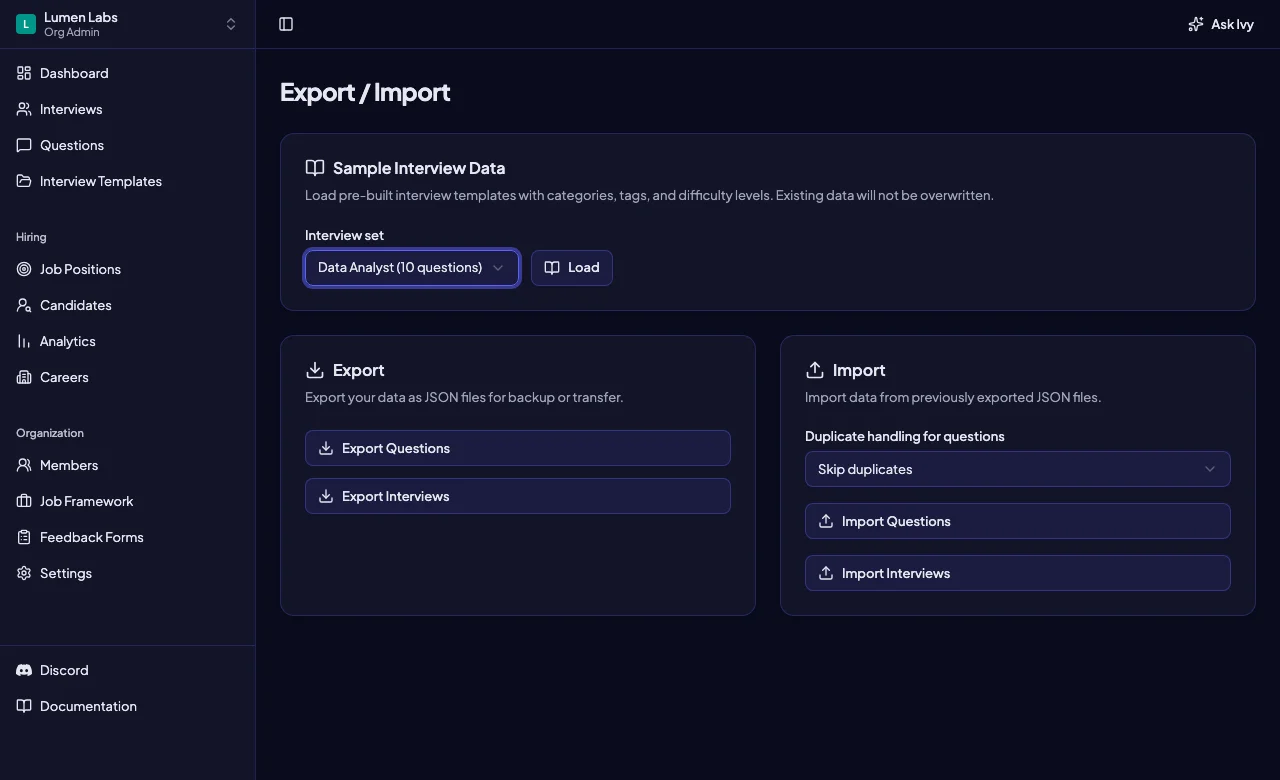
Key takeaway: Importing a bank prepares the material; it does not choose the hiring bar. Select the scenarios that match the job, agree on the anchors and review the evidence before making your recommendation.