Data Engineer Interview Questions for Real Pipelines
On this page
- Data engineer interview questions for pipeline design
- 1. Design the daily revenue pipeline
- 2. Handle an upstream contract change
- 3. Make a nightly load safe to rerun
- Data engineer interview questions for quality and freshness
- 4. Investigate a current but incorrect dashboard
- 5. Set a useful freshness alert
- 6. Decide when the incident is over
- Data engineer interview questions on SQL and modeling trade-offs
- 7. Diagnose a join that doubles a metric
- 8. Choose between a wide table and a normalized model
- AI data governance and stakeholder decisions
- 9. Assess AI search over support records
- 10. Communicate an incomplete morning number
- Score data engineer answers with shared anchors
The best data engineer interview questions reveal what a candidate does when a number is wrong and other teams need an answer. SQL fluency matters, but an operating data engineer must also protect contracts, detect incomplete data, recover a pipeline, and explain uncertainty. Use these scenarios to hear decisions and trade-offs rather than a list of tools.
TL;DR: Give every candidate the same pipeline facts and follow-up probes. Score how they define the data contract, locate a quality failure, choose a model, and communicate what can safely be trusted.
The role is changing too. In Ashby's July 2026 analysis of more than 200,000 qualifying job postings, 53% of sampled Data job descriptions since 2025 mentioned AI. That finding is a reason to ask about data governance and retrieval boundaries, not to substitute AI trivia for the fundamentals.
Data engineer interview questions for pipeline design
Start with a whiteboard or shared document. Give each candidate the same assumptions: a product emits order events, finance needs a daily revenue report by 08:00, and late events may arrive. Ask them to state what they would clarify before drawing boxes. A useful answer names the business definition of revenue and the acceptable delay before choosing a pipeline shape.
1. Design the daily revenue pipeline
Ask: “Design a pipeline for event data that powers a daily revenue report. Which contracts, stages, and failure paths would you define?”
Listen for: event identity, a documented meaning for each amount, schema change handling, a raw record to replay, validation, an atomic report update, and reconciliation against the source. Strong candidates ask whether refunds, currency conversion, and late orders belong in the daily number. They explain who owns an alert and what the report displays while data is incomplete.
Probe: “Late events can arrive for three days. How does yesterday's number change?” Look for a clear correction window and a way to distinguish a revised figure from a silently changing one.
2. Handle an upstream contract change
Ask: “An upstream team adds an optional field and changes an identifier format. How do you keep consumers safe?”
Listen for: a distinction between shape and meaning. An optional field might be compatible while a changed identifier breaks joins even when every record still validates. A strong answer tests downstream consumers with representative data, agrees a staged rollout with the source owner, and keeps a rollback path.
Tip: Give the candidate a new fact halfway through: two consumers parse the identifier as an integer. The useful signal is whether they revise the plan and identify the owners to contact.
3. Make a nightly load safe to rerun
Ask: “A load fails after writing half its output. How do you rerun it without doubling the report?”
Listen for: stable record keys, a bounded checkpoint or partition, deterministic transformation, and publication only after validation. Ask how they would test a failure halfway through. “Just rerun the job” is incomplete until they show where duplicate writes are prevented and totals are reconciled.
Data engineer interview questions for quality and freshness
A dashboard can look current while its values are wrong. These data quality interview questions separate timestamp monitoring from confidence in the actual business metric. Ask for the first hour of action before inviting a long-term redesign.
4. Investigate a current but incorrect dashboard
Ask: “Yesterday's dashboard refreshed on time, but its orders total is 18% low. Walk through your first hour.”
Listen for: confirmation against an independent source, a defined impact window, stage-by-stage counts, late arrivals, and a decision about whether to pause publication. Strong candidates name an incident owner and tell affected users when they will hear more. They backfill carefully, then verify the repaired metric before calling the incident resolved.
Probe: “The source system's own total is also low.” A capable candidate revisits the source-of-truth assumption rather than treating the pipeline as guilty by default.
5. Set a useful freshness alert
Ask: “One source is four hours late. When should the alert fire, and what should consumers see?”
Listen for: a per-source freshness expectation, the last complete period, the consumer decision at risk, and an alert that distinguishes routine lateness from an outage. A single universal threshold creates noise for slow sources and hides failures in fast ones. The candidate should say how uncertainty appears in the report.
6. Decide when the incident is over
Ask: “The freshness alert cleared. Is the incident resolved?”
Listen for: source recovery plus complete backfill, downstream reconciliation, stable monitoring, and an update to people who used the affected report. A clear alert only proves the latest arrival resumed; it does not prove yesterday's totals were repaired.
Key takeaway: A strong incident answer has three parts: what evidence is trusted, what consumers should do now, and what proof will close the issue.
Data engineer interview questions on SQL and modeling trade-offs
The SQL interview questions guide covers query fundamentals. In a data engineering interview, put SQL inside a production decision: a join changes a metric, or a model makes one consumer fast and another unreliable. The candidate should reason about grain and ownership before reaching for syntax.
7. Diagnose a join that doubles a metric
Ask: “A daily metric doubles after a dimension table is joined. What do you inspect?”
Listen for: the grain of the fact table, uniqueness of the dimension key, historical versions, missing keys, and row counts before and after the join. An as-of join or deduplicated dimension may be appropriate. DISTINCT can hide fanout while leaving the business meaning wrong; ask the candidate to show a reconciliation test.
8. Choose between a wide table and a normalized model
Ask: “When would you choose a wide reporting table over a normalized model?”
Listen for: the dominant query pattern, latency target, refresh frequency, storage cost, lineage, and consistency. A wide table may make repeated reads simpler; it can also multiply stale copies of the same field. The strongest answer defines a governed source of truth and explains how the chosen model stays correct as more teams use it.
AI data governance and stakeholder decisions
AI adds a new consumer of data, often with retrieval and retention questions. The fundamentals still apply: who may see a record, what use is allowed, and how a mistake would be detected. This is where practical judgment matters more than naming a model.
9. Assess AI search over support records
Ask: “Product wants AI search over customer support records. What data-governance questions come first?”
Listen for: data classification, allowed use, sensitive content, retrieval permissions, retention, deletion, leakage tests, and an owner for review. A credible candidate may suggest a limited pilot with redacted records and explicit failure criteria. They should test whether a user can retrieve a record they are not allowed to read.
10. Communicate an incomplete morning number
Ask: “A stakeholder needs the morning number now, but the pipeline is incomplete. What do you publish?”
Listen for: the last complete period, an honest confidence statement, and a next update time. A clearly labelled provisional number may help some decisions; a partial value presented as final can make the situation worse. Ask what changes if an executive presentation starts in ten minutes.
Score data engineer answers with shared anchors
Before the interview, select the scenarios that match the role and agree what evidence would count as a strong answer. Ask the same core prompt of each candidate, record examples in their own words, then use follow-ups to test depth. A structured interview tool helps preserve that comparison when several interviewers meet different candidates.
| Score | Observable answer signal |
|---|---|
| 1 — weak | Jumps to a product or command, assumes data is correct, or gives no verification path. |
| 2 — developing | Names a plausible fix but misses scope, ownership, or downstream impact. |
| 3 — solid | Clarifies assumptions, proposes a workable sequence, and verifies the result. |
| 4 — strong | Handles failure and replay, names trade-offs, and communicates uncertainty. |
| 5 — exceptional | Changes the plan as facts change, prioritizes business impact, and defines evidence for closure. |
Use the anchors across the scenarios, then note role-specific strengths. A junior candidate may demonstrate sound diagnosis without having owned a large platform. For a senior hire, expect explicit contracts, rollback or replay, and stakeholder choices under uncertainty. The backend interview guide offers adjacent service-design prompts when the role owns both application and data boundaries.
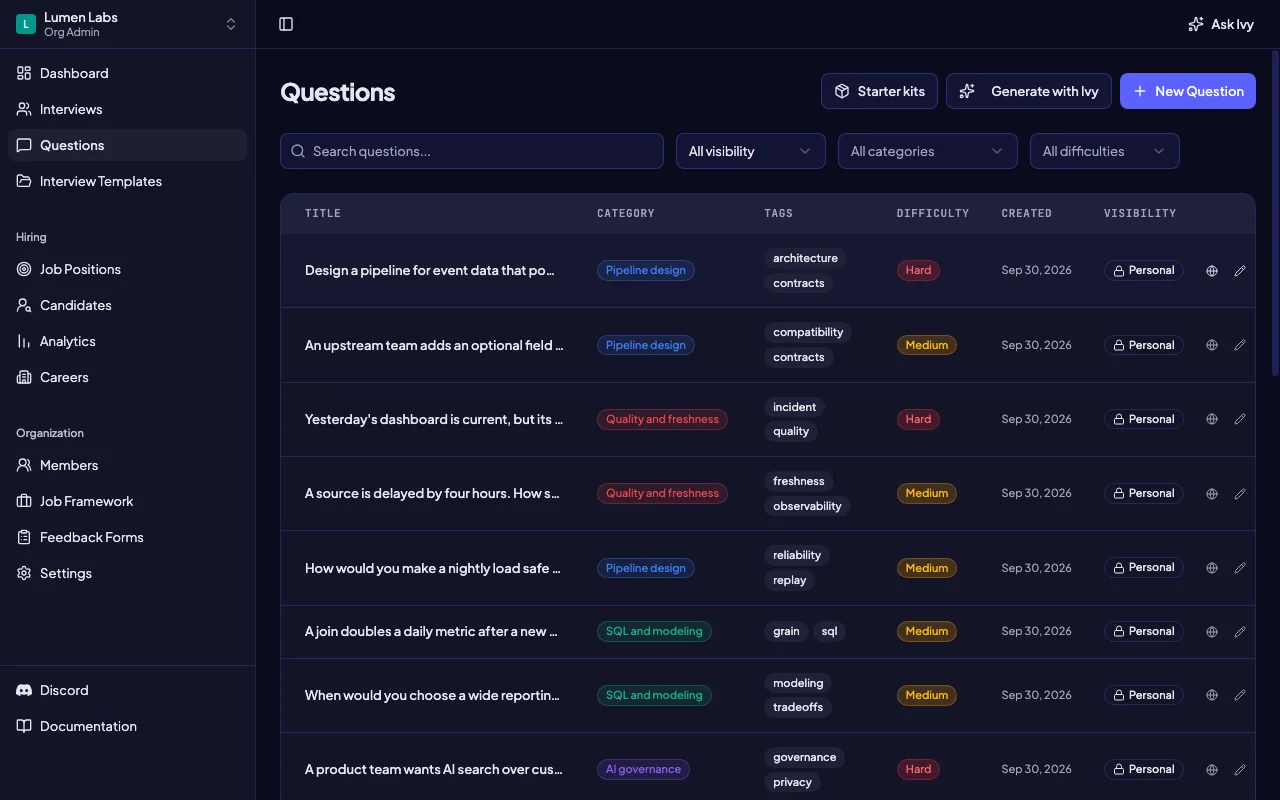
In Intervy, you can organize prompts by category and difficulty, build an interview template, and record ratings with comments. That makes an interview scoring tool useful for comparing evidence after the conversation, without turning the candidate into a number.
Want a starting set? Open the Import section, choose “Data Engineer” in Sample Interview Data, and load all 10 questions into your workspace. Adapt the follow-ups and scoring anchors to the data decisions your team actually makes.