Cybersecurity Interview Questions for Real-World Judgment
On this page
- Cybersecurity interview questions for cloud threat modeling
- 1. A public cloud storage bucket exposes customer documents. What do you do in the first hour?
- 2. A deployment role asks for broad cloud permissions. How do you review the request?
- 3. Threat-model a new customer file upload workflow.
- Cybersecurity interview questions for incident response
- 4. A production workload shows unusual outbound traffic. What is your triage sequence?
- 5. Brief executives while the incident scope is still uncertain.
- 6. A teammate wants to wipe a compromised host immediately. How do you respond?
- Cybersecurity interview questions about AI and cloud trade-offs
- 7. Product wants to send support tickets to an AI provider. What do you assess?
- 8. An AI assistant can retrieve internal documents. How do you test access boundaries?
- 9. A vendor says its AI detector eliminates phishing risk. How do you evaluate it?
- Collaboration questions that expose security judgment
- 10. Engineering disagrees with your control before launch. What do you do?
- 11. An alert was ignored and the team had a near miss. What would you change?
- 12. A critical issue has no immediate fix. How do you prioritize and communicate it?
- Score cybersecurity interview questions with clear anchors
Cybersecurity interview questions should reveal how someone makes decisions when evidence is incomplete, systems are live, and other people need an answer. A candidate who can define a term may still struggle to contain an incident or explain a trade-off to engineering. These scenarios give security hiring managers concrete prompts, follow-up questions, and observable answer signals.
TL;DR: Ask the same realistic scenarios of every candidate. Listen for a clear sequence, evidence, risk trade-offs, and communication. Use the scoring anchors below to distinguish a plausible answer from sound security judgment.
The emphasis matches the hiring problem. In ISC2's April 2026 research on cybersecurity hiring, hiring managers ranked problem solving (29%), collaboration (24%), and communication (22%) ahead of AI and cloud security (15% each) when technical and nontechnical skills appeared in one list. That ranking does not make technical depth optional. It suggests an interview should test how technical knowledge becomes a decision other people can act on.
Cybersecurity interview questions for cloud threat modeling
Give the candidate a system sketch and ask them to name assumptions before proposing controls. Keep the same starting facts for every candidate; use follow-ups to see how they adapt. These cloud security interview questions measure whether they can trace data, identity, and exposure through a workflow.
1. A public cloud storage bucket exposes customer documents. What do you do in the first hour?
Listen for: confirmation without downloading customer content; a reversible access restriction; preservation of access logs and configuration history; a timeline and affected-data estimate; an incident owner. A strong answer separates immediate containment from later root-cause work and avoids guessing about customer impact.
Probe: “What evidence would change your severity assessment?” A mature answer names the decision it would change, such as whether to broaden containment or notify an additional stakeholder.
2. A deployment role asks for broad cloud permissions. How do you review the request?
Listen for: a request to identify the actual deployment actions and resources, narrower permissions, short-lived access where practical, and a way to test the role. Merely saying “least privilege” is a starting point, not a review plan.
Probe: “How would you detect permission drift six months later?” Look for review ownership and observable usage, not a one-time policy edit.
3. Threat-model a new customer file upload workflow.
Ask the candidate to draw the path from browser to storage, processing, and reviewer access. Listen for: assets, trust boundaries, abuse cases, malicious files, unauthorized reads, and prioritization of controls by likely harm. A senior candidate should identify what they need to learn from product and operations before choosing controls.
Probe: “What changes when an external reviewer can see a file?” The useful answer revisits identity, sharing duration, revocation, and auditability rather than repeating the original list.
Tip: Ask for a diagram or verbal data flow before asking for a control list. It exposes missing assumptions early.
Cybersecurity interview questions for incident response
Incident response questions should test sequence and communication under uncertainty. Tell candidates the service is live and that every action has a possible customer cost. The best answers protect evidence while reducing active harm.
4. A production workload shows unusual outbound traffic. What is your triage sequence?
Listen for: validation of the alert, identification of the workload and destination, related telemetry, scope, evidence preservation, and a containment option whose blast radius is understood. Good candidates assign an incident owner and record decisions as they go.
Probe: “What if blocking traffic also interrupts a customer service?” The candidate should explain a narrower or reversible control and name who accepts the residual risk.
5. Brief executives while the incident scope is still uncertain.
Listen for: confirmed facts, open questions, customer impact, actions in progress, an owner, and the next update time. Candidates should distinguish suspicion from confirmation and avoid promising a conclusion they cannot support.
Probe: “Now evidence confirms exfiltration. What changes in your briefing?” Look for a direct update, an impact estimate with caveats, and coordinated legal and customer communication.
6. A teammate wants to wipe a compromised host immediately. How do you respond?
Listen for: respect for the containment goal, preservation of useful evidence where feasible, and a less destructive isolation option. Strong candidates also recognize when active damage makes immediate shutdown the right trade-off and document that decision.
Probe: “What facts would make you shut it down now?” An answer tied to continuing harm is more useful than a universal rule.
Key takeaway: Incident answers should explain what the candidate would do next, what evidence they would preserve, and who needs the next update.
Cybersecurity interview questions about AI and cloud trade-offs
AI security adds unfamiliar data flows and uncertain model behavior to familiar access-control questions. Ask for a bounded assessment rather than a promise of perfect safety. These prompts also reveal whether the candidate can compare risk with product value.
7. Product wants to send support tickets to an AI provider. What do you assess?
Listen for: ticket contents, sensitive data, provider retention and access terms, data location, redaction, limited access, human review, and monitoring. A credible recommendation may be a limited pilot with explicit success and failure criteria.
Probe: “What would you measure in that pilot?” Look for both utility and leakage or error signals.
8. An AI assistant can retrieve internal documents. How do you test access boundaries?
Listen for: users with different permissions, recent access revocation, a prompt embedded in a document, and attempts to retrieve content across boundaries. The candidate should distinguish a retrieval permission failure from an unsafe generated answer and describe how they would investigate each.
Probe: “What evidence tells you the permission check failed before the model responded?” Strong answers inspect the retrieved material and request context, not only the final text.
9. A vendor says its AI detector eliminates phishing risk. How do you evaluate it?
Listen for: skepticism about an absolute claim, representative attack and legitimate samples, missed attacks, false alarms, operational load, and a comparison with existing controls. The answer should say who reviews disputed detections.
Probe: “When would false positives become more damaging than the detections are useful?” This tests whether the candidate can reason about trade-offs without a memorized benchmark.
Tip: Do not require candidates to name a particular vendor. Ask them to specify evidence that would support or weaken a recommendation.
Collaboration questions that expose security judgment
Security engineers rarely act alone. These prompts test whether a candidate can turn a risk finding into a decision with engineering, product, and leadership. Ask for a real example after the hypothetical answer when time allows.
10. Engineering disagrees with your control before launch. What do you do?
Listen for: curiosity about the delivery constraint, a specific statement of risk, options with different residual risk, and a named decision owner. A strong candidate avoids treating disagreement as proof that either team does not care.
Probe: “Who accepts the risk if you cannot agree?” Look for an escalation path and a temporary mitigation.
11. An alert was ignored and the team had a near miss. What would you change?
Listen for: a blameless timeline, review of alert quality and routing, on-call capacity, a concrete improvement, and a way to verify it. “Tell people to pay attention” is not a durable fix.
Probe: “How would you know the new escalation path worked?” A drill or measurable response target is stronger than a policy document alone.
12. A critical issue has no immediate fix. How do you prioritize and communicate it?
Listen for: exploitability, exposure, impact, compensating controls, affected owners, and a decision cadence. A senior answer makes uncertainty visible and updates the priority when new evidence arrives.
Probe: “What would make you pause a launch?” The candidate should connect that call to user harm and the limits of available mitigation.
Score cybersecurity interview questions with clear anchors
A structured interview tool helps only when interviewers share a bar. Agree on the job's scope first, choose a few scenarios, and score each answer before the panel compares impressions. Use these anchors as a starting rubric, then adjust the examples to the role's actual environment.
| Score | Observable answer |
|---|---|
| 1 — Weak | Jumps to a tool or irreversible action, misses exposure or stakeholder impact, and cannot explain the decision. |
| 2 — Developing | Identifies a relevant risk but leaves sequencing, evidence, or ownership vague. |
| 3 — Capable | States assumptions, follows a reasonable sequence, limits harm, and communicates what remains unknown. |
| 4 — Strong | Weighs alternatives, names evidence and decision thresholds, and coordinates the right owners. |
| 5 — Exceptional | Anticipates second-order effects, adapts when facts change, and turns the outcome into a measurable improvement. |
Junior signal: identifies key assets and asks useful questions, even if they need help selecting a control. Mid-level signal: owns a safe triage sequence and explains trade-offs. Senior signal: shapes decisions across teams, handles uncertainty, and creates a repeatable response. Do not penalize a candidate for lacking your exact cloud vendor's vocabulary when their reasoning is sound.
Key takeaway: Score the observed reasoning, not the number of security terms used. Record the evidence behind each rating so another interviewer can understand it.
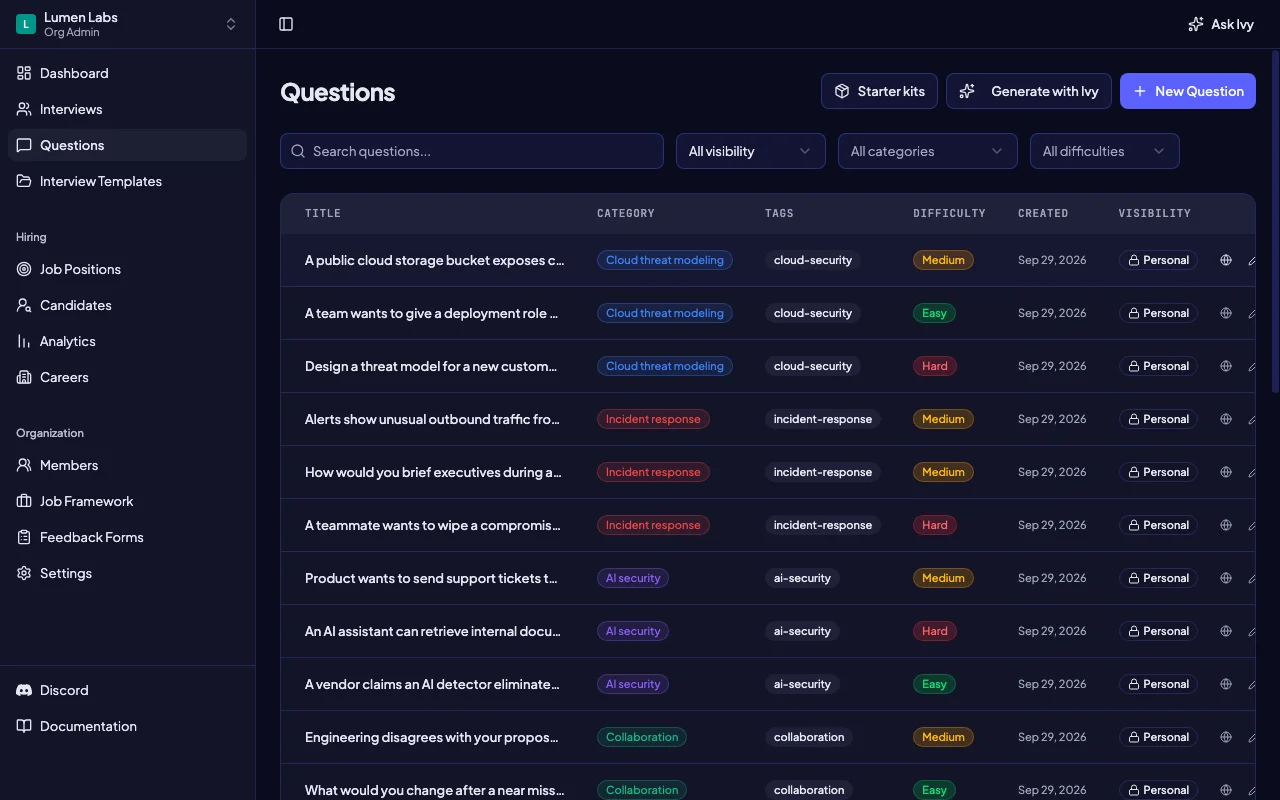
Intervy's question bank can hold these prompts by category and difficulty, and its interview review shows question-level ratings. That makes it practical to keep the same probes in a technical interview platform and compare answers against a shared rubric. For adjacent technical roles, pair this set with DevOps interview questions or system design interview questions.
Want to try the full set as an interview scoring tool? Open the Import section, choose “Cybersecurity Engineer” under Sample Interview Data, and load all 12 questions into your workspace. Then choose the scenarios that match your role and set your scoring anchors before the first candidate joins.