AI Interview Disclosure: A Checklist for Hiring Teams
On this page
- Why AI Interview Disclosure Starts Before the Interview
- Map Every AI Touchpoint Before Writing the Notice
- Draft an AI Interview Disclosure Candidates Can Understand
- Keep Human Review and Escalation Real
- Handle Questions and Opt-Out Requests Without Guesswork
- Check Data Claims Against What the Product Actually Does
- Put the Checklist Into Your Next Hiring Loop
AI interview disclosure should happen before a candidate reaches a tool that uses their information, not after they ask whether a machine reviewed their CV. A clear notice tells them what the tool does, what data it sees, who makes the decision, and whom to contact. That is a more useful promise than a broad statement that your company “uses AI.”
TL;DR: Map every AI touchpoint, give candidates a plain-language notice before each relevant step, and name the person who owns the hiring decision. Check your data-handling claims against the actual workflow and give candidates a real route for questions or requests.
Why AI Interview Disclosure Starts Before the Interview
AI may touch an application days before an interviewer joins a call. It may help a recruiter review a CV, help an interviewer prepare questions, or help a team organize feedback. A candidate should not have to guess which of those happened.
Greenhouse’s May 2026 Candidate AI Interview Report surveyed 2,950 active job seekers across five markets. Among its U.S. respondents, 63% had faced an AI interview, up 13 percentage points from six months earlier. The useful lesson for a hiring team is to describe the specific use of AI, rather than asking candidates to accept a vague label.
- At application: Say whether automated tools may analyze the CV or application before a person reviews it.
- Before the interview: Say whether AI helped draft questions or prepare the interviewer, and whether the interview itself uses recording, transcription, or automated evaluation.
- After the interview: Say whether any tool summarizes notes or contributes to a score. Identify who checks the evidence and makes the next-stage decision.
Key takeaway: Your notice should match the candidate’s actual path. A statement about AI-assisted prep does not cover a recorded or automatically scored interview if your team later adds one.
Map Every AI Touchpoint Before Writing the Notice
Make one row for each stage of your hiring process. Record the input, the AI task, the human check, the decision owner, and the message the candidate sees. Ask the person who owns each tool to walk through a real example; a feature list alone will miss manual uploads and optional settings.
For an interview preparation app for hiring managers, the map might look like this:
| Touchpoint | Possible AI task | Human owner to name |
|---|---|---|
| Application | Extract a structured profile from a CV | Recruiter reviews the application |
| Interview preparation | Draft questions from role or candidate context | Interviewer chooses and edits questions |
| Interview | No AI task, unless a separate tool is used | Interviewer conducts the conversation |
| Review | Summarize recorded questions, ratings, and notes when your tool offers it | Interview panel checks the summary against the record and decides |
The table is a worksheet, not a claim that every Intervy workflow performs every row. In Intervy, the public application form warns that a CV may be analyzed by automated tools, including AI, and requires the applicant to acknowledge the disclosure and consent to processing for the role. A separate interview-stage notice is still your team’s responsibility if you use another AI tool or change the interview format.
Tip: Put the map next to your interview plan. Review it when you change a candidate screening tool, a structured interview tool, or a provider setting.
Draft an AI Interview Disclosure Candidates Can Understand
Write in the same order a candidate would ask questions: what happens, why, what data is involved, who decides, and how can I ask for help? Give the notice before the relevant step, in the invitation or application flow. Keep the privacy link near it, and make the contact route usable without requiring an applicant to find an internal policy.
Here is a starting example. Replace the bracketed text only after checking your own process:
“We use [tool or provider] to [specific task, such as helping our interviewers draft questions]. It may process [specific information, such as your CV or interview notes]. [Named role] reviews the output and makes the decision about your application; the tool does not make that decision. We [do/do not] record or automatically score this interview. Read our applicant privacy notice at [public link]. If you have questions, need an adjustment, or want to discuss an alternative process, contact [recruiting contact] before [stage].”
- Name the action: “Draft questions from your CV” is clearer than “improve the hiring experience.”
- Name the data: Distinguish a CV, profile, interview notes, and a recording. Do not imply that all are processed identically.
- Name the owner: Give a role that can actually review the result and answer a challenge.
- Name the route: Tell candidates where to send questions or an alternative-process request and when to expect a response.
Key takeaway: Candidate consent to process an application is not a substitute for explaining a new AI use later in the interview journey. Update the notice when the workflow changes.
Keep Human Review and Escalation Real
“Human in the loop” is easy to print and hard to prove. Assign a reviewer before any AI output can influence a candidate decision. Give that person the source material and the authority to correct the output, ignore it, or pause the process. In a debrief, ask for job-related evidence from the interview rather than a model’s conclusion.
Intervy’s interview screen asks the interviewer for your rating, and its review screen displays the average rating alongside feedback and answers. For a completed interview, a team member can also generate an AI summary from the recorded questions, ratings, and notes. The decision owner should check that summary against the notes and ratings before relying on it, then name who approves an advance or rejection.
- Before the conversation: The interviewer reviews AI-drafted questions, removes irrelevant or sensitive prompts, and confirms the same core criteria for each candidate.
- During the conversation: A person can explain a question and adapt when the candidate needs clarification or an accommodation.
- At decision time: The decision owner reviews the notes and ratings, records the job-related reasons, and resolves conflicts in the evidence.
Tip: If a candidate challenges a profile or summary, pause its use until a person checks the original material. Give the candidate a contact who can correct the record.
For more on the interviewer’s role, see our AI-assisted interview guide and guide to scoring candidates fairly.
Handle Questions and Opt-Out Requests Without Guesswork
A candidate may ask whether AI touched their CV, whether a person will review their application, or whether they can take a different route. Prepare answers before publishing the notice. The recruiter who receives the question should know which tool was used in that candidate’s path, not just what the platform can do in general.
Do not promise an automatic opt-out if your process cannot deliver one. Decide in advance which steps can be done manually, who can approve an alternative, and how to prevent the request from quietly disadvantaging the candidate. If an alternative is unavailable, explain that promptly and provide a person to discuss the options.
- Questions: Log the question, the candidate’s stage, and the answer given. Point to the actual notice and privacy information.
- Correction: Route a disputed CV profile or interview summary to a human reviewer before it influences a decision.
- Alternative request: Confirm what the candidate wants to avoid, check the feasible manual path, and tell them the next step and owner.
- Escalation: Set a clear owner for privacy, accessibility, and process concerns. Keep the candidate informed while that owner reviews the request.
Key takeaway: A useful opt-out process is an operational decision by the hiring team. Do not present it as a product switch unless you have verified that switch exists and works for this candidate’s route.
Check Data Claims Against What the Product Actually Does
This is the last pass before your AI interview disclosure goes live. Put the proposed notice next to a real application, a manual CV upload, and your AI provider settings. Trace what is sent, what is retained, and what a reviewer can see. Ask the privacy owner to approve only statements that match those paths.
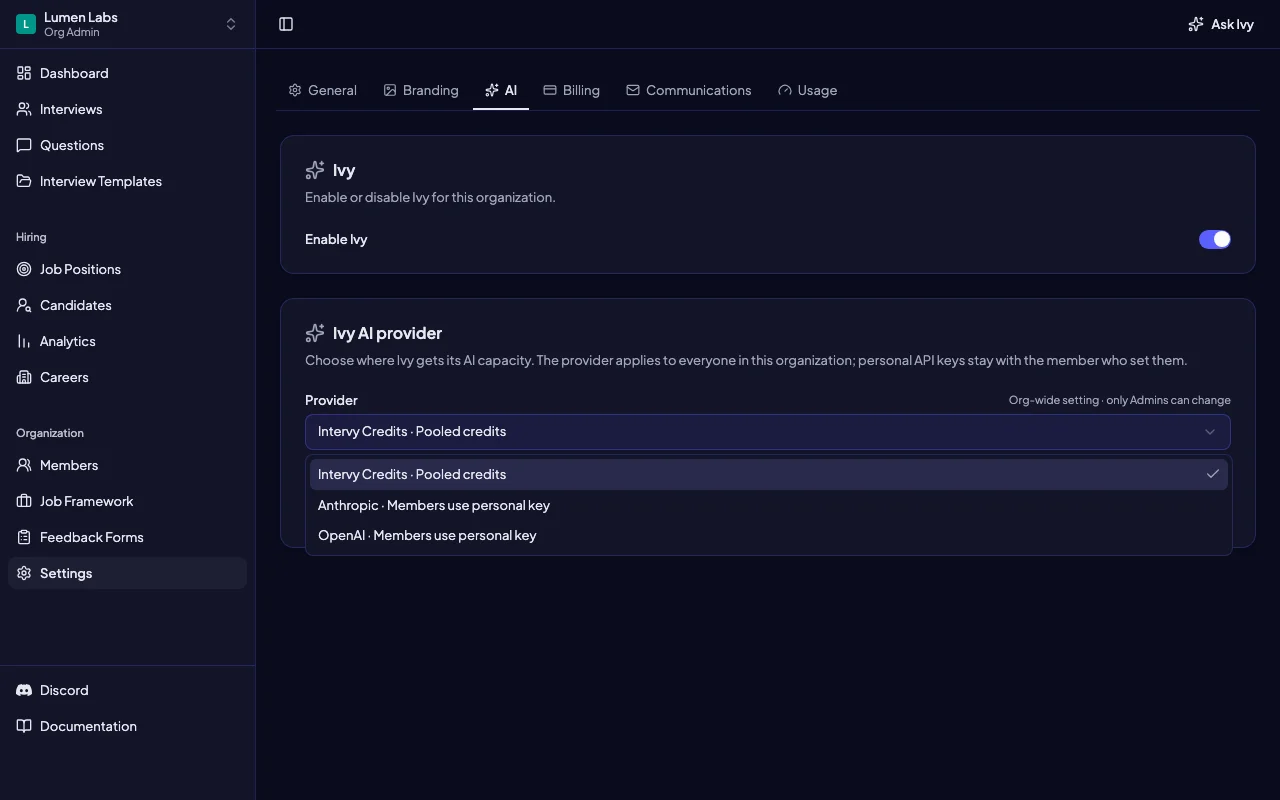
There are two important distinctions in Intervy. A manual CV upload can send the full file to an AI provider for analysis; the resulting profile is intended to remove personal identifiers. Do not say the CV is anonymized before the provider receives it. In that manual upload flow, keeping the original file is optional. The public application form, however, uploads and stores the submitted CV, so a notice about that route must not borrow the manual-upload claim.
The post-interview summary has its own data path: when a team member generates it, recorded questions, ratings, and notes are sent to the selected AI provider. Include that optional step in the candidate notice if your team uses it; do not describe the review as purely manual.
The public application form also links to applicant privacy information and records an applicant’s consent for that role. Those controls do not tell a candidate which AI provider your organization selected, whether you use a separate meeting tool, or what your internal decision policy is. Check those with the relevant owners before making a promise. Teams on Growth or Scale can bring their own AI key; our provider choice guide explains that option. The careers page guide covers the application flow.
- Data: Which files or notes reach each AI tool, and at what stage?
- Storage: Is the original CV retained in this specific route? Who can access it?
- Provider: Which provider setting applies today, and who can change it?
- Decision: Which person reviews the output and owns the next action?
- Request path: Who answers a question, correction, or alternative-process request?
Tip: Keep a copy of the approved notice with the process map. Review both whenever a tool, provider, or interview step changes.
Put the Checklist Into Your Next Hiring Loop
Start with one open role. Map its candidate path, write the notice, test it against a real application flow, and ask the recruiter and hiring manager to rehearse the three hardest candidate questions. Then assign the review and escalation owners before the first invitation goes out.
A structured interview tool can help keep the evidence and interviewer ratings organized. It cannot write your organization’s promise to candidates or make an unverified data claim safe. Explore Intervy’s AI copilot to see where assistance fits, then make your notice as specific as the process you actually run.
- Publish: Put the notice before the AI touchpoint, with a working contact route.
- Rehearse: Test the candidate questions and alternative request with the people who must answer them.
- Recheck: Repeat the data and decision-owner review whenever the workflow changes.
Key takeaway: Good disclosure is a repeatable hiring practice: tell candidates what AI does, let them reach a person, and keep a person responsible for the decision.