Customer Support Interview Questions for AI-Era Service
On this page
- Prepare customer support interview questions around decisions
- Customer support interview questions with sample answers
- 1. A customer has contacted support three times about a duplicate charge. What do you say first?
- 2. How do you explain a policy that prevents the outcome a customer wants?
- 3. A customer reports possible account takeover. When do you escalate, and what do you own?
- 4. Engineering accepts your escalation but gives no resolution time. What do you tell the customer?
- 5. An AI draft promises a refund within 24 hours, but the policy says eligibility must be reviewed. How do you correct it?
- 6. An AI answer cites a help article that you cannot find. What do you do before sending?
- 7. A case contains customer payment details. How would you use an AI assistant safely?
- 8. You have an account takeover report, a service outage affecting several customers, and a routine invoice request. How do you prioritize?
- 9. A quick workaround helps one customer but could damage their data. What do you do?
- 10. How do you know a support case is ready to close?
- Score the evidence against shared anchors
- Build a reusable support interview
Good customer support interview questions reveal what an agent does when a reassuring answer would be easy but unsafe. A customer has been charged twice, an urgent case needs another team, and an AI draft promises a refund nobody has approved. Ask candidates to make the next decision, explain their reasoning, and write the message they would actually send.
TL;DR: Use the same fictional scenarios to test empathy, escalation, AI draft review, prioritization and ownership. Score verified actions and realistic commitments; treat the sample answers as examples of sound reasoning, not scripts to memorize.
Prepare customer support interview questions around decisions
AI review belongs in the exercise when it belongs in the job. In Ashby’s “The Rise of AI in Job Postings” report, published July 9, 2026, 27% of Customer Support postings in its category sample mention AI in their descriptions. That chart covers postings dating back to the start of 2025; it does not measure how many support teams use AI or whether those tools improve service.
Give every candidate the same short case pack, with fictional details and the policies needed to answer:
- Billing: a duplicate charge requires eligibility review; frontline agents cannot approve refunds or promise a processing time.
- Security: suspected account takeover goes to the security responder through an approved verification process; passwords and full payment details must never be requested in a message.
- Service: an outage has an incident owner and a verified status update, but no confirmed restoration time.
- AI use: only an approved assistant may receive permitted information; its draft must be checked against the case and current guidance before sending.
State which actions the role can take and what information is deliberately missing. Allow clarifying questions, and ask the interviewer to supply the same answers to everyone. Do not penalize a candidate for declining to invent your company’s policy.
Tip: Tell candidates whether AI is allowed during the exercise. For a draft-review task, provide the same flawed draft yourself so access to a particular tool does not determine the result.
Customer support interview questions with sample answers
These questions test immediate service judgment. For account adoption and renewals, use the separate customer success manager interview questions; for evidence from past experience, add a probe from the behavioral interview questions guide.
1. A customer has contacted support three times about a duplicate charge. What do you say first?
Listen for: acknowledgment of repeated effort, a review of the earlier conversations, and a next step that stays within authority. Empathy should connect to action rather than become a generic apology.
Sample answer: “I understand why another contact about the same charge is frustrating. I’ll review the billing record and what we’ve already tried, then explain the next action and when I’ll update you.” The candidate should describe approved verification before discussing account details.
- Probe: What would you verify before promising a refund?
- Concern: promising an immediate refund before checking eligibility or asking the customer to repeat everything already documented.
2. How do you explain a policy that prevents the outcome a customer wants?
Listen for: a clear limit, recognition of the impact, and alternatives the agent can deliver. An exception request is different from an approved exception.
Sample answer: “I’d explain the relevant rule in plain language, acknowledge why the result is disappointing, and offer the available options. If an exception review is possible, I’d explain that process without suggesting it has already been approved.”
- Probe: What if the customer calls the policy unfair?
- Concern: blaming another department, debating the customer’s emotions, or implying that persistence guarantees an exception.
3. A customer reports possible account takeover. When do you escalate, and what do you own?
Listen for: prompt use of the security procedure, approved identity verification and a useful handoff. The candidate should recognize the risk without inventing technical remedies.
Sample answer: “I’d activate the security escalation and send the responder a concise timeline, relevant evidence and actions already taken. I’d avoid asking for passwords or full payment details, and keep responsibility for customer updates until a named colleague accepts that responsibility.”
- Probe: What would you avoid asking the customer to send?
- Concern: treating a possible compromise as a routine queue item or forwarding a ticket with no context or owner.
4. Engineering accepts your escalation but gives no resolution time. What do you tell the customer?
Listen for: separation of known facts from unknown timing, a realistic next update, and follow-through after escalation. “Engineering has it” does not establish that the customer’s problem is resolved.
Sample answer: “The team is investigating, and I don’t yet have a confirmed fix time. I’ll update you tomorrow even if the investigation is still open.” The agent should make that commitment only if they can meet it, record a reminder and share a workaround only when verified.
- Probe: How do you keep the case from disappearing?
- Concern: fabricating a deadline or closing the ticket merely because another team accepted it.
5. An AI draft promises a refund within 24 hours, but the policy says eligibility must be reviewed. How do you correct it?
Give the candidate this fictional draft: “Your refund is approved and will arrive within 24 hours. There is nothing else you need to do.” Ask for a replacement and the checks they would perform first.
Listen for: removal of both unsupported approval and timing, verification of policy and case facts, and a helpful replacement rather than a vague refusal.
Sample answer: “I understand why the duplicate charge is worrying. I have submitted it for eligibility review and will update you tomorrow, even if the review is still open.” This wording is appropriate only after the submission and update commitment are real; otherwise the candidate should adjust it.
- Probe: Which parts of the draft are unsupported, and how would you report the recurring error?
- Concern: changing the tone while leaving the invented refund approval intact.
6. An AI answer cites a help article that you cannot find. What do you do before sending?
Listen for: checking an approved current source and whether the instructions fit the customer’s situation. A fluent explanation is not evidence that the link or procedure exists.
Sample answer: “I’d find a verified article or ask a knowledgeable colleague. If I cannot substantiate the advice, I’d remove it and explain what I’m checking instead of sending an invented link.”
- Probe: When would you stop using the draft entirely?
- Concern: assuming a citation is reliable because the assistant supplied it.
7. A case contains customer payment details. How would you use an AI assistant safely?
Listen for: checking approved tools and allowed data before sharing anything. The candidate should be willing to complete the response without AI when the permitted path is unclear.
Sample answer: “I’d follow the organization’s tool and data policy, removing sensitive details where required before any permitted use. If the tool or information is not approved, I’d write the reply without it.”
- Probe: What if an unapproved tool produces better wording?
- Concern: pasting the full conversation into a personal assistant account to save time.
8. You have an account takeover report, a service outage affecting several customers, and a routine invoice request. How do you prioritize?
Listen for: risk and impact triage, parallel coordination where colleagues are available, and acknowledgment of customers who must wait. Give candidates the relevant response commitments rather than expecting a universal ordering rule.
Sample answer: “I’d activate the security response promptly, coordinate the outage with its incident owner, and acknowledge the invoice request with a realistic update time. I’d reassess against the documented urgency rules as impact and available capacity change.”
- Probe: What new fact could change your order?
- Concern: serving only the loudest customer or using arrival order despite a clear urgent risk.
9. A quick workaround helps one customer but could damage their data. What do you do?
Listen for: stopping the risky instruction, consulting the appropriate technical owner and communicating uncertainty. Speed targets should inform coordination, not excuse an unverified remedy.
Sample answer: “I’d pause that instruction, verify the workaround and offer a safe alternative if one exists. I’d explain what I’m checking and give the customer a next update instead of asking them to accept an unknown risk.”
- Probe: What if your response-time target is about to expire?
- Concern: recommending the workaround without verification to make the queue metrics look better.
10. How do you know a support case is ready to close?
Listen for: evidence of resolution or a clearly explained limit, understood next steps and an owner for remaining work. Silence alone does not prove success.
Sample answer: “I’d verify the outcome, document what was done and make sure the customer knows the next steps. If they stop replying, I’d follow the closure policy and explain how to reopen the issue rather than record an unverified fix.”
- Probe: What if the customer has stopped replying?
- Concern: equating a sent response with a resolved problem.
Score the evidence against shared anchors
Use the following as a proposed rubric, adapting it to the role before interviewing. Rate each dimension separately and record the candidate’s words or action; a polished message can coexist with an unsafe decision.
| Dimension | 1: below the bar | 2: meets the bar | 3: strong evidence |
|---|---|---|---|
| Empathy | Dismisses impact or offers an empty apology | Acknowledges impact and offers a relevant next action | Uses case history to reduce repeated effort and checks understanding |
| Escalation and ownership | Misses urgent risk or abandons the handoff | Uses the right channel and names the update owner | Supplies a useful timeline and verifies handoff and outcome |
| AI review | Sends unsupported promises or unverified sources | Corrects claims against policy and case facts | Explains why the draft failed and reports the issue for improvement |
| Prioritization | Follows volume or pressure without assessing harm | Uses urgency, impact and commitments | Coordinates parallel work and explains when priorities change |
Keep privacy and unauthorized commitments visible in the decision. Agree beforehand which unsafe actions require another probe or fail the exercise; do not let an average hide them. If the interview did not establish a dimension, mark it unassessed rather than assign a low score.
Key takeaway: Score the reasoning and observed choices, not whether the candidate matches the sample wording. Have interviewers score independently before comparing evidence, using the candidate scoring rubric guide to prepare the debrief.
Build a reusable support interview
A structured interview tool is useful when it preserves the same prompts across candidates. An interview template builder should serve the agreed evidence goals: choose the questions you need, retain the policy pack, and keep the follow-up probes consistent.
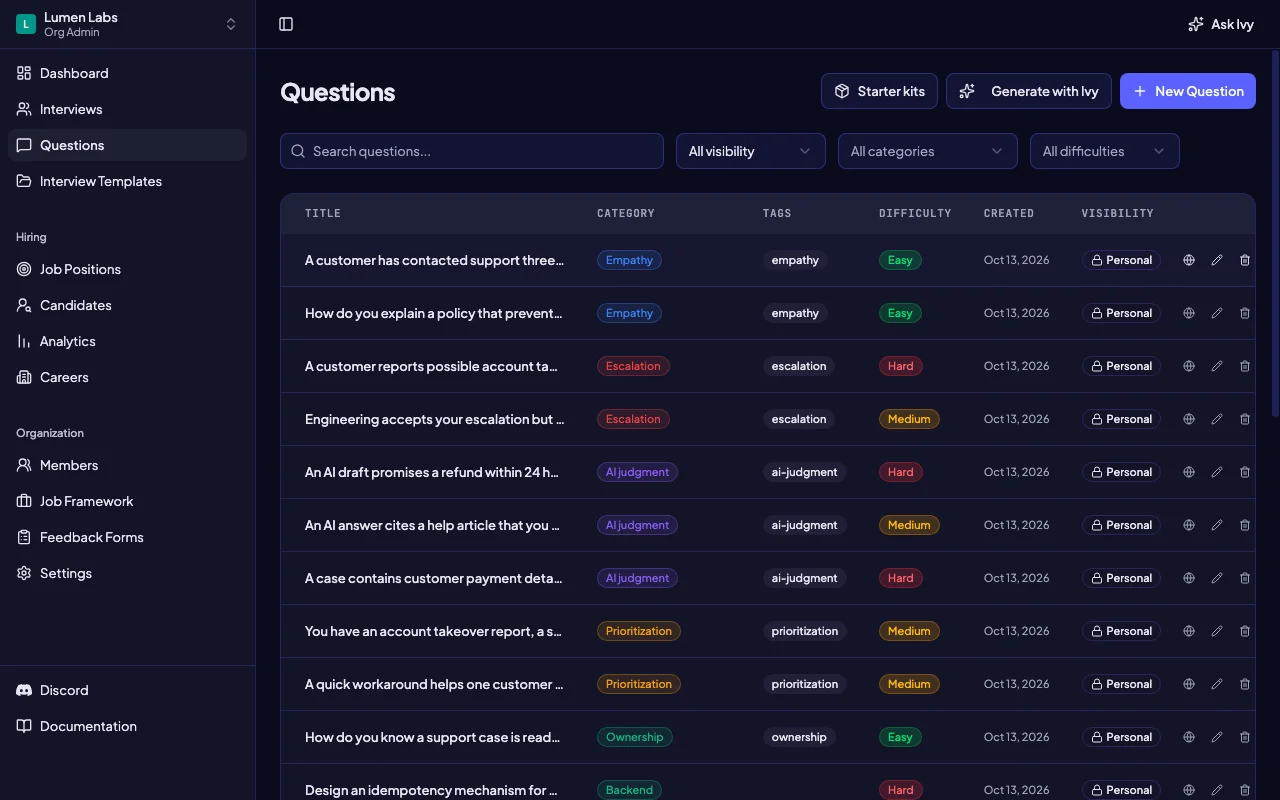
You can load all 10 questions through the Import section: select “Customer Support” in the Sample Interview Data card. Sign in with permission to publish questions in your workspace, then use the set as a starting point for your role-specific interview.
- Before interviewing: replace fictional policy assumptions with your approved rules and agree on scoring anchors.
- During the exercise: record the action, the source the candidate checks and the commitment they make.
- Afterward: compare evidence dimension by dimension and identify any unresolved safety concern before making the hiring decision.