Rust Interview Questions for Real Production Judgment
On this page
- How to use these Rust interview questions
- Rust interview questions on ownership and lifetimes
- 1. A parser returns borrowed fields, but the caller drops the input. What should the API promise?
- 2. A cache lookup returns a reference, then the caller needs to update the cache. How would you redesign it?
- 3. A helper must return one of two borrowed strings. What does its lifetime annotation establish?
- Errors that preserve caller choices
- 4. A configuration lookup can be missing, malformed or unreadable. Which outcomes belong in Option and Result?
- 5. A library returns only “request failed.” What error information should cross its boundary?
- Shared state and async cancellation
- 6. Several workers share a map through Arc. Is mutation now safe?
- 7. An async handler holds a map lock while awaiting a network response. What would you change?
- 8. A timeout wins while a future is partway through sending a framed message. Is retrying safe?
- Production diagnosis and focused testing
- 9. A safe-Rust service has rising tail latency and low CPU. What do you investigate first?
- 10. A cancelled operation leaves a reservation stuck. What is the smallest convincing regression test?
- Score evidence before reaching a hiring judgment
- Reuse the Rust question bank in your next interview
Rust interview questions should reveal whether a candidate can explain who owns a buffer, what survives cancellation, and which evidence would isolate a production stall. Use these fictional scenarios to assess mid-level and senior backend or systems engineers through concrete decisions.
TL;DR: Choose a consistent subset of these ten questions, ask candidates to explain the failure mechanism, then probe the boundary and the test. Score observable reasoning about ownership, error contracts and progress; record missing evidence separately.
How to use these Rust interview questions
Agree on the role requirements before choosing questions. For a mid-level role, start with ownership and errors; for a senior role, add cancellation, shared-state invariants and diagnosis. The reference answers describe useful evidence, rather than a script candidates must repeat.
- Keep conditions comparable. Give candidates for the same role the same core scenarios and follow-up time.
- Allow useful clarification. Ask whether they need an owned result, a snapshot, or a long-lived reference before judging a design choice.
- Separate language knowledge from operations. A Rust answer should explain borrowing, guard scope or future ownership; a backend answer should also explain the business invariant.
Tip: Use your technical interview preparation tool to keep the prompt and answer signals together. Calibrate the anchors with your interviewers before the first candidate.
Rust interview questions on ownership and lifetimes
The Rust Book’s references and borrowing chapter explains shared and exclusive borrowing. Its lifetime chapter explains how signatures describe reference validity. Use those rules to discuss an API boundary, rather than asking candidates to memorize annotation syntax.
Key takeaway: Ask who keeps the underlying value alive, then ask what the caller needs after the operation.
1. A parser returns borrowed fields, but the caller drops the input. What should the API promise?
Keep borrowed fields tied to the input lifetime when the caller retains the buffer. Return owned strings when results must outlive it. Moving ownership of the input into a suitable owner is another design, but a plain struct containing a buffer and references into itself is not a straightforward safe-Rust solution. Ask who owns the bytes before adding clones.
- Follow-up: What changes if the parsed result enters a long-lived work queue?
- Adequate signal: Explains the input owner and valid reference duration.
- Strong signal: Compares borrowed and owned APIs, including allocation cost and queue retention.
2. A cache lookup returns a reference, then the caller needs to update the cache. How would you redesign it?
Locate the last use of the borrowed value. End that borrow before taking an exclusive mutable borrow, or return a small owned result when the caller needs a snapshot. If lookup and update form one operation, encapsulate them behind one method. Cloning the whole cache hides the ownership question and may add substantial work.
- Follow-up: What if the caller needs the old value after the update?
- Adequate signal: Identifies overlapping shared and exclusive access.
- Strong signal: Defines whether the caller needs a snapshot or a live view and chooses the boundary accordingly.
3. A helper must return one of two borrowed strings. What does its lifetime annotation establish?
The signature relates the returned reference to the input references; annotations do not extend the life of either string. A shared lifetime can restrict the usable result to the overlap of the input lifetimes. If the helper constructs a new local string, it must return an owned value instead of a reference to that local.
- Follow-up: How would you explain the caller restriction without naming lifetime-elision rules?
- Adequate signal: Describes the relationship between input and output validity.
- Strong signal: Uses a caller example to show why an annotation cannot rescue a dangling reference.
Errors that preserve caller choices
The standard library distinguishes optional values from recoverable failures. Its error trait documentation describes underlying error sources; decide which distinctions a caller needs before choosing the public error shape.
Tip: A useful answer connects the return type to the caller’s next action.
4. A configuration lookup can be missing, malformed or unreadable. Which outcomes belong in Option and Result?
Use Option for meaningful absence and Result for failure. Result<Option<T>, E> can preserve both, if missing configuration is allowed. For required configuration, missing can itself be a domain error. Preserve distinctions callers need for defaults, user correction or operational response; do not silently convert every failure into absence.
- Follow-up: Which outcome may use a default, and which should stop startup?
- Adequate signal: Distinguishes absence from parsing or I/O failure.
- Strong signal: Connects the return contract to explicit caller decisions and tests each outcome.
5. A library returns only “request failed.” What error information should cross its boundary?
Expose stable error distinctions when callers must branch, while retaining the underlying cause and useful operation context. Application boundaries may add context for diagnosis without making callers parse display strings. Avoid including credentials or entire request bodies. Propagating with ? does not by itself add the domain explanation an operator needs.
- Follow-up: How would you change the message without breaking callers that handle retryable failures?
- Adequate signal: Preserves a useful cause rather than replacing it with a generic string.
- Strong signal: Separates machine-readable handling, diagnostic context and safe public messages.
Shared state and async cancellation
The Rust Book on shared state separates shared ownership from locking. For async details, Tokio’s mutex guidance and cancellation-safety guidance provide the operation-specific contracts.
Tip: Ask for the complete invariant and the exact suspension boundary, not just a synchronization type.
6. Several workers share a map through Arc. Is mutation now safe?
Arc provides shared ownership with atomic reference counting, not arbitrary thread-safe mutation of its contents. Choose synchronization for the complete invariant, such as a mutex around a check-and-update operation, or give a single task ownership and communicate by messages. Explain the expected contention and avoid splitting one invariant across separate lock acquisitions.
- Follow-up: How can separately locked reads and writes still exceed a capacity limit?
- Adequate signal: Distinguishes shared ownership from synchronized mutation.
- Strong signal: Shows an interleaving that violates the invariant and places the whole transition under one owner.
7. An async handler holds a map lock while awaiting a network response. What would you change?
First decide whether the lock must span the I/O. Prefer a short critical section that extracts owned work, releases the guard, awaits I/O, then rechecks any state needed before committing. A standard mutex can suit short non-awaiting data operations; an async mutex allows waiting without blocking the thread, but still serializes the protected work. Changing mutex types alone does not repair a stale-state race.
- Follow-up: What can change between releasing the lock and applying the response?
- Adequate signal: Identifies the guard held across suspension and removes unnecessary lock duration.
- Strong signal: Also protects the post-I/O invariant through revalidation, versioning or a single owner.
8. A timeout wins while a future is partway through sending a framed message. Is retrying safe?
Identify exactly which future is dropped and where progress lives. Cancellation may leave partial I/O or an external effect; it does not imply rollback. Check the operation’s cancellation contract, retain progress outside a disposable future when appropriate, and define framing recovery or idempotent retry. Distinguish directly selected futures from independently spawned tasks whose lifecycle needs separate management.
- Follow-up: How would you prove what the peer received before allowing a retry?
- Adequate signal: Recognizes partial progress and refuses to assume timeout means no effect.
- Strong signal: Defines a recoverable protocol boundary and a test that cancels after observable progress.
Production diagnosis and focused testing
The Rustonomicon on races distinguishes data races from broader races and deadlocks. The Rust Book on tests shows how tests arrange state, exercise behavior and assert outcomes; the scenarios below ask which outcome matters.
Tip: Ask what would disprove the candidate’s first hypothesis before discussing a repair.
9. A safe-Rust service has rising tail latency and low CPU. What do you investigate first?
Treat lock contention, blocked executor threads, queue growth and slow dependencies as hypotheses. Trace request spans and measure queue time, lock wait and hold time, and downstream duration before changing synchronization. Safe Rust prevents data races in safe code, but does not promise freedom from deadlock or application-level races. Choose the next measurement that separates competing explanations.
- Follow-up: What observation would make you abandon your lock-contention hypothesis?
- Adequate signal: Names a mechanism and a measurement that could disprove it.
- Strong signal: Connects request-level delay to a specific resource and proposes a bounded experiment.
10. A cancelled operation leaves a reservation stuck. What is the smallest convincing regression test?
Arrange the real reservation transition, pause at the vulnerable async boundary with a controlled dependency, then cancel. Assert the intended terminal state and whether later work can acquire capacity. Use explicit synchronization rather than sleep-based timing. For external effects, exercise the relevant I/O boundary as well; a pure helper test cannot establish the peer’s state.
- Follow-up: How would the test fail if cleanup released the lock but forgot to release capacity?
- Adequate signal: Asserts the reservation outcome after controlled cancellation.
- Strong signal: Demonstrates the bug before the fix, verifies subsequent progress and distinguishes local cleanup from remote effects.
Score evidence before reaching a hiring judgment
Use this editorial scale across the selected questions. It is a discussion aid, not a validated predictor of performance or an automatic Intervy score. Agree what adequate evidence means for your particular role before interviewing.
- Weak: Names a type, tool or rule but cannot connect it to the scenario’s failure.
- Adequate: Explains the mechanism and proposes a design that addresses it under stated assumptions.
- Strong: Also identifies a boundary case, a trade-off and an observation that would verify or disprove the proposal.
- Not observed: The interview did not establish this dimension; do not silently turn missing evidence into a weak score.
For example, “would use an async mutex” alone leaves the invariant unexplained. “Would release the guard before I/O, then compare a version before applying the response” provides specific evidence for the shared-state discussion. Keep that note alongside the rating so another interviewer can follow the reasoning.
Key takeaway: A senior answer should make its assumptions inspectable. Reward a justified alternative when it protects the same contract, even if it differs from the reference answer.
Reuse the Rust question bank in your next interview
Use a structured interview tool to retain consistent prompts while you adapt the selection to the role. The new “Rust Production Judgment” sample question set contains all ten scenarios with reference answers, follow-up probes, categories, difficulty levels and scoring anchors.
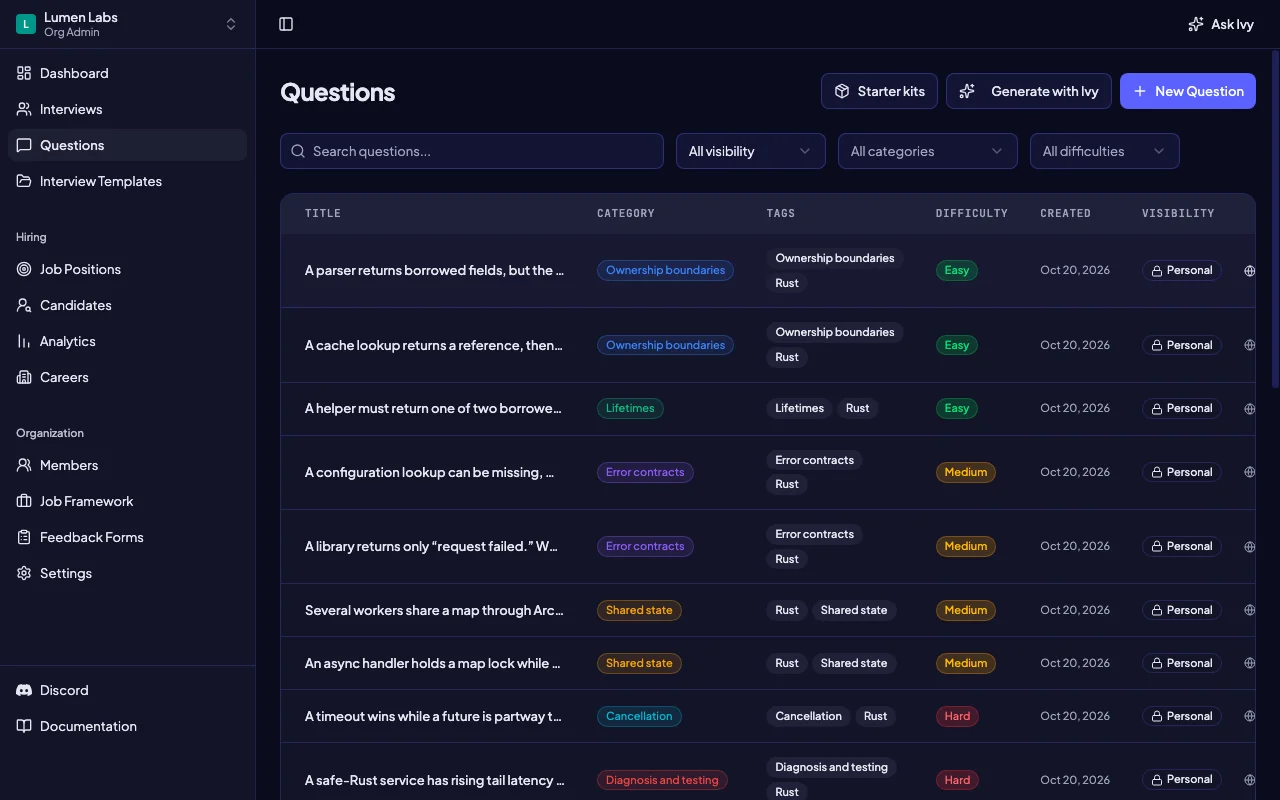
- Import with the right access. Sign in to your workspace with permission to publish questions. In Import section, choose “Rust Production Judgment” in Sample Interview Data and load all 10 questions.
- Review before interviewing. Read the answers, choose the role-relevant subset and agree which follow-ups each interviewer will use.
- Keep adjacent skills separate. Use the backend developer question bank for broader service design and the Go production question bank when hiring for Go. Rust ownership evidence needs its own conversation.
Tip: Importing questions gives you reusable interview material. Your team still owns the role criteria, the evidence notes and the hiring decision.