Java Interview Questions That Test Production Judgment
On this page
- Choose Java interview questions for the job level
- Java interview questions about concurrency and shared state
- 1. A shared request counter loses increments. Would volatile fix it?
- 2. A worker sees a ready flag but stale configuration. What would you inspect?
- 3. Requests stall while an executor queue grows. Should you add threads?
- JVM memory and debugging: ask for diagnostic evidence
- 4. Heap usage rises after each full collection. How would you investigate?
- 5. The process runs out of memory while the Java heap looks healthy. What next?
- 10. Latency spikes but CPU is low. Which evidence would you collect first?
- Collections: test identity and consistency requirements
- 6. A HashMap lookup fails after a key object is edited. Why?
- 7. Can a ConcurrentHashMap provide an exact whole-map snapshot during writes?
- API failures: bound waiting and uncertain outcomes
- 8. An HTTP dependency sometimes never responds. What would you bound?
- 9. A create-order call times out. Is retrying safe?
- Turn the answers into a repeatable interview
Your Java interview questions should give candidates room to explain a failure, choose evidence and defend a repair. This bank offers ten production scenarios for mid-level and senior backend engineers, each with a reference answer, a follow-up probe and observable scoring anchors. Use them to prepare a focused conversation about the work your team actually does.
TL;DR: Choose a consistent core covering shared state, JVM diagnostics, collections and API failures. Score the explanation and supporting evidence; these editorial anchors are discussion aids, not validated predictors of job performance.
Choose Java interview questions for the job level
Before the first interview, agree which failures the role must handle independently. State the Java version and deployment constraints in the prompt; the technical references here use Oracle’s Java SE 21 documentation. Allow candidates to consult API documentation when recall is not the skill being assessed.
- Mid-level core. Start with questions 1, 4, 6 and 8: explain the mechanism, suggest a safe change and name a check that could disprove it.
- Senior core. Use the same questions, then add executor overload or native-memory investigation. Ask the candidate to connect local changes to caller behavior and operational limits.
- Consistent prompts. Keep the core, initial context and available time the same for candidates for the same role. Record which probes were asked before comparing evidence.
Tip: Pick fewer questions and explore the reasoning. A candidate who asks for the workload, version or exact failure message is gathering context; give every candidate the same additional facts.
This bank complements our broader backend developer interview questions. Use the system design question bank when the decision concerns service architecture rather than Java-specific failure mechanisms.
Java interview questions about concurrency and shared state
Begin with an observable failure. Ask candidates to describe an interleaving or resource constraint before proposing a library class. A technical interview preparation tool can hold the agreed prompts, but the panel still needs to decide what evidence counts.
1. A shared request counter loses increments. Would volatile fix it?
Reference answer: No. Increment is a read-modify-write operation; visibility alone does not make the whole operation atomic. Use an atomic increment for an independent counter, or a shared lock when the counter belongs to a larger invariant.
Follow-up: What if updating the count must also reserve capacity?
- Evidence anchors. Weak: Says volatile makes increment atomic. Adequate: Explains lost updates and proposes an atomic increment. Strong: Identifies the larger invariant and synchronizes the whole decision.
Technical basis: Oracle, AtomicInteger, Java SE 21 (2023).
2. A worker sees a ready flag but stale configuration. What would you inspect?
Reference answer: Check how the configuration is published. A volatile flag can publish preceding writes when the reader observes that publication, but does not protect later mutations. Prefer an immutable configuration snapshot published through a volatile reference, or guard reads and writes with the same lock.
Follow-up: What changes if another thread edits the configuration after publication?
- Evidence anchors. Weak: Adds a delay and assumes the race is fixed. Adequate: Names a happens-before relationship and a publication mechanism. Strong: Separates publication from later mutation and proposes a focused concurrent reproduction.
Technical basis: Oracle, concurrent package memory consistency, Java SE 21 (2023).
3. Requests stall while an executor queue grows. Should you add threads?
Reference answer: First inspect arrival rate, task duration, queue depth and downstream capacity. An unbounded work queue can accumulate pending tasks; with that queue strategy, increasing maximum pool size does not make extra workers consume the backlog. Consider bounded admission and explicit rejection or backpressure; choose capacity from measured constraints.
Follow-up: How will callers behave when the queue is full?
- Evidence anchors. Weak: Only increases the maximum pool size. Adequate: Connects queue growth to slow tasks and bounds queued work. Strong: Explains queue policy, caller impact and how to validate recovery under load.
Technical basis: Oracle, ThreadPoolExecutor, Java SE 21 (2023).
Key takeaway: Listen for the protected invariant and the chosen synchronization boundary. Naming a concurrent collection does not explain how the whole operation stays correct.
JVM memory and debugging: ask for diagnostic evidence
Give candidates the graph or symptom, then ask what it cannot establish. The next three prompts distinguish retained heap, total process memory and waiting threads. Treat the investigation order as an editorial recommendation that should adapt to incident impact and available tooling.
4. Heap usage rises after each full collection. How would you investigate?
Reference answer: Compare the live-set trend under comparable load. Inspect retained objects and paths to roots in a heap dump; a class histogram gives counts and sizes but does not establish the retaining owner. A cache retaining obsolete entries is one hypothesis. Capture deliberately because heap dumps can pause work and contain sensitive data.
Follow-up: What evidence distinguishes a growing cache from temporary allocation pressure?
- Evidence anchors. Weak: Calls every upward heap graph a leak. Adequate: Looks for growth that remains after collection and inspects retained objects. Strong: Connects retention to an owner and validates that the proposed fix bounds growth.
Technical basis: Oracle, Troubleshoot Memory Leaks, Java SE 21 (2023).
5. The process runs out of memory while the Java heap looks healthy. What next?
Reference answer: Separate heap occupancy from total process memory. Investigate thread stacks, direct buffers, class metadata and native allocations; do not assume a larger heap will help. Native Memory Tracking can compare tracked JVM allocations when enabled, but does not account for every third-party native allocation. Correlate its results with operating-system measurements.
Follow-up: What would you collect if Native Memory Tracking was not enabled?
- Evidence anchors. Weak: Treats heap size as total process memory. Adequate: Names non-heap consumers and asks for process-level evidence. Strong: States tool coverage limits and collects evidence before changing memory limits.
Technical basis: Oracle, Diagnostic Tools, Java SE 21 (2023).
10. Latency spikes but CPU is low. Which evidence would you collect first?
Reference answer: Start with the incident timeline, thread dumps and a time-bounded flight recording where available. Compare repeated samples for lock contention, waiting and I/O; low CPU alone does not diagnose deadlock. A heap dump addresses retention questions, so choose it only when memory evidence calls for it.
Follow-up: What observation would separate lock contention from a slow dependency?
- Evidence anchors. Weak: Declares deadlock from a latency graph. Adequate: Collects thread evidence and checks waiting locations. Strong: Correlates repeated samples with dependency timing and tests a specific hypothesis.
Technical basis: Oracle, Diagnostic Tools, Java SE 21 (2023).
Tip: Ask for one observation that would change the diagnosis. “I would check memory” is incomplete; “I would inspect which owner retains these objects” gives you something to evaluate.
Collections: test identity and consistency requirements
These questions concern contracts that can be hidden behind otherwise familiar collection choices. Ask the candidate to state what the caller expects before they recommend a replacement.
6. A HashMap lookup fails after a key object is edited. Why?
Reference answer: Inspect whether the edit changes equality or hash-code behavior. The Map contract leaves behavior unspecified when a stored key is mutated in a way that affects equality. Use a stable immutable key; changing the value does not require changing the key.
Follow-up: How would you redesign a key that includes editable customer details?
- Evidence anchors. Weak: Assumes the map randomly lost data. Adequate: Connects key mutation to equality and hashing. Strong: Uses a stable identifier and checks the equality/hash-code contract.
Technical basis: Oracle, Map, Java SE 21 (2023).
7. Can a ConcurrentHashMap provide an exact whole-map snapshot during writes?
Reference answer: Individual concurrent operations do not make a traversal an atomic snapshot. Iterators can reflect concurrent changes; aggregate results can describe transient states. If an exact snapshot is required, coordinate all writers with a snapshot protocol or publish immutable versions. Choose the consistency requirement before choosing the collection.
Follow-up: Would copying the map while writers continue solve the requirement?
- Evidence anchors. Weak: Equates thread safety with a consistent snapshot. Adequate: Explains that traversal can mix observations. Strong: Proposes a snapshot boundary that every writer respects.
Technical basis: Oracle, ConcurrentHashMap, Java SE 21 (2023).
Key takeaway: Judge whether the proposed collection satisfies the required identity and consistency rules. A safe individual operation and an exact whole-map view are different requirements.
API failures: bound waiting and uncertain outcomes
Keep this section concrete: a Java caller, an HTTP dependency and an ambiguous failure. The goal is to explain what the client knows, what it cannot know and which server guarantees recovery needs.
8. An HTTP dependency sometimes never responds. What would you bound?
Reference answer: For the JDK HTTP client, configure a request timeout: without one the documented behavior is an infinite duration. Separately budget the entire operation, including waiting and retries. Inspect how the selected response-body handler completes consumption; do not promise that one timeout covers every application stage.
Follow-up: How much budget remains for a second attempt after the first times out?
- Evidence anchors. Weak: Retries indefinitely. Adequate: Sets a request timeout and a finite attempt budget. Strong: Accounts for queueing, retries and body consumption within the caller deadline.
Technical basis: Oracle, HttpRequest.Builder, Java SE 21 (2023).
9. A create-order call times out. Is retrying safe?
Reference answer: A timeout leaves the remote outcome uncertain. Do not automatically retry a non-idempotent operation unless the service contract makes repetition safe or you know the first attempt was not applied. A server-supported idempotency key and an outcome lookup can support recovery; a locally generated key alone provides no guarantee.
Follow-up: What happens if the order was committed but the response was lost?
- Evidence anchors. Weak: Blindly repeats the create request. Adequate: Recognizes possible duplicate side effects. Strong: Defines server deduplication and reconciliation, with bounded retries.
Technical basis: IETF, HTTP Semantics, RFC 9110 (2022), section 9.2.2.
Tip: Add “the server committed the order before the connection failed” to the scenario. Record whether the candidate revises the recovery plan when the outcome becomes uncertain.
Turn the answers into a repeatable interview
Use a shared record of criteria, evidence and ratings alongside your structured interview tool. The weak, adequate and strong labels above are editorial anchors for this bank; they are not automatic scores or a calibrated hiring threshold. Mark missing evidence separately from demonstrated mistakes.
- Capture the explanation. Write “identified the lost-update interleaving and used an atomic increment” rather than “good at concurrency.” Record any hint that made the answer possible.
- Probe the trade-off. Ask what breaks when the workload or invariant changes. A strong senior answer should connect the repair to caller behavior and explain how to check its limits.
- Decide against the role. Compare evidence with the responsibilities agreed before interviewing. Do not let a total score hide a missing capability the job requires, and do not reject someone solely for unfamiliar tooling names.
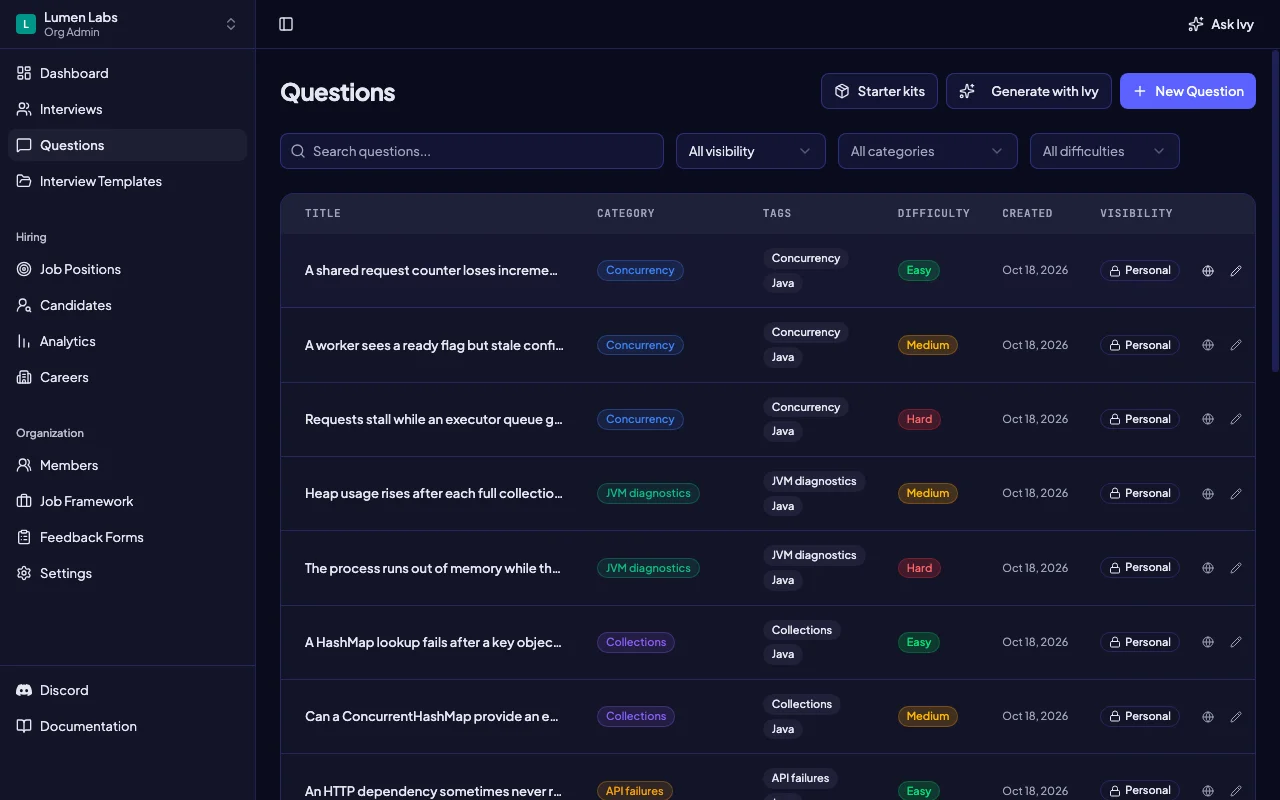
You can load all 10 questions, including their reference answers, follow-up probes and editorial scoring anchors, from the Import section. Choose “Java Production Judgment” in the Sample Interview Data card and select Load; importing requires permission to publish questions in your workspace.
Key takeaway: Keep the prompts consistent, keep the evidence specific and use the debrief to resolve unanswered questions against the job’s requirements.