25 Scrum Master Interview Questions That Reveal Skill
On this page
- How to use Scrum Master interview questions well
- Scrum Master interview questions on the framework
- Foundations and team agreements
- Scrum Master interview questions on facilitation
- Planning, reviews, and retrospectives
- Scrum Master interview questions on improvement and metrics
- Evidence beyond velocity
- Scrum Master interview questions on scaling and conflict
- Cross-team work and difficult conversations
- Put the Scrum Master interview questions into a repeatable process
The best Scrum Master interview questions uncover how someone helps a team make decisions, handle friction, and improve its work. A candidate can recite Scrum events and still struggle when priorities change mid-sprint or a retrospective goes quiet. Use the questions below to move from framework vocabulary to examples of judgment and facilitation.
TL;DR: Ask about real team situations, then probe for the candidate's actions and the effect on the team. This set covers Scrum foundations, facilitation, improvement, metrics, scaling, and conflict. Intervy also has all 25 questions ready to import as a sample interview set.
How to use Scrum Master interview questions well
Choose questions that match the role rather than trying to ask all 25 in one conversation. An early screen can establish how the candidate understands Scrum and Kanban. A later conversation can test what they do when a team is stuck, a stakeholder changes direction, or a metric encourages the wrong behavior.
For each question, ask for a specific example. What was happening? What did the candidate do personally? Who else was involved, and what changed? The follow-up often reveals more than the first answer. Our guide to behavioral interview questions offers a useful structure for that probing.
- Use the same core questions. Keep a consistent set for candidates applying to the same role, then allow follow-ups based on their examples.
- Agree on answer signals first. Decide what strong facilitation, coaching, and judgment would look like before hearing a candidate's story.
- Record evidence separately from ratings. A memorable anecdote is useful only if the panel can explain what skill it demonstrated.
Tip: Pick one easy foundation question, several medium questions about daily work, and one hard scenario. A balanced interview is more revealing than a long list of definitions.
Scrum Master interview questions on the framework
Framework questions establish shared language, but they should lead into decisions. Listen for someone who can explain why a practice helps a team, when it needs adjustment, and how they would involve the people doing the work.
Foundations and team agreements
- What are the key differences between Scrum and Kanban? A strong answer distinguishes timeboxed sprints from continuous flow and explains why a team might prefer one approach for its work. Ask for an example of choosing between them.
- How do you define and maintain a Definition of Done? Listen for a team-owned agreement that makes quality visible. The candidate should describe how the team revisits the agreement when its work or risks change.
- How do you run an effective backlog refinement session? Look for shared understanding and readiness to discuss work, beyond simply assigning estimates. Ask how they notice when people leave with different interpretations.
- What challenges arise when scaling agile to multiple teams? A thoughtful answer names dependencies, communication, and decision boundaries rather than assuming a framework alone will solve coordination.
Key takeaway: Knowledge of events and roles is a starting point. The stronger signal is whether the candidate can help a team use those practices with purpose.
Scrum Master interview questions on facilitation
Facilitation is visible when a conversation becomes difficult. The candidate needs to help people surface differences without taking over their decisions. Ask for concrete examples, especially when the planned event did not go as expected.
Planning, reviews, and retrospectives
- How do you facilitate an effective sprint planning session? Listen for preparation with the Product Owner, a clear goal, and space for the team to decide what it can take on. A useful follow-up is what the candidate would do when the proposed work exceeds capacity.
- What retrospective formats do you use, and how do you keep them engaging? Strong candidates vary the format to fit the problem and build enough safety for honest discussion. They should also explain how an action from the previous retrospective is followed through.
- How do you facilitate a sprint review that generates meaningful stakeholder feedback? Look for a conversation about the product and next decisions, rather than a presentation followed by a ceremonial sign-off.
- How do you run a retrospective when the team repeats the same complaints? Ask how the candidate would find a root cause, identify an action within the team's control, and revisit whether it helped.
- How do you help a team that resists agile practices? Listen for curiosity about the resistance and small changes that make work easier. A candidate who relies only on enforcing ceremonies may miss the underlying concern.
Tip: Follow every facilitation answer with “What did the team decide?” It helps distinguish coaching from directing.
Scrum Master interview questions on improvement and metrics
Metrics can reveal a bottleneck or hide one. Ask how a candidate combines numbers with conversations about the work. Look for someone who uses measures to learn, while noticing when a measure becomes a target that distorts behavior.
Evidence beyond velocity
- How do you use velocity without creating pressure? A strong answer treats it as a team planning aid, not an individual performance score. Ask what they would say when a stakeholder demands a higher number next sprint.
- What is the difference between lead time and cycle time? Listen for a clear explanation of each interval and a practical example of finding waiting time in the delivery flow.
- A burndown chart looks healthy, but the team is struggling. What do you do? A good answer investigates what the chart misses: unfinished quality work, work added late, or people carrying too much invisible effort.
- How do you measure team health beyond velocity? Look for qualitative feedback alongside delivery signals. The candidate should be able to describe how they would discuss a concerning pattern with the team.
- What does a cumulative flow chart tell you about a bottleneck? Ask the candidate to connect a widening band to work piling up at a stage, then explain what they would investigate before changing the process.
These questions are useful because they require interpretation, not a memorized definition. For a broader way to define what good performance means across levels, see our competency-based hiring framework.
Key takeaway: A strong Scrum Master treats a metric as a prompt for inquiry. They do not let the chart replace a conversation with the team.
Scrum Master interview questions on scaling and conflict
Senior candidates should be able to name trade-offs when several teams share work or when authority is unclear. There is rarely a tidy answer to these scenarios. Ask what the candidate would do first, what they would avoid deciding alone, and how they would know whether the situation improved.
Cross-team work and difficult conversations
- How do you coordinate dependencies between Scrum teams? Listen for early visibility, direct relationships between teams, and a way to raise a risk before it becomes a surprise.
- How do SAFe, LeSS, and Nexus differ when choosing a scaling approach? Look for trade-offs between coordination and overhead, not a declaration that one approach suits every organization.
- A Product Owner changes priorities frequently. How do you respond? Strong answers explore the reason, clarify the cost of interrupting work, and help the team and Product Owner make an explicit decision.
- Two senior team members openly disagree during planning. What do you do? The candidate should keep the conversation safe, make the disagreement concrete, and help the team reach a decision without taking sides.
- A team member's performance is affecting morale. What is the Scrum Master's role? Listen for coaching and support, plus a clear boundary around formal people management. Ask who else should be involved.
- A Scrum Master and Product Owner disagree about authority over the team. How would you handle it? Strong answers clarify responsibilities and protect the team's ability to decide how it works.
Tip: Ask for a real example after the hypothetical. A candidate's account of a difficult conversation gives you more to evaluate than a polished ideal response.
Put the Scrum Master interview questions into a repeatable process
Five more questions round out the set. They test whether the candidate can help a team act on its problems without becoming its decision-maker.
- How do you identify and remove impediments for your team? Look for proactive detection, collaboration with the people closest to the work, and an explanation of what the candidate escalates.
- What agile anti-patterns do you look for in a team? Strong answers identify a recurring behavior, seek its cause, and describe a small change the team can test.
- What is a Program Increment in SAFe, and how do you prepare a team for planning? Listen for preparation around dependencies, capacity, and goals, plus an understanding of the overhead involved.
- How do you coach a team toward genuine self-organization? A strong candidate gradually gives decisions back to the team while making it safe to learn from the results.
- How do you onboard a new developer mid-sprint? Look for an honest account of the team's capacity, a practical pairing plan, and an adjustment to expectations where needed.
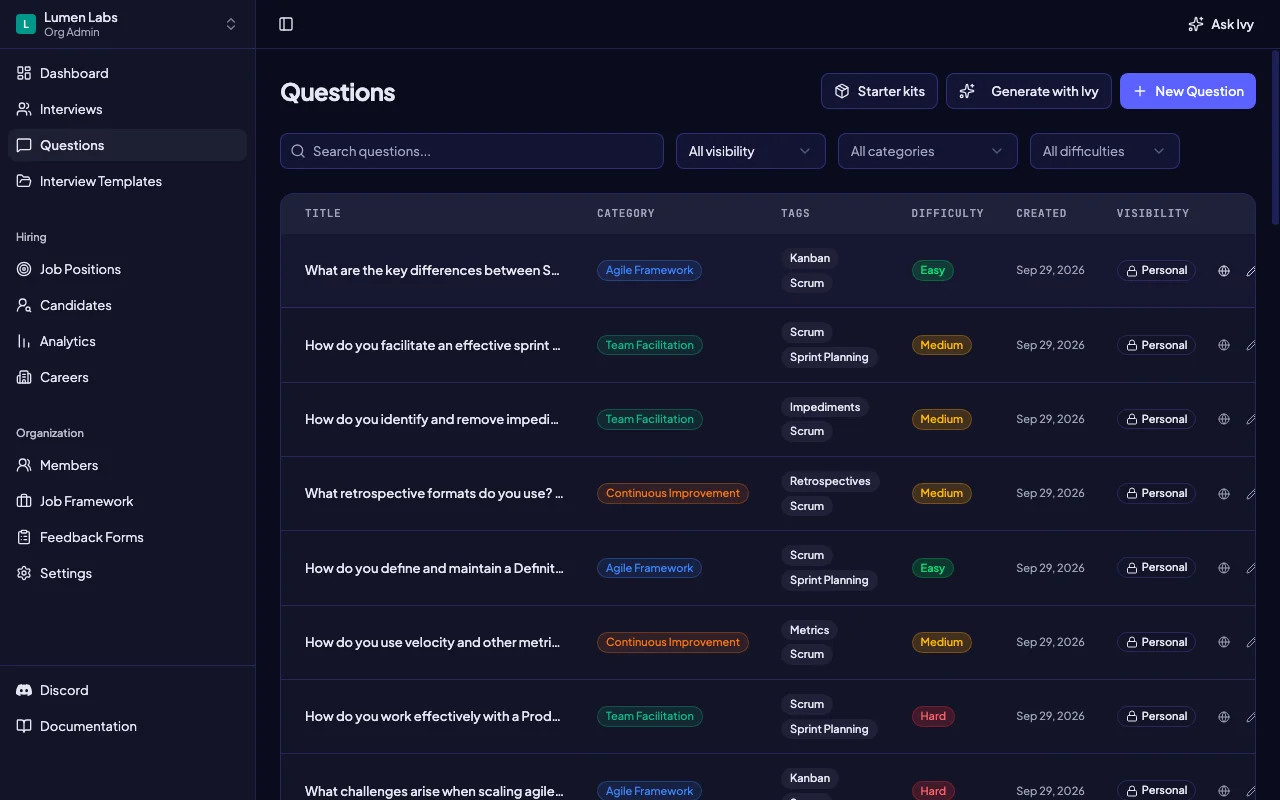
Each question in the full set has a category, difficulty level, tags, and answer guidance, so an interviewer can choose a focused subset.
In Intervy, the Questions page lets you filter by category and difficulty. The sample set also includes a Scrum Master interview template. A structured interview tool helps the panel ask comparable questions; an interview scoring tool helps keep the discussion tied to recorded evidence. For more on turning observations into a consistent evaluation, read how to score candidates fairly.
- Before the interview: Select the questions that match the job and agree on what a strong answer should show.
- During the interview: Probe for actions and trade-offs, then write down the evidence you heard.
- After the interview: Compare notes against the agreed criteria before discussing an overall recommendation.
Key takeaway: The value of a question bank is consistency. Choose a manageable set, ask it across candidates, and make the evidence visible before reaching a decision.
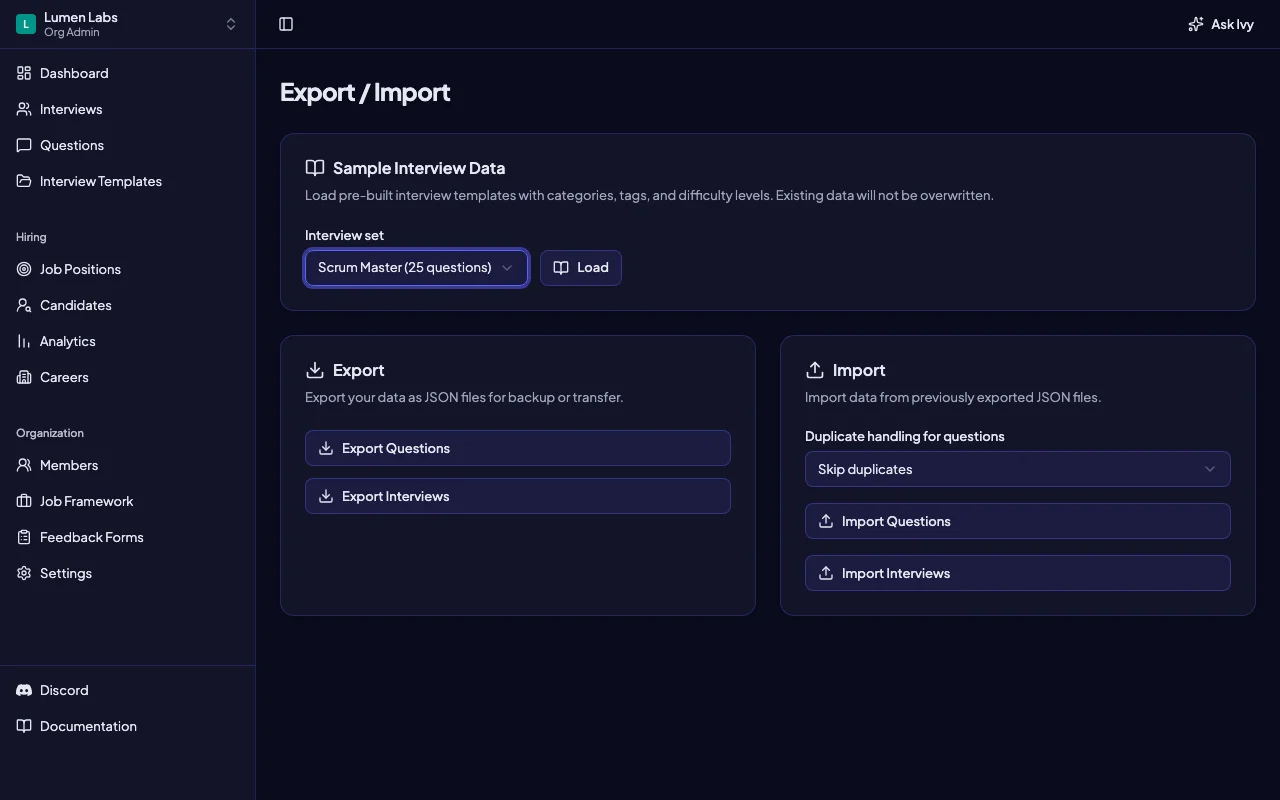
Want the complete set? Open the Import section, choose “Scrum Master” in Sample Interview Data, and load all 25 questions into your workspace. You can then tailor the selection for your role and use the included interview template as a starting point.