Angular Interview Questions for Senior Frontend Roles
On this page
- How to use Angular interview questions well
- Angular interview questions on components and forms
- Component behavior and composition
- Forms and services
- Angular interview questions on RxJS and data flow
- Streams in real features
- Angular interview questions on performance and security
- Diagnose before changing code
- Angular interview questions on architecture
- Decisions that last beyond one feature
Angular interview questions should reveal how a developer makes decisions in a working product, not only whether they remember framework names. A senior candidate should be able to explain a trade-off, diagnose a problem, and say what evidence would change their mind. The questions below give you a focused route through components, forms, RxJS, performance, security, and architecture.
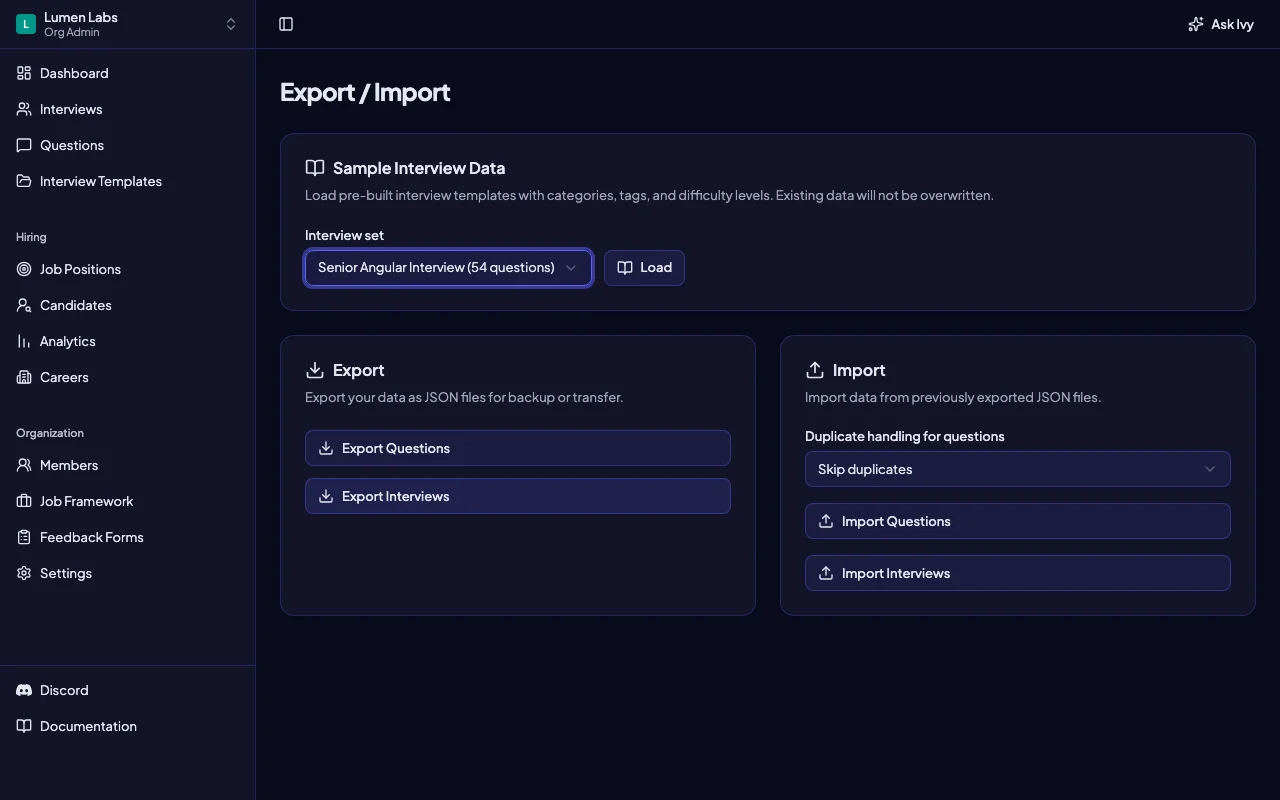
TL;DR: Ask a small, consistent set of Angular questions, then probe for examples from shipped work. Listen for reasoning about change detection, data flow, and maintainability. You can load the complete 54-question Senior Angular Interview set into Intervy when you want a broader bank.
How to use Angular interview questions well
A long list is useful for building an interview, but it is too much for one conversation. Pick questions that match the role's actual work. If your team owns a large application, spend more time on state and architecture; if it builds complex forms, spend more time on validation and accessible interaction.
Ask the same core questions of candidates for the same role. Follow-ups can differ, but the evidence goal should stay stable. Our frontend developer interview questions cover the wider browser and JavaScript foundation that complements this Angular-specific set.
- Start with a decision. Ask what the candidate would build and why before requesting an API definition.
- Probe for a failure mode. Ask what would break under load, an unexpected response, or a growing team.
- Record evidence. Note the reasoning and example you heard before assigning a rating.
Tip: Choose one foundation question, several questions tied to your product, and one harder scenario. That mix makes a focused interview more useful than a rapid tour of framework vocabulary.
Angular interview questions on components and forms
These questions start with everyday Angular work. A strong answer connects a feature to the boundaries between components, services, templates, and forms. Ask the candidate to name a concrete situation rather than recite a list of hooks or decorators.
Component behavior and composition
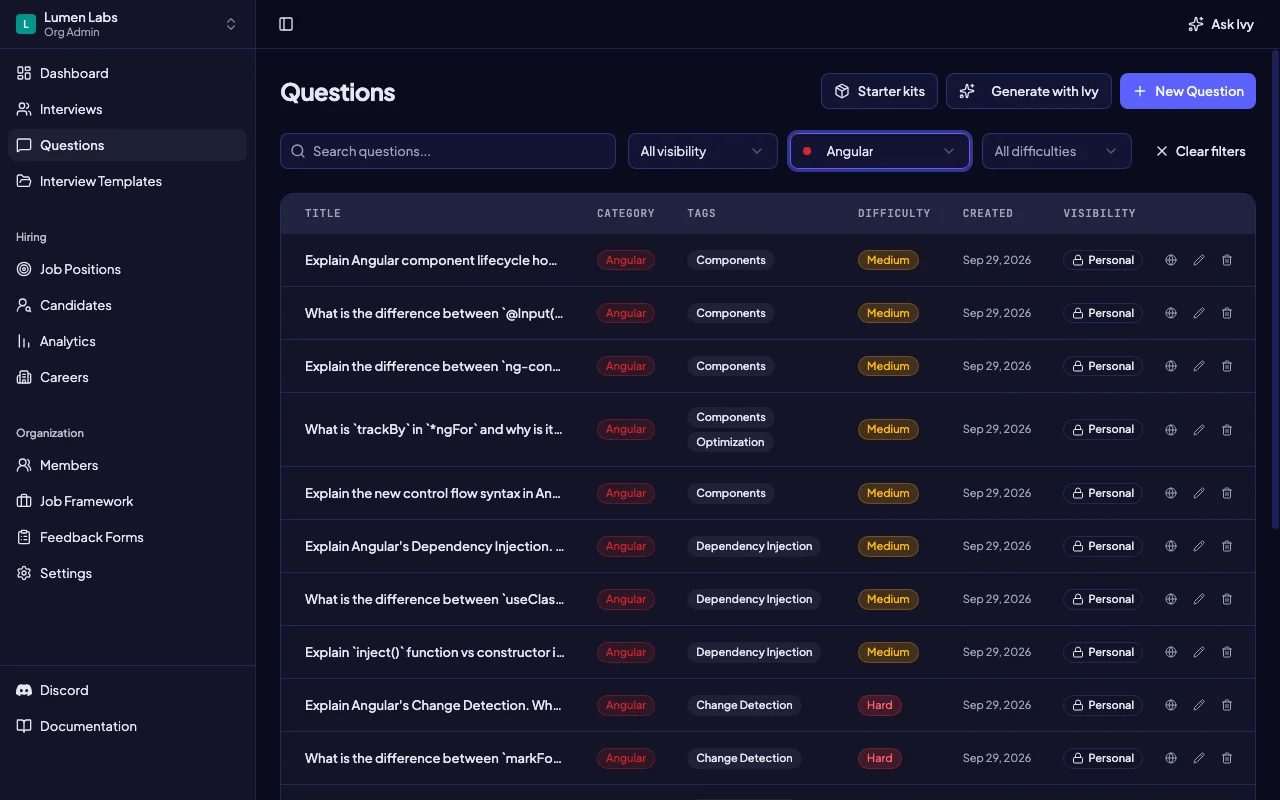
- Which component lifecycle hooks have you used most often, and why? Listen for a clear link between the hook and the work it performs. Ask how the candidate cleans up long-lived work when a component leaves the screen.
- When would you use an input or output between components? A useful answer describes the direction of data and events, then explains when the relationship has become too complex for a simple parent-child exchange.
- How do projected content, templates, and structural containers differ? Look for an example of flexible component composition, plus an explanation of what each choice does to the rendered page.
- What does Angular's newer control-flow syntax change for you? Listen for familiarity with conditional and repeated rendering, and ask how the candidate keeps a changing list stable as items update.
Key takeaway: Framework vocabulary is the opening, not the score. Ask how a choice affects reuse, readability, and behavior when data changes.
Forms and services
- How would you choose between template-driven and reactive forms? A strong answer considers validation complexity, testability, and the team's needs. Ask for an example where the first choice stopped fitting.
- How would you validate a form with rules that depend on more than one field? Look for clear error states and a way to keep validation close to the form's behavior, rather than scattered checks after submission.
- Where should an Angular service be provided? Ask what sharing a service across the application means, and when a narrower lifetime is useful. The answer should connect scope to state and ownership.
Angular interview questions on RxJS and data flow
RxJS questions work best as scenarios. A candidate who can name an operator may still choose the wrong behavior when requests overlap. Ask what should happen to earlier work, whether order matters, and what the user sees when a request fails.
Streams in real features
- How would you build a search box that sends requests as someone types? Listen for a short pause before searching, avoidance of duplicate requests, and a clear decision about replacing an older result with a newer one.
- When would you choose switchMap, mergeMap, concatMap, or exhaustMap? Ask for one real use case for each. A strong answer distinguishes latest-only work, parallel work, ordered work, and ignoring repeated triggers while busy.
- How do you handle errors inside a stream? Look for an answer that keeps the interface usable after a failure and makes recovery possible. Ask where an error should be caught so the rest of the flow can continue.
- How do you avoid subscriptions outliving a component? Listen for an approach that ties the stream to the view or its lifetime. Ask how the candidate would spot a leak during review or testing.
Tip: Give candidates a search scenario with slow responses arriving out of order. Their explanation of which result wins tells you more than a definition of any one operator.
For a broader way to compare responses across candidates, see our guide to scoring candidates fairly.
Angular interview questions on performance and security
Senior work often starts with diagnosis, not an optimization trick. Ask the candidate how they would gather evidence before changing a component. Their answer should separate an observed bottleneck from a familiar performance slogan.
Diagnose before changing code
- How would you investigate a slow Angular screen? Look for a measurement plan, a likely source of repeated work, and a way to confirm that a change helped. Ask what they would inspect in the browser and in Angular's tooling.
- How would you render a very large list? A strong answer considers what the user needs to see, keeps item identity stable, and may show only visible rows. Ask how filtering or keyboard navigation would still work.
- When do signals help with state and updates? Listen for a distinction between state that belongs in one component and state shared across a feature. Ask how derived values stay in sync without manual bookkeeping.
- What does Angular protect against when displaying untrusted content? Look for an explanation of escaping and sanitization, followed by caution around deliberately bypassing those protections. Ask what review they would require before displaying rich user content.
Key takeaway: A strong candidate explains how they would verify a performance or security decision, not just which feature they would turn on.
Angular interview questions on architecture
Architecture questions reveal how a candidate thinks beyond a single screen. Give them a specific product boundary and ask how a new team member would find, change, and test the relevant code. Avoid rewarding the largest diagram.
Decisions that last beyond one feature
- How would you organize a growing Angular application? Listen for clear feature boundaries, sensible shared code, and a way to keep dependencies understandable. Ask what they would change when one shared area becomes a bottleneck.
- When would you use standalone components or a module? A strong answer explains the application's current structure and the migration cost. The decision should serve maintenance and loading needs rather than fashion.
- How would you manage state across several features? Ask what stays local, what must be shared, and how the team would debug a state change. Look for the simplest approach that fits the data flow and collaboration needs.
- Before the interview: Pick a subset and agree on what each answer should demonstrate.
- During the interview: Use the same core prompts, then follow the candidate's examples and trade-offs.
- After the interview: Compare recorded evidence against the agreed criteria before discussing an overall recommendation.
A structured interview tool helps keep the sequence consistent. An interview template builder organizes the prompts, while an interview scoring tool gives the panel a shared place for evidence. For the full process, read our structured technical interviews guide.
Key takeaway: Choose fewer questions and probe more deeply. A consistent structure makes technical judgment easier to compare without turning the interview into a memorization test.
Want the complete bank? Open the Import section, choose “Senior Angular Interview” in Sample Interview Data, and load all 54 questions into your workspace. The set also includes an interview template you can adapt to your role.